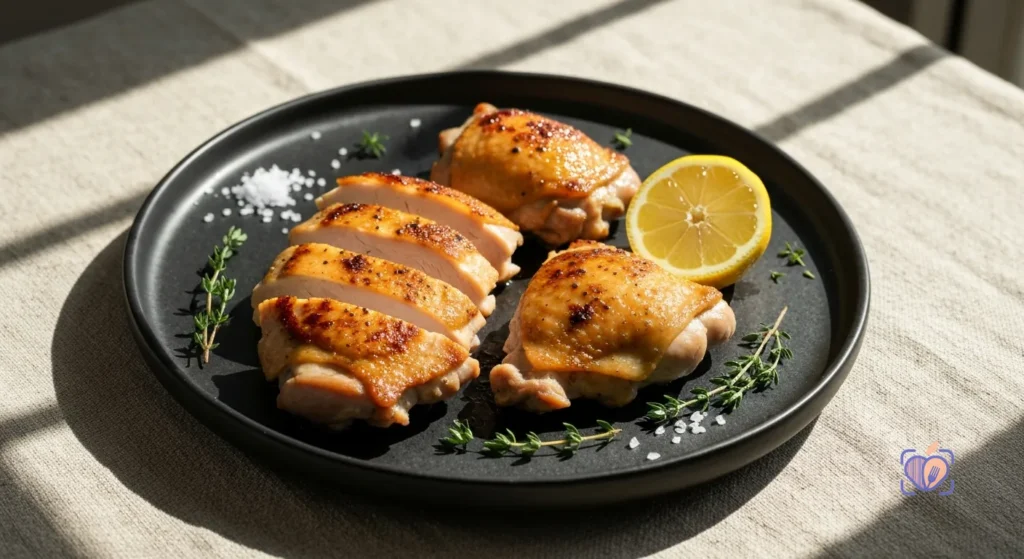
The best way to cook boneless, skinless chicken thighs is to season them well, then pan-sear them in a hot, heavy-bottomed skillet with a little oil for 5-7 minutes per side, until the internal temperature reaches 165°F (74°C). This creates a deeply browned crust and guarantees a juicy interior.
The Problem with Predictability
We’ve been sold a story about chicken. A story of dry, flavorless chicken breasts, a canvas so bland it requires a gallon of sauce to feel like a meal. It’s the safe choice, the boring choice.
Boneless chicken thighs are the answer. They’re the corner office of poultry—richer, more forgiving, and possessing a character all their own. Cooking them isn’t about following a recipe; it’s about executing a technique. It’s about control.
Here’s how you achieve that perfect result, turning a simple dinner into a statement.
The Four-Step Method to Perfection
Forget complicated marinades and 12-ingredient rubs for a moment. Mastery begins with simplicity.
Step 1: Create a Perfect Canvas
Moisture is the enemy of a good sear. Remove your chicken thighs from the package and pat them thoroughly dry with paper towels. Don’t be gentle; you want the surface bone-dry. This single act is the difference between a crisp, golden-brown crust and a sad, steamed piece of gray meat.
Step 2: Season with Intention
Generously season both sides of the thighs with kosher salt, black pepper, and garlic powder. This isn’t the time for shyness. But a word of caution: do you know what’s in your spice blend? Many contain anti-caking agents, maltodextrin, or other additives that don’t belong on your plate. Being aware of potential allergens and additives is a modern necessity, and resources from organizations like Food Allergy Research & Education are invaluable for understanding what to look for on a label.
This is where a simple meal becomes complex. At Food Scan Genius, we built our app to see through the noise, parsing over 200 hidden labels and edge-case ingredients so you don’t have to guess.
Step 3: The Sear is Everything
Heat a tablespoon of a high-smoke-point oil (like avocado or canola) in a cast-iron or stainless-steel skillet over medium-high heat. When the oil shimmers, it’s ready. Place the chicken thighs in the pan, making sure not to overcrowd them. Let them cook, undisturbed, for 5-7 minutes. You’ll hear the sizzle, and that’s the sound of flavor being created. Flip them once, and cook for another 5-7 minutes on the second side.
Step 4: The Art of Patience
Your chicken is cooked when a meat thermometer inserted into the thickest part reads 165°F (74°C). This is not negotiable. Remove the chicken from the pan and let it rest on a cutting board for 5-10 minutes. This allows the juices to redistribute throughout the meat, ensuring every bite is succulent. Slicing into it immediately is a rookie mistake you won’t make.
Beyond the Pan: Other Paths to Flavor
While pan-searing is the most direct path to greatness, your oven and grill offer compelling alternatives.
- For the Oven: Season as above, place on a baking sheet, and cook at 400°F (200°C) for 20-25 minutes. It’s hands-off, but you sacrifice some of that beautiful crust.
- For the Grill: A hot grill imparts a smoky flavor that is second to none. Grill for 4-6 minutes per side over direct, medium-high heat until the internal temperature is correct.
Know What You’re Eating
Chicken thighs contain more fat than breasts, and that’s a good thing. Fat equals flavor and satiety. But nutritional labels can be a labyrinth of marketing terms and confusing data. We all look for inspiration from top food creators like Half Baked Harvest, but replicating their results requires starting with quality ingredients whose nutritional profiles you can trust. Remember that any online nutrition information should be considered an estimate, as brands and preparations vary wildly.
Food Scan Genius eliminates that uncertainty. Scan a barcode, and we translate the label for you, showing you the hidden sugars, the questionable additives, and the allergens you need to avoid. We give you the truth, so you can make a better choice.
Stop Guessing. Start Knowing.
Cooking is about confidence. You’ve just learned how to master boneless chicken thighs. The next step is to master your ingredients.
Don’t let confusing labels dictate your health. Food Scan Genius deciphers over 200 specific edge-case ingredients and hidden additives to give you clarity and control over what you eat. You deserve to know exactly what’s in your food. Download the app for free and see the truth for yourself.
Your Questions, Answered
How do I know for sure when my chicken thighs are cooked?
The only way to know for sure is with an instant-read meat thermometer. The color of the juices is an unreliable myth. The chicken is safe and perfectly cooked when the internal temperature reaches 165°F (74°C) at its thickest point.
Can I cook boneless chicken thighs from frozen?
We wouldn’t recommend it. For the best texture and an even cook, you should always thaw chicken completely before cooking. Cooking from frozen often results in a rubbery exterior and an undercooked center.
Why are my pan-seared chicken thighs tough?
You overcooked them. Chicken thighs are forgiving, but they are not invincible. Use a thermometer to pull them from the heat the moment they hit 165°F, and remember that they will continue to cook slightly as they rest.
Every scan is answered by NutriGraphAPI, our own catalogue of over 5 million barcode-indexed packaged products with allergen, additive and dietary data. Building a food or grocery app yourself? The same data is available as an API.