Is Amul Cheese Suitable for Keto? A Comprehensive Macro Guide
Navigating the grocery aisles while maintaining a specialized dietary lifestyle can often feel like an intricate guessing game. Whether you are aiming for metabolic balance, weight management, or therapeutic ketosis, every item you place in your shopping cart demands careful scrutiny. Modern consumers are increasingly expected to decode complex food labels, understand hidden additives, and compute macronutrients on the fly. This challenge extends far beyond exotic health foods into everyday household staples, including dairy products like cheese.
For millions of people—particularly across South Asia and international diaspora communities—Amul is a household name synonymous with dairy. But when transitioning to a high-fat, low-carbohydrate ketogenic diet, a common question arises: Is Amul cheese suitable for keto? To answer this thoroughly, we must look beyond brand familiarity and examine the actual science of macronutrients, ingredient processing, and how everyday foods impact ketosis.
Understanding the Ketogenic Diet and Dairy
The ketogenic diet is characterized by a high intake of fats, a moderate amount of protein, and a strict restriction of carbohydrates—typically kept under 20 to 50 grams of net carbs per day. By drastically lowering carbohydrate availability, the body shifts its primary metabolic fuel from glucose to ketone bodies produced from fats.
Dairy products occupy a unique space in this dietary framework. Naturally rich in fats and proteins, many cheeses are inherently low in carbohydrates because the cheesemaking process removes most of the liquid whey, which contains lactose ( milk sugar). However, not all dairy products are created equal. Processed cheese products, spreads, and flavored variants often introduce added starches, milk solids, and emulsifiers that can subtly elevate carbohydrate counts.
Nutritional Breakdown of Amul Cheese Products
To determine if Amul cheese fits your daily macro targets, we must evaluate its specific variants. Amul offers a wide portfolio, ranging from blocks and cubes to slices and cheese spreads.
1. Amul Processed Cheese (Blocks, Cubes, and Slices)
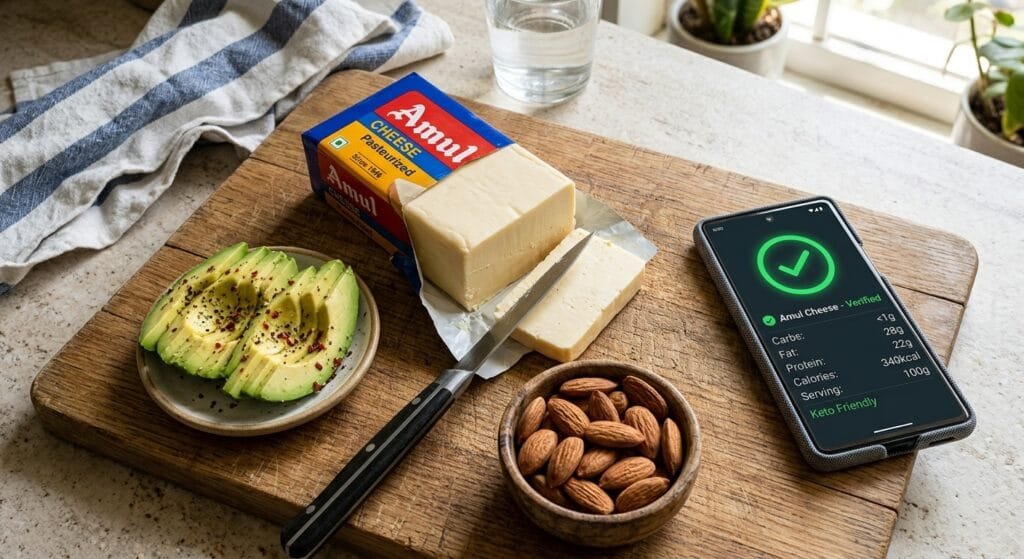
Standard Amul processed cheese blocks, cubes, and slices are formulated from graded cow/buffalo milk, microbial rennet, salt, and permitted emulsifying agents and preservatives. Looking closely at the nutritional profile per 100 grams:
- Calories: ~320 kcal
- Total Fats: ~26g (heavy emphasis on saturated fats)
- Protein: ~20g
- Total Carbohydrates: ~1.5g to 2g
- Net Carbs: ~1.5g to 2g
Because a standard serving size (such as a single 20g cube or slice) contains less than 0.5 grams of carbohydrates, Amul processed cheese blocks, cubes, and slices are generally keto-friendly when consumed in moderation and accounted for in your daily macro tracking.
2. Amul Cheese Spread
Unlike solid blocks, cheese spreads require additional agents, milk solids, and stabilizers to achieve a smooth, spreadable texture. Consequently, the nutritional profile shifts dramatically. Amul Cheese Spread contains significantly higher carbohydrate levels—often averaging around 13 grams of carbohydrates per 100 grams. While a stray teaspoon might not immediately kick you out of ketosis, heavy reliance on cheese spreads can quietly consume a large portion of your strict daily carb allotment.
Comparing Amul Cheese Options for Keto
| Amul Product Type | Serving Size | Carbohydrates (per serving) | Keto Suitability |
|---|---|---|---|
| Amul Processed Cheese Cubes | 20g | ~0.3g – 0.4g | High (Fits well into macros) |
| Amul Processed Cheese Slices | 20g | ~0.3g – 0.4g | High (Convenient for low-carb burgers/wraps) |
| Amul Pure Milk Cheddar/Mozzarella | 30g | < 0.5g | Very High (Minimal processing) |
| Amul Cheese Spread | 30g | ~3.9g – 4.5g | Moderate to Low (Watch portion sizes carefully) |
Expert Insights on Dairy and Low-Carb Diets
Leading nutritional platforms and low-carb educators frequently emphasize that brand names matter less than individual item metrics. According to guidelines shared by clinical nutrition researchers, keeping a close eye on hidden sugars and fillers is vital for metabolic health. As noted in public health discussions regarding processed foods, manufacturing techniques can alter how our bodies respond to inflammatory triggers or additives.
Current food science reporting underscores a broader consumer trend: transparency is paramount. Recent studies highlighted by major health publications emphasize that modern shoppers are dealing with “label fatigue,” struggling to decipher complex chemical names and marketing terminology on product packaging. This makes digital tracking tools and transparent ingredient analysis more critical than ever.
The Broader Issue: Ingredient Transparency and Dietary Restrictions
The question of whether Amul cheese is keto-friendly highlights a much larger systemic issue in modern consumer packaged goods. Shoppers managing food sensitivities, religious dietary laws, or therapeutic diets (such as keto, low-FODMAP, or gluten-free) face a maze of opaque terminology. Terms like “milk solids,” “modified food starch,” and “permitted emulsifiers” can conceal unwanted sugars, allergens, or gluten derivatives.
When consumers fail to catch these hidden ingredients, it can lead to unexpected blood sugar spikes, chronic digestive discomfort, or accidental disruption of strict nutritional therapy. Building food literacy requires more than just reading front-of-pack marketing claims; it requires granular inspection of the back-of-pack ingredient label.
How Food Scan Genius Resolves the Challenge
Overcoming label fatigue and avoiding hidden pitfalls in everyday grocery items is precisely where modern digital health technology steps in. The Food Scan Genius app is designed to eliminate guesswork at the supermarket shelf. By simply scanning a product barcode or ingredient list, the app instantly breaks down whether an item matches your specific dietary constraints—whether you are tracking strict keto macros, avoiding hidden sugars, or monitoring food sensitivities.
What Users Are Saying
“I used to spend twenty minutes in the grocery aisle squinting at tiny labels, stressing over whether a local cheese or condiment would break my ketosis. Since I started using Food Scan Genius, I just scan the barcode and get an instant breakdown. It has taken all the anxiety out of my keto journey!”
If you want to simplify your grocery shopping, safeguard your dietary goals, and instantly understand what is inside your food, take control of your nutrition today. Download Food Scan Genius and transform the way you shop.
Frequently Asked Questions (FAQ)
1. Will Amul processed cheese kick me out of ketosis?
Generally, no. Amul processed cheese blocks, cubes, and slices contain very low carbohydrates (roughly 0.3g to 0.4g per single serving), making them safe for a ketogenic diet if consumed within your daily macro limits.
2. Is Amul cheese spread keto-friendly?
Amul cheese spread has a higher carbohydrate count due to added milk solids and texturizers (around 13g of carbs per 100g). While small portions can occasionally fit, it should be consumed cautiously compared to solid cheese blocks.
3. Does all cheese have zero carbohydrates?
No. While most aged, hard, and semi-hard cheeses have near-zero carbs due to the removal of whey during production, soft cheeses, processed spreads, and cheeses with added milk powders can carry hidden carbohydrates.