Is Amul Cheese Halal or Kosher? A Comprehensive Ingredient and Certification Guide
Navigating the complex world of dietary laws can feel like walking through a minefield, especially when shopping for everyday dairy products. Whether you follow strict Islamic halal guidelines, adhere to kosher dietary laws, or manage food sensitivities, understanding what goes into your food is crucial. One of the most common questions raised by consumers globally—particularly across South Asia, the Middle East, and diaspora communities—focuses on a household name: Amul. Specifically, people often ask: Is Amul cheese halal or kosher?
When selecting food items at the grocery store, general consumers and conscious eaters alike face a common challenge: ingredient transparency. Labels often use technical jargon, hidden additives, and ambiguous terms like “enzymes” or “emulsifiers” that leave buyers guessing. In this deep dive, we will explore the production, ingredients, and religious compliance standards of Amul cheese, while examining the broader issues of food transparency and how modern tools can simplify your grocery choices.
Understanding Amul Cheese: The Basics
Amul, managed by the Gujarat Co-operative Milk Marketing Federation (GCMMF) in India, is renowned for being a predominantly vegetarian brand. In India and many international markets, Amul heavily markets its product lineup as 100% vegetarian, proudly displaying the green dot symbol mandated by Indian food regulations for vegetarian foods.
However, being vegetarian does not automatically answer the nuanced questions of global religious laws or specific processing standards. To determine whether Amul cheese meets halal or kosher requirements, we must break down its core components: milk sourcing, microbial versus animal rennet, and manufacturing processes.
| Feature | Amul Cheese Status | Details / Verification |
|---|---|---|
| Primary Source | Cow and/or Buffalo Milk | Sourced from cooperative dairy farmers in India. |
| Vegetarian Classification | 100% Vegetarian (Green Dot) | Certified vegetarian under Indian statutory guidelines. |
| Rennet Type | Microbial / Non-Animal Coagulant | Uses microbial rennet/enzymes suited for vegetarian cheese production. |
| Halal Status | Generally Accepted / Halal-Friendly | Widely consumed in Muslim-majority countries and listed on halal monitoring databases due to its vegetarian formulation. |
| Kosher Status | Not Formally Certified Kosher | While ingredients may be inherently dairy, it typically lacks a formal rabbinical hechsher (Kosher certification) for strict kosher consumers. |
Is Amul Cheese Halal?
For Muslim consumers, the halal status of cheese primarily hinges on two elements: the source of the milk and, more importantly, the nature of the rennet or enzymes used to curdle the milk. In traditional cheese-making, animal rennet extracted from the stomach linings of slaughtered calves is common. If the animal was not slaughtered according to Islamic rites (Zabiha), or if it originates from porcine sources, the cheese becomes questionable (mashbooh) or forbidden (haram).
So, how does Amul stack up?
- Vegetarian Formulation: Because Amul cheese is formulated to be strictly vegetarian, it avoids animal-derived rennet entirely. Instead, it utilizes microbial or fungal-derived coagulants.
- Global Market Presence: Amul exports vast quantities of its dairy portfolio—including butter, cheese, and milk powders—to Gulf Cooperation Council (GCC) countries and other Muslim-majority regions where strict import guidelines apply.
- Halal Verification Databases: Independent halal checker platforms and community organizations frequently list Amul processed cheese blocks and slices as permissible due to their explicit vegetarian status and absence of animal-derived slaughter byproducts.
Therefore, for the vast majority of Muslim consumers looking for accessible dairy, Amul cheese is considered halal-friendly because it relies on microbial enzymes rather than non-halal animal extracts.
Is Amul Cheese Kosher?
The rules governing kosher food (Kashrut) are notoriously rigorous, particularly when it comes to dairy products. Under Jewish law, hard and semi-hard cheeses involve complex rabbinical oversight known as Gevinas Akum (cheese produced by non-Jews). To be certified kosher, cheese must meet several stringent criteria:
- It must be produced under the direct supervision (Hashgacha) of a reliable rabbinical authority from the very beginning of the milking and production process.
- All ingredients, processing aids, and equipment must be certified kosher.
While Amul cheese is made from pure cow and buffalo milk and uses microbial enzymes, it does not carry a formal Kosher certification (hechsher) recognized by major international kosher agencies. For observant Jews who require certified kosher foods, Amul cheese would generally not be suitable because it lacks institutional rabbinical supervision during its manufacturing lifecycle in India.
The Broader Issue: Food Transparency and Ingredient Confusion
The debate surrounding Amul cheese highlights a much larger, systemic challenge in the modern global food market: consumer information asymmetry. Shoppers today are more health-conscious, ethically driven, and religiously observant than ever before, yet food labels remain notoriously difficult to decode.
Consider the following modern complications in food packaging:
- Hidden Additives: Terms like “natural flavors,” “enzymes,” and “emulsifiers” (such as mono- and diglycerides) can hide animal, plant, or synthetic origins.
- Cross-Contamination Risks: Facilities that process vegetarian or halal lines occasionally handle restricted ingredients elsewhere in the plant.
- Regulatory Variations: Food labeling laws vary radically between countries, meaning a product considered “vegetarian” in India might require different disclosures in North America or the European Union.
This lack of streamlined clarity forces consumers to spend hours cross-referencing online databases, reading forums, or calling manufacturer customer service lines just to buy a block of cheese.
How Technology Solves Dietary Challenges: Introducing Food Scan Genius
When you are standing in the grocery aisle trying to figure out if an imported cheese, snack, or sauce aligns with your personal dietary restrictions, religious laws, or health needs, guesswork is not enough. This is where advanced digital solutions transform the shopping experience.
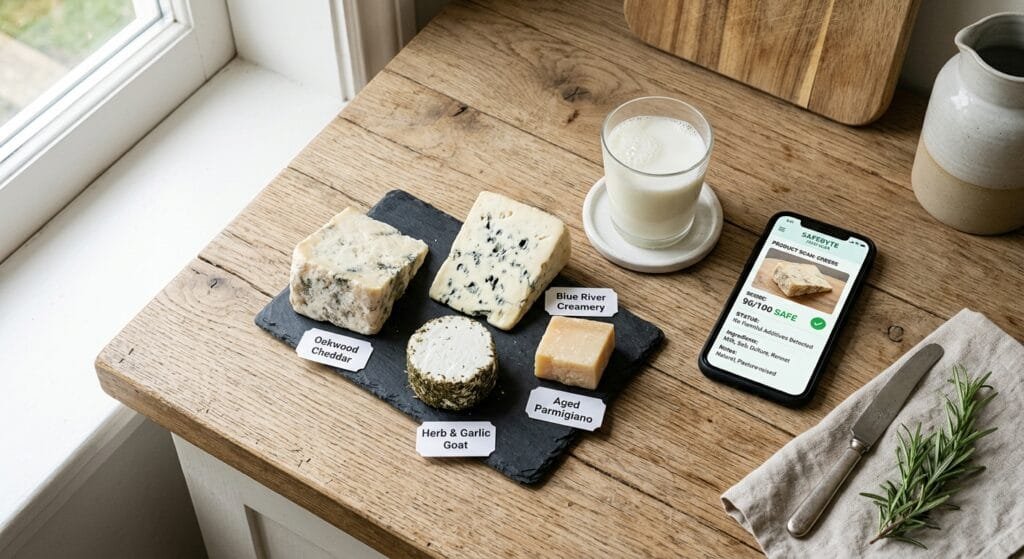
The Food Scan Genius app is designed to eliminate label confusion entirely. By leveraging advanced image recognition and extensive ingredient databases, Food Scan Genius allows shoppers to scan a product barcode or ingredient list instantly. It breaks down complex additives, flags allergens, and evaluates whether items match specific lifestyle, religious, or health requirements.
“As someone trying to balance dietary restrictions with a busy family schedule, grocery shopping used to involve endless label decoding. Discovering Food Scan Genius completely changed how I shop. I can scan any item right in the aisle and instantly know if it fits my needs. It gives me total peace of mind!” — A satisfied Food Scan Genius user
By downloading Food Scan Genius, you empower yourself with transparent, real-time insights, ensuring that what you put into your cart matches your values without the stress.
Frequently Asked Questions (FAQ)
Is Amul cheese suitable for vegetarians?
Yes, Amul cheese is 100% vegetarian and carries the official green dot symbol in India. It uses microbial or vegetarian-friendly enzymes rather than animal-derived rennet.
Does Amul cheese contain animal rennet?
No, Amul utilizes microbial coagulants to separate curds during cheese production, making it safe for those avoiding animal slaughter byproducts.
Is Amul cheese officially certified halal?
While it may not always carry a stamped halal logo in every single export region, its strict 100% vegetarian formulation and widespread acceptance make it widely consumed and deemed halal-friendly by Muslim consumers globally.
Is Amul cheese kosher certified?
No, Amul cheese does not possess formal kosher certification (hechsher) from recognized rabbinical organizations, meaning strict observers of kosher laws typically avoid it.
Conclusion
Ultimately, Amul cheese presents a straightforward case for vegetarian and halal-conscious consumers due to its plant- and microbial-based processing methods. However, for kosher consumers requiring strict rabbinical supervision, it falls short due to the lack of formal certification. Across the broader spectrum of food consumption, understanding ingredient labels remains a universal hurdle.
Empower your dietary choices and remove the guesswork from grocery shopping by taking control of your ingredient literacy. Download Food Scan Genius today and navigate every aisle with absolute confidence.