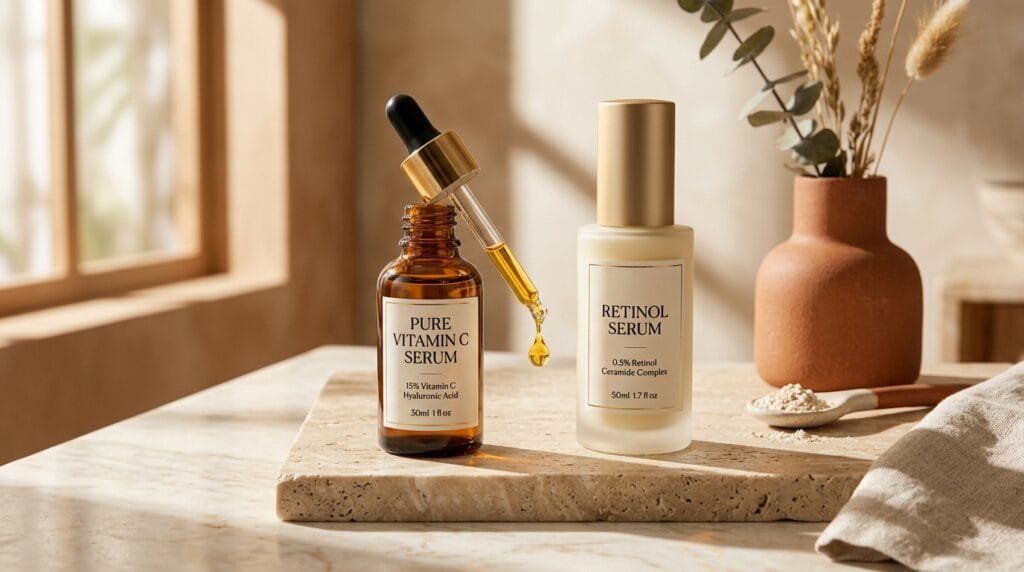
1. The Core Algorithm: How to Layer Skincare Products
To layer skincare products correctly, apply formulations from thinnest to thickest consistency—cleanser, water-based serums, lipid-based emulsions, and occlusive creams—while prioritizing low-pH active ingredients directly after cleansing and concluding with broad-spectrum sunscreen each morning.
Skincare layering is governed by physicochemical principles: molecular weight, vehicle rheology, and thermodynamic activity across the stratum corneum. The stratum corneum behaves as a lipophilic barrier composed of anucleated corneocytes embedded within an intercellular lipid matrix of ceramides, cholesterol, and free fatty acids. Applying a dense, occlusive lipid matrix prior to a low-molecular-weight hydrophilic solute creates an impenetrable thermodynamic barrier, preventing water-soluble actives from partitioning into the viable epidermis.
The sequence in which topicals are applied directly alters their flux—the rate at which a compound traverses the skin barrier per unit area over time. When products are applied incorrectly, active ingredients can precipitate out of solution, degrade through unwanted oxidation-reduction reactions, or trigger trans-epidermal water loss via barrier disruption. Clinical efficacy requires understanding vehicle architecture: low-viscosity aqueous formulations must be absorbed first, followed by gel-based humectants, light oil-in-water emulsions, dense water-in-oil creams, and non-polar occlusives.
For patients managing chronic dermatological conditions such as rosacea, atopic dermatitis, or recalcitrant melasma, the physiological response to multi-product regimens differs fundamentally from unimpaired skin. Inflamed skin presents with disrupted intercellular lipid lamellae, altered filaggrin expression, and compromised enzyme activity. In these clinical presentations, haphazard layering amplifies cutaneous irritation and neurosensory stinging; such conditions require evaluation and management by a board-certified dermatologist rather than aggressive cosmetic regimens.
2. The pH Hierarchy: Acid Mantle Dynamics and Actives Sequencing
The chemical microenvironment of the skin surface maintains a physiological acid mantle with a baseline pH typically ranging from 4.5 to 5.5. Certain active compounds demand a dramatically lower pH to ensure molecular stability and transdermal permeation. Free-acid availability dictates that chemical exfoliants and specific antioxidants must be layered based on increasing pH values to preserve their biological activity.
L-ascorbic acid (pure vitamin C) serves as the quintessential example. To cross the hydrophobic stratum corneum, L-ascorbic acid must remain un-ionized (protonated), requiring an aqueous vehicle formulated at a pH below 3.5 at concentrations between 10% and 20%. Alpha-hydroxy acids (AHAs, such as glycolic acid at 5% to 10% or lactic acid at 5% to 12%) and beta-hydroxy acids (salicylic acid at 0.5% to 2%) operate optimally between pH 3.0 and 4.0, where their un-ionized fractions remain sufficiently high to induce controlled keratolysis and desquamation.
Applying a physiological or alkaline formulation (pH 5.5 to 7.0)—such as a basic peptide solution, an unbuffered niacinamide serum, or a lipid replenishment cream—immediately over an unbuffered L-ascorbic acid or glycolic acid product neutralizes the proton concentration. This sudden shift in pH converts the active molecule into its ionized state, drastically impairing lipid solubility and therapeutic bioavailability. While the skin’s endogenous buffering capacity will gradually restore baseline pH, sequential application of conflicting pH formulations creates chemical competition on the skin’s surface.
To optimize penetration without causing molecular interference, apply low-pH actives (pH 3.0 to 3.8) immediately following a gentle, non-stripping cleanser. Allow the formulation two to three minutes to absorb and equilibrate into the stratum corneum before applying physiological-pH treatments (pH 5.0 to 6.5). If multiple low-pH products are included in a routine, order them strictly by pH: lowest pH first, moving upward toward physiological neutral.
3. Vehicle Architecture: Viscosity, Volatility, and Molecular Weight
Formulation vehicles serve as the transport medium for topical molecules. The macroscopic texture of a product reflects its microscopic vehicle classification: hydrophilic aqueous solutions, hydro-alcoholic solutions, hydrogels, light oil-in-water (O/W) emulsions, heavy water-in-oil (W/O) emulsions, anhydrous lipid ointments, and cross-linked silicone suspensions. Layering must follow the thermodynamic principle of increasing viscosity and lipid density.
Aqueous solutions and low-viscosity essences contain minimal thickening agents and depend on rapid solvent evaporation to concentrate the solute at the stratum corneum interface. Applying a light aqueous toner or low-molecular-weight hyaluronic acid serum (typically 20 to 300 kDa) allows the active molecules to migrate into the intercellular matrix. If an emulsion containing long-chain hydrocarbons, plant triglycerides, or synthetic esters (such as caprylic/capric triglyceride) is applied first, it forms a hydrophobic lipid film that repels aqueous solutes, causing them to bead, pool, and evaporate without entering the tissue.
Emulsions introduce nuanced chemical considerations:
- Oil-in-Water (O/W) Emulsions: These contain water as the continuous external phase, allowing them to blend seamlessly over aqueous serums without inducing phase separation or surface pill-up.
- Water-in-Oil (W/O) Emulsions and Balms: These feature oil as the continuous external phase, embedding microscopic water droplets within a non-polar exterior that functions as a structural seal.
- High-Molecular-Weight Polymers: Silicones (e.g., cyclopentasiloxane, dimethicone cross-polymers) create breathable but hydrophobic barriers that reduce active uptake if layered beneath hydrophilic compounds.
When users introduce new products into established regimens, understanding how base vehicles interact is critical. Utilizing Skin Scan Genius to scan product barcodes allows patients to dissect the structural vehicle of a formula—identifying whether a product is built upon an aqueous, siliconized, or lipid-continuous phase—ensuring it is inserted at the precise physical step required for unrestricted penetration.
4. Active Ingredient Interactions: Incompatibilities and Synergies
Layering multiple bioactive ingredients introduces the risk of both molecular inactivation and acute cutaneous barrier failure. Direct chemical antagonism occurs when two compounds react chemically on the skin surface, modifying their active structures or shifting their physical state into an inert precipitate. Simultaneously, pharmacodynamic antagonism can overwhelm cutaneous tolerances through compounding desquamative mechanisms.
Primary contraindications and active interactions include:
- Benzoyl Peroxide and Tretinoin: Standard all-trans retinoic acid (tretinoin at 0.025% to 0.1%) is highly vulnerable to oxidative degradation. Co-applying unencapsulated tretinoin with benzoyl peroxide (2.5% to 10%) results in the rapid chemical oxidation and inactivation of the tretinoin molecule. (Note: Synthetic third-generation retinoids like adapalene exhibit structural stability in the presence of benzoyl peroxide).
- Direct Acids and High-Potency Retinoids: Combining chemical exfoliants (glycolic, lactic, or salicylic acids) with pure retinol (0.1% to 1%) or prescription retinoids in the same application window increases stratum corneum desquamation beyond physiological repair rates. This leads to marked lipid depletion, heightened trans-epidermal water loss, and reactive sterile dermatitis.
- Copper Tripeptide-1 and Low-pH Actives: Direct exposure of copper peptides to strong unbuffered acids (pH < 4.0) or concentrated L-ascorbic acid can induce premature cleavage of the coordinate copper bonds, denaturing the peptide complex and promoting pro-oxidative catalytic reactions.
- L-Ascorbic Acid and Niacinamide: While earlier literature suggested these form a stable 1:1 complex that hydrolyzes into skin-flushing nicotinic acid, this reaction requires sustained temperatures above 120 degrees Celsius. However, at room temperature, co-formulating them into an unbuffered single phase can shift the optimal pH outside the ideal penetration window for L-ascorbic acid; separating their application times remains clinically prudent.
Beneficial synergies, by contrast, enhance physiological outcomes. Niacinamide (2% to 5%) stabilized at pH 5.5 to 6.5 stimulates endogenous ceramide synthesis, improving barrier resilience and building tolerance to subsequent evening retinoid applications. Similarly, combining 15% L-ascorbic acid with 1% alpha-tocopherol (vitamin E) and 0.5% ferulic acid provides an octuple increase in photochemical protection compared to L-ascorbic acid alone, as ferulic acid stabilizes the formulation while tocopherol functions synergistically in lipid membrane domains.
5. The Complete Regimen Protocol: Morning and Evening Execution
A clinically sound skincare routine must be divided cleanly across circadian phases to match the skin’s biological shifts. During daytime hours, the objective is shielding the cutaneous membrane against ultraviolet radiation (UVA/UVB), visible light, particulate pollutants, and free-radical cascades. The evening regimen centers entirely on structural renewal, DNA repair enzyme activation, and epidermal lipid matrix restoration.
A structured morning protocol should follow this sequence:
- 1. Cleanse: A non-foaming or low-surfactant wash designed to remove nocturnal sebum and degraded topical residues without stripping structural ceramides.
- 2. Targeted Low-pH Antioxidant: Aqueous L-ascorbic acid (10% to 20%) applied cleanly to dry skin to secure optimal un-ionized partitioning.
- 3. Humectant Hydration: Multi-weight hyaluronic acid or glycerin-based serums containing soothing osmoprotectants (such as ectoin or panthenol).
- 4. Barrier Support: A light, physiologic-lipid moisturizer containing ceramides, cholesterol, and free fatty acids in an O/W emulsion base.
- 5. Photoprotection: A broad-spectrum sunscreen (SPF 30 to 50+) providing validated critical wavelength protection. Sunscreen must invariably form the terminal cosmetic layer; introducing any active or moisturizer over dry sunscreen compromises the uniform polymeric film required for UV filtration.
The evening protocol adapts for deeper cellular intervention:
- 1. Pre-Cleanse and Primary Cleanse: Lipophilic cleansing oil or micellar dispersion to solvate sunscreen and external particulates, followed by a gentle physiological-pH cleanser.
- 2. Exfoliation or Retinoid (Alternated): Apply active resurfacing treatments on designated alternating evenings. Retinoids (retinol 0.3% to 1%, retinaldehyde 0.05% to 0.1%, or prescription topicals) should generally be applied to thoroughly dry skin to minimize transient irritation.
- 3. Restorative Hydration and Barrier Repair: Richer water-in-oil (W/O) creams or lipid formulations enriched with biomimetic lipids, squalane, or colloidal oatmeal.
Before introducing novel components to an established baseline, utilizing Skin Scan Genius provides instant verification of product compatibility. Scanning a new product’s barcode cross-references its exact concentration profiles and inactive stabilizing agents against the user’s specific skin concerns and current topical prescriptions, systematically eliminating hazardous interactions before application.
Check it against your own routine. Skin Scan Genius reads a product’s full INCI list and flags conflicts with the actives you already use, by skin type and concern.
Frequently asked questions
How long should I wait between applying different skincare layers?
For most hydrators and moisturizers, you only need to wait until the product feels absorbed and non-tacky—typically 30 to 60 seconds. However, when applying low-pH active ingredients like pure L-ascorbic acid (vitamin C) or direct AHA/BHA chemical exfoliants, waiting 2 to 3 minutes before applying neutral-pH products preserves the un-ionized state required for optimal skin penetration.
Can I use niacinamide and vitamin C in the same skincare routine?
Yes, but they perform best when sequenced correctly or split between routines. If applying pure L-ascorbic acid, apply it first to bare, dry skin due to its low pH requirement (pH < 3.5). Allow it several minutes to penetrate before applying your niacinamide serum, which is typically formulated closer to physiological skin pH (pH 5.0 to 6.5).
Should I apply face oil before or after my moisturizer?
Pure facial oils should almost always be applied after your water-based moisturizer, or blended directly into it. Oils act as occlusive or semi-occlusive lipids; applying an oil before a water-based humectant or light emulsion establishes a hydrophobic barrier that prevents the water-soluble compounds from effectively penetrating the skin.
Why does my skincare pill when I layer multiple products?
Pilling occurs when topical formulas fail to bond with the skin barrier and instead coalesce into visible flecks. This is typically driven by vehicle incompatibility—such as layering high-molecular-weight silicones (like dimethicone) over aqueous gels, using excessive concentrations of film-forming polymers (such as carbomer or xanthan gum), or failing to allow adequate dry-down time between steps.