1. The Grocery Aisle Minefield: Why Finding a Safe Gluten Free Cracker Is Broken
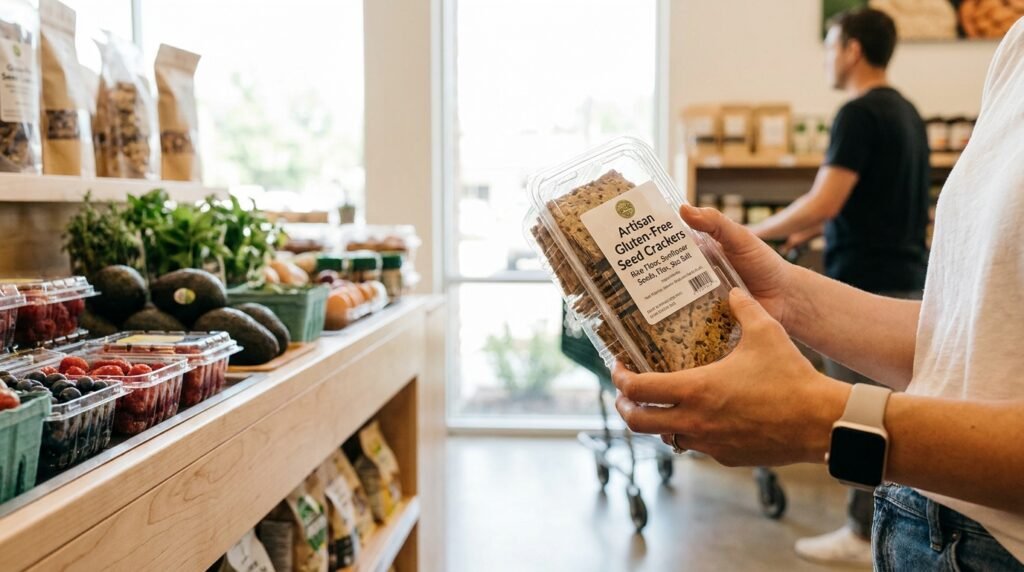
Standing in the snack aisle hunting for a safe, wholesome gluten free cracker should not feel like an exercise in clinical pathology. Yet for millions of individuals living with celiac disease, non-celiac gluten sensitivity (NCGS), or systemic autoimmune conditions, navigating supermarket shelves is an exhausting gauntlet. You pick up a box boasting a pristine ‘wheat-free’ claim on the primary display panel, only to flip it over and discover obscure yeast extracts, malted flavorings, or ambiguous starches lurking in six-point type. What should be an innocent vehicle for hummus or cheese becomes an immediate vector for chronic gastrointestinal distress, systemic inflammation, or debilitating brain fog.
The fundamental problem stems from the stark disparity between marketing jargon and clinical safety. While the FDA defines gluten-free food as containing fewer than 20 parts per million (ppm) of gluten—a threshold aligned with the Celiac Disease Foundation Threshold Requirements—that legal benchmark does not eliminate the risk of micro-exposures or sub-ingredient cross-contact for hyper-sensitive biologies. Many commercial bakeries run gluten-free formulations across shared lines, relying on cursory clean-downs that leave trace residues capable of blunting intestinal villi over repeated exposures. For parents safeguarding a newly diagnosed child or adults juggling multiple auto-antibodies, the mental toll of scrutinizing every single barcode transforms a twenty-minute grocery run into a high-stakes ordeal.
Compounding this anxiety is the nutritional profile of modern gluten-free substitutes. In an effort to replicate the elastic tensile strength and crisp snap of conventional wheat flour, manufacturers frequently turn to highly refined tapioca, corn, and potato starches hyper-stabilized with aggressive synthetic thickeners and hydrogenated fat. As detailed in groundbreaking PubMed Research on Ultra-Processed Foods & Gut Microbiome Disruption, pervasive industrial emulsifiers like carboxymethylcellulose and polysorbates directly erode the intestinal mucus barrier, sparking the precise micro-inflammation that individuals avoiding gluten are desperately seeking to heal. Finding an authentic, non-inflammatory gluten free cracker requires peeling back the packaging illusion with total biochemical clarity.
Scan Any Label for Hidden Additives and Allergens — Free
Never second-guess confusing grocery labels again. Download Food Scan Genius to uncover hidden additives, toxic dyes, and allergens for the whole household before you buy.


2. The Gluten-Free Cracker Checklist: Deceptive Ingredients and Processing Loopholes
To protect your digestive health, relying solely on front-of-box claims is never enough. Even products explicitly stamped with consumer-facing certifications can feature problematic sub-components, hyper-processed fillers, or ingredients governed by ambiguous regional definitions. When evaluating any prospective gluten free cracker, watch for these critical formulation traps and labeling loopholes:
- Barley Malt Extract and ‘Natural Flavors’: In many jurisdictions, ‘natural smoke flavor’ or generic ‘flavoring’ can conceal barley malt, which yields potent hordein proteins. Even when ‘gluten-free’ claims are legally applied under 20 ppm thresholds, residual fractions can trigger severe T-cell mediated reactions in celiac consumers.
- Autolyzed Yeast Extract & Hydrolyzed Proteins: Derived often from spent brewer’s yeast—a direct byproduct of beer brewing—yeast extracts frequently slip past consumer inspection. Unless the yeast source is specifically certified derived from primary baker’s yeast or sugar cane, it carries an elevated hazard for gluten protein contamination.
- ‘Gluten-Free’ Wheat Starch (Codex Alimentarius): Commonly utilized in European formulations to mimic conventional cracker crispness, this ingredient has had gluten mechanically and chemically washed to under 20 ppm. While legally permitted under European Food Safety Authority (EFSA) Additive Safety Regulations, it remains unsafe for anyone with true immunoglobulin-E (IgE) mediated wheat allergies and frequently causes psychological hesitation or flare-ups in celiac patients.
- Uncertified and Non-Purity Protocol Oats: Oats are inherently gluten-free, but commercial oat crops are overwhelmingly co-harvested, transported, and milled in facilities handling rye, barley, and wheat. Without an explicit ‘Purity Protocol’ sourcing standard, oat flour in crackers regularly fails clinical safety thresholds.
- Inflammatory Seed Oils and Saturated Palm Fractions: Gluten-free crackers often over-index on industrial refined oils (soybean, cottonseed, fractionated palm oil) to maintain structural integrity and shelf stability, running counter to the World Health Organization Guidelines on Healthy Diets & Saturated Fats for long-term cardiovascular and metabolic resilience.
- Synthetic Gums and High-Load Emulsifiers: Heavy doses of xanthan gum, guar gum, and hydroxypropyl methylcellulose (HPMC) are deployed to bind glutenless dough. In individuals with irritated gastrointestinal linings, these structural additives can ferment aggressively in the distal colon, causing severe bloating, gas, and disruption of commensal bifidobacteria.
3. Evaluating Gluten-Free Crackers: Food Scan Genius vs. Legacy Scanning Methods
| Feature / Capability | Food Scan Genius | Fig | Spoonful | Manual Label Reading |
|---|---|---|---|---|
| Core Price & Access Model | 100% Free Core (No Paywalls) | $59/year Subscription Wall | Freemium (Limited Free Scans) | Free (High Time Cost) |
| Database Scale & Parsing | NutriGraph (5M+ UPC/EAN) Recursive AST | Proprietary (~1M-2M Items) | Curated (~1M Items) | None (Human Eye Scan) |
| Multi-Household Screening | Yes (Single scan with named fail attribution) | No (Single-user focus) | No (Single-user focus) | Mental tracking across multiple profiles |
| Custom Sensitivity Support | 39 Profiles + Custom Sensitivities | Fixed Diet Profiles | FODMAP / Preset Diets Only | Unlimited (Prone to fatigue & error) |
| Nutritional Processing Context | ScanGenius AI + NOVA 1-4 + Nutri-Score | Binary Green/Yellow/Red Flags | FODMAP Specific Scale | Subjective Guesswork |
| Language Translation | 11 Languages (Real-Time In-App) | English Only | English Only | External Translation Tool Required |
While legacy food scanner apps restrict shoppers behind steep $59/year subscription models or arbitrary monthly scan quotas, Food Scan Genius democratizes safety by offering full, uncompromised core scanning power 100% free. Behind the camera viewfinder sits the enterprise NutriGraph Database, cataloging over 5,000,000 verified global UPC/EAN barcodes. Rather than merely matching simple text strings, NutriGraph employs recursive Abstract Syntax Tree (AST) parsing to dissect convoluted sub-ingredient parentheticals. When evaluating a gluten free cracker, the engine maps deep multi-tier ingredient trees down to the carrier solvents, processing aids, and anti-caking agents that human readers or superficial scanners overlook.
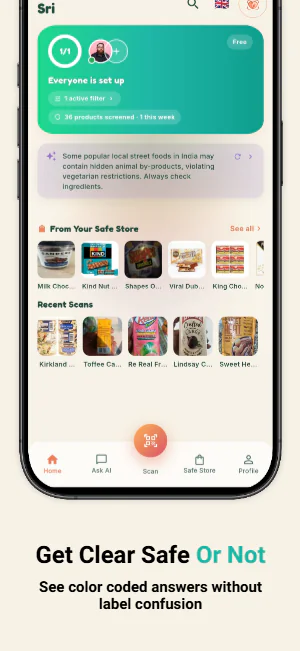
Crucially, ScanGenius AI Insight transcends simplistic, moralizing scoring systems that arbitrarily brand foods as ‘good’ or ‘bad.’ Instead, it provides nuanced, clinically grounded context by coupling robust allergen detection with objective international benchmarks: NOVA 1-4 ultra-processing classifications and the scientifically validated Nutri-Score. If you are grocery shopping for a blended family where one child has celiac disease and a partner avoids inflammatory seed oils or synthetic colorants, our Multi-Household Family Profiles screen for every conflicting restriction simultaneously in a single two-second barcode scan. The interface instantly delivers transparent, pinpoint fail attribution—such as “Fails for Sri (Gluten)”—accompanied by real-time translation across 11 global languages for effortless international label decoding.
4. Related Food Safety & Dietary Guides
- Best Food Allergy Scanner App – Scan Food Labels Instantly — Food Allergy & Sensitivity Scanner Hub
- The 7 Best Free Food Scanner Apps of 2026 — best free food scanner apps
- Choosing the Best Barcode Scan App for Your Health — guide to choosing a barcode scanner app
- Food Scan Genius: World’s #1 Food Ingredient Scanner App — Food Scan Genius scanner app
5. Scientific & Health Authority References
- Celiac Disease Foundation Threshold Requirements
- European Food Safety Authority (EFSA) Additive Safety Regulations
- PubMed Research on Ultra-Processed Foods & Gut Microbiome Disruption
- World Health Organization Guidelines on Healthy Diets & Saturated Fats
6. How to Scan in 3 Simple Steps
- Download the Food Scan Genius app for free on iOS or Android—no mandatory subscriptions, paywalls, or scan limits.
- Set up your customized household dietary profile by selecting Gluten-Free / Celiac from our 39 clinical profiles, and add custom sensitivities like specific seed oils, gums, or artificial preservatives.
- Scan the barcode of any cracker in under two seconds to view an instant sub-ingredient audit, NOVA ultra-processing score, and multi-user safety confirmation.
Instant Gluten-Free Audit Trail
7. Frequently Asked Questions (FAQ)
What makes a cracker truly safe for someone with celiac disease versus non-celiac gluten sensitivity?
For celiac disease, a cracker must be strictly verified below 20 ppm gluten, ideally produced in a certified dedicated gluten-free facility using purity-protocol grains to avoid micro-enteropathy. Non-celiac gluten sensitivity may tolerate broader cross-contact environments, but both profiles benefit from scanning with Food Scan Genius, which parses recursive sub-ingredients like barley malt and hydrolyzed vegetable proteins that simple ingredient lists obscure.
Why do some certified gluten-free crackers trigger digestive distress?
Many gluten-free cracker alternatives swap wheat flour for hyper-processed starches and large quantities of emulsifying gums (such as xanthan, guar, or carboxymethylcellulose). In sensitive microbiomes, these additives cause rapid fermentation, gas distension, and gut barrier irritation. Food Scan Genius flags these additives and highlights the cracker’s NOVA 1-4 processing level so you can select gut-friendly, whole-food options.
How does Food Scan Genius catch hidden gluten that other scanning apps miss?
Legacy scanning apps frequently rely on superficial string matching that skips over complex, parenthetical sub-ingredients. Food Scan Genius utilizes the NutriGraph Database (5,000,000+ UPCs) and recursive Abstract Syntax Tree (AST) parsing, exposing hidden derivatives like barley-based flavorings, maltodextrins from unstated sources, and ambiguous yeast extracts instantly.
Can I use Food Scan Genius if our family manages multiple dietary allergies alongside gluten?
Yes. Food Scan Genius features Multi-Household Family Profiles. In a single scan of a cracker box, the app cross-checks up to 39 pre-configured dietary conditions plus any custom sensitivity you input (such as sesame, nightshades, or seed oils). If an item is unsafe for any family member, it clearly attributes the reason (e.g., ‘Fails for Sri (Gluten)’).
Know What’s In Your Food Before You Buy — Scan Free Today
Never second-guess confusing grocery labels again. Download Food Scan Genius to uncover hidden additives, toxic dyes, and allergens for the whole household before you buy.