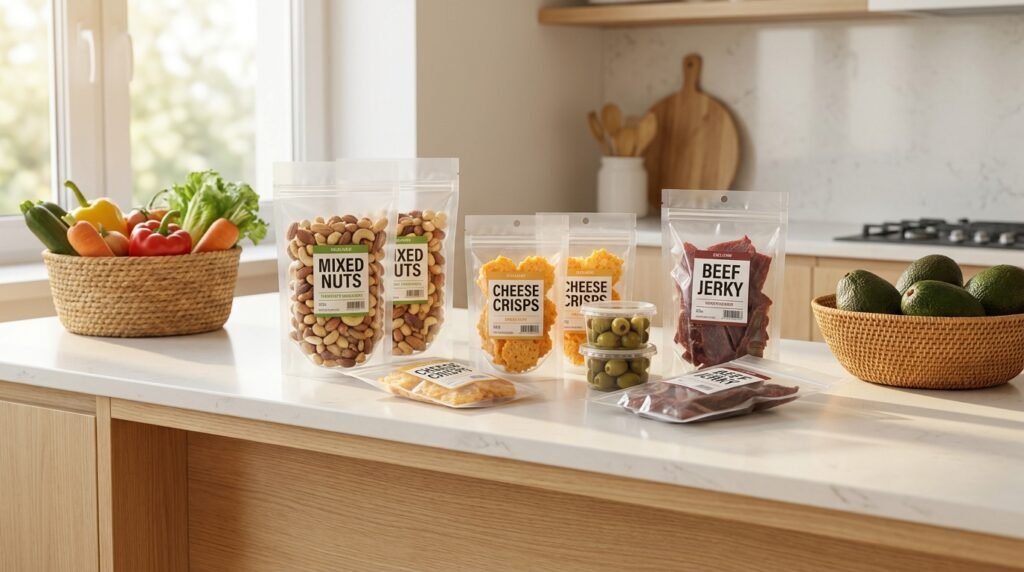
1. The Modern Grocery Aisle Paradox: Why Finding True Keto Friendly Snacks Is Harder Than Ever
Rushing through grocery aisles on an overscheduled weekday while trying to maintain nutritional ketosis is an exhausting mental workout. When your schedule leaves zero margin for weekend meal prepping, convenient grab-and-go options become an absolute lifeline. You spot a package boldly stamped with claims like ‘Zero Sugar,’ ‘Keto Certified,’ or ‘Net 2g Carbs,’ and for a brief second, you feel a wave of relief. Yet, as thousands of seasoned low-carb dieters have learned the hard way, the front of the packaging is fundamentally marketing copy, not metabolic science. All too often, those convenient store-bought bites quietly stall fat adaptation, trigger digestive distress, or spike postprandial blood glucose as aggressively as a standard candy bar.
The fundamental challenge in sourcing authentic keto friendly snacks stems from regulatory ambiguities and manufactured loopholes. Under standard food labeling frameworks, brands can legally highlight engineered fiber math and subtract total sugar alcohols to claim impossibly low net carbohydrate numbers. However, when clinical metabolic impact is evaluated, your liver and endocrine system do not read marketing banners. Ingredients like maltitol, high-dextrose bulking agents, and chemical texturizers demand metabolic processing that can eject your body straight out of ketosis. Navigating these landmines while managing a broader wellness plan—balancing micronutrients alongside the World Health Organization Guidelines on Healthy Diets & Saturated Fats—creates profound consumer fatigue.
Moreover, modern grocery shopping is rarely an individual pursuit. If you are picking up packaged provisions for a bustling household, your dietary parameters are compounded by competing family needs. A shelf-stable snack bar that matches your strict 5% daily carbohydrate limit might harbor hidden whey derivatives, refined nut butter blends, or undisclosed trace allergens that run counter to protective mandates under the FDA Food Allergen Labeling & Consumer Protection Act (FALCPA). Trying to reconcile personal low-carb goals with a spouse’s gluten sensitivity and a child’s peanut allergy turns a quick 5-minute convenience run into an anxiety-inducing clinical trial in the snack aisle.
Empowerment begins with looking past aesthetic fonts and deceptive product claims. Authentic sustained energy on a ketogenic diet requires functional foods engineered from biologically compatible lipids, whole proteins, and transparent, low-glycemic fiber structures that safeguard metabolic flexibility without wrecking gut integrity.
Scan Any Label for Hidden Additives and Allergens — Free
Never second-guess confusing grocery labels again. Download Food Scan Genius to uncover hidden additives, toxic dyes, and allergens for the whole household before you buy.


2. Deceptive Labeling & Sneaky Additives: What Is Really Hiding in ‘Low-Carb’ Packaging?
Food manufacturers are well aware of the lucrative demand for low-carb nutrition, leading to widespread ‘keto-washing’ of ultra-processed items. A product may boast minimal net carbs on its prominent label while simultaneously relying on cheap, chemically modified fillers to preserve mouthfeel, bulk, and shelf-stability. To make truly informed decisions for your metabolic health, it is essential to look beyond the top-line macro breakdown and inspect the underlying ingredient cascade.
When evaluating store-bought packaged treats, watch out for these pervasive, deceptive culprits:
- Maltitol and Hydrogenated Starch Hydrolysates: Commonly utilized in sugar-free chocolates and snack bars, maltitol possesses a glycemic index (GI) of roughly 35 to 52, which is significantly higher than that of erythritol, stevia, or pure allulose. It causes dramatic glycemic spikes and metabolic interruptions while drawing severe osmotic fluid into the colon, triggering gastrointestinal distress.
- Resistant Dextrin and ‘Soluble Tapioca Fiber’ derived from Isomalto-oligosaccharides (IMOs): While brands often subtract these entirely as dietary fiber to advertise ‘1g Net Carb,’ scientific research reveals that many commercial IMOs are partially hydrolyzed and digested in the small intestine as active carbohydrates, directly precipitating an insulin response.
- Industrial Emulsifiers and Thickening Gums: Additives like polysorbate 80, carboxymethylcellulose, and excessive carrageenan are deployed to artificially simulate natural dairy creaminess. Authoritative literature, including PubMed Research on Ultra-Processed Foods & Gut Microbiome Disruption, underscores how persistent exposure to synthetic emulsifiers erodes the protective intestinal mucus layer, potentially worsening systemic low-grade inflammation.
- Refined, High-PUFA Seed Oils: Rather than utilizing extra virgin olive oil, cold-pressed avocado oil, or unrefined coconut oil, manufacturers frequently cut costs with solvent-extracted soybean, canola, or corn oils. These highly oxidized fats readily compromise cellular membrane stability and trigger inflammation, undermining the anti-inflammatory benefits of clean ketosis.
- Unregulated Synthetic Sweetener Cocktails: Combining acesulfame potassium (Ace-K) or sucralose with powdered bulking agents like maltodextrin introduces hidden metabolizable sugars. These formulations frequently cross-examine safety boundaries outlined in the European Food Safety Authority (EFSA) Additive Safety Regulations, specifically regarding daily cumulative consumer intake.
- Modified Wheat Starch and Vital Wheat Gluten Blends: Marketed extensively as zero-carb sandwich bread and low-carb keto cookies, these concentrated gluten fractions can provoke high gastrointestinal permeability and auto-reactive responses, even among consumers without clinically diagnosed celiac disease.
3. Instant Grocery Clarity: Comparing Nutritional Intelligence Tools
| Platform / Capability | Food Scan Genius | Fig App | Spoonful | Manual Label Reading |
|---|---|---|---|---|
| Core Pricing Model | 100% Free Core Access (Zero Paywalls) | Strict $59/yr Paywall for Full Utility | Freemium with Limited Scans per Month | Free (High Personal Time Investment) |
| Keto & Sugar-Alcohol Analysis | Deep Sub-Ingredient AST Parsing for Glycemic Fillers | Basic Ingredient Tagging | FODMAP / Basic Carbs Focus | Prone to Missing Obscured Dextrose/Maltitol |
| Multi-Household Screening | Yes (e.g., ‘Fails for Sri (Gluten)’) in 1 Scan | Single User Profile Centric | Limited Multi-Filter Sharing | Impossible for Complex Household Combinations |
| Database Breadth | NutriGraph (5M+ UPC/EAN Barcodes) | Proprietary US-Only Database | Specialty Diet Curated Set | Limited to Physical Packaging on Shelf |
| Objective Processing Insights | NOVA 1-4 + Nutri-Score (Contextual, No Shaming) | Binary Match / No Match | Traffic Light Green/Yellow/Red | Subjective Guesswork |
While legacy nutrition apps enforce rigid financial walls or arbitrary scan limits, Food Scan Genius changes how shoppers evaluate keto friendly snacks directly in the aisle. At the core of the platform is the enterprise NutriGraph Database, mapping over 5,000,000 verified global UPC/EAN barcodes. Rather than relying on simple text-string matching that overlooks disguised carbohydrates, the engine deploys recursive Abstract Syntax Tree (AST) parsing. This technology deconstructs compound parenthetical ingredients—such as ‘Dark Chocolate Coating (Cocoa Butter, Inulin, Maltitol, Soy Lecithin)’—and identifies every hidden glycemic disrupter and sub-additive before you place the product in your cart.
Rather than assigning arbitrary, moralizing product grades, the platform provides nuanced ScanGenius AI Insights alongside validated NOVA 1-4 ultra-processing classifications and official Nutri-Score standards. Furthermore, Food Scan Genius natively accommodates 39 distinct dietary profiles while offering complete freedom to append custom personal sensitivities—such as expeller seed oils, synthetic food dyes, or unique gums. With our innovative Multi-Household Family Profiles, a single rapid scan immediately confirms if a keto snack is safe for your low-carb macros while instantly highlighting safety flags for other family members (e.g., ‘Fails for Sri (Gluten)’). Available in 11 global languages with live in-app label translation, it turns complex grocery choices into effortless, evidence-based certainty.
4. Related Food Safety & Dietary Guides
- Best Food Allergy Scanner App – Scan Food Labels Instantly — Food Allergy & Sensitivity Scanner Hub
- The 7 Best Free Food Scanner Apps of 2026 — best free food scanner apps
- Choosing the Best Barcode Scan App for Your Health — guide to choosing a barcode scanner app
- Food Scan Genius: World’s #1 Food Ingredient Scanner App — Food Scan Genius scanner app
5. Scientific & Health Authority References
- FDA Food Allergen Labeling & Consumer Protection Act (FALCPA)
- European Food Safety Authority (EFSA) Additive Safety Regulations
- PubMed Research on Ultra-Processed Foods & Gut Microbiome Disruption
- World Health Organization Guidelines on Healthy Diets & Saturated Fats
6. How to Scan in 3 Simple Steps
- Download Food Scan Genius for free on iOS or Android—instantly access the entire 5,000,000+ NutriGraph database with zero paywalls.
- Activate the ‘Keto / Low-Carb’ dietary profile, configure custom exclusions (like seed oils or maltitol), and add any household allergy profiles.
- Scan any store-bought snack barcode in the aisle to receive an instant 2-second audit detailing net carb integrity, sub-ingredients, and multi-profile safety.

Instant Keto & Sugar Audit Trail
7. Frequently Asked Questions (FAQ)
How does Food Scan Genius help me detect hidden carbs in store-bought keto snacks?
Food Scan Genius utilizes the NutriGraph Database with recursive AST parsing to analyze parenthetical ingredient declarations. Instead of taking front-of-package ‘net carb’ claims at face value, it flags deceptive fillers like maltitol, resistant dextrin, and modified food starches that frequently trigger insulin spikes and interrupt ketosis.
Why are some sugar alcohols considered bad for a ketogenic diet?
Not all sugar alcohols interact with your metabolism identically. While erythritol has a glycemic index near zero and passes through the body largely unabsorbed, alternatives like maltitol and sorbitol carry a glycemic index between 35 and 52. These sweeteners raise blood sugar, prompt insulin release, and frequently cause severe gastrointestinal distress.
Can Food Scan Genius screen snacks for multiple family members on different diets at once?
Yes. With Multi-Household Family Profiles, you can scan a product once to evaluate its suitability across everyone in your home simultaneously. For example, the app can verify that a grab-and-go snack fits your strict low-carb parameters while clearly displaying a warning such as ‘Fails for Sri (Gluten)’ if an allergen is present.
Is Food Scan Genius really 100% free with no scanning limits?
Yes. Unlike apps that restrict free users to limited monthly scans or charge steep recurring subscriptions (such as Fig’s $59/year paywall), Food Scan Genius offers 100% free core power. You can scan unlimited products, audit sub-ingredients, and utilize custom dietary profiles without hidden charges.
Know What’s In Your Food Before You Buy — Scan Free Today
Never second-guess confusing grocery labels again. Download Food Scan Genius to uncover hidden additives, toxic dyes, and allergens for the whole household before you buy.