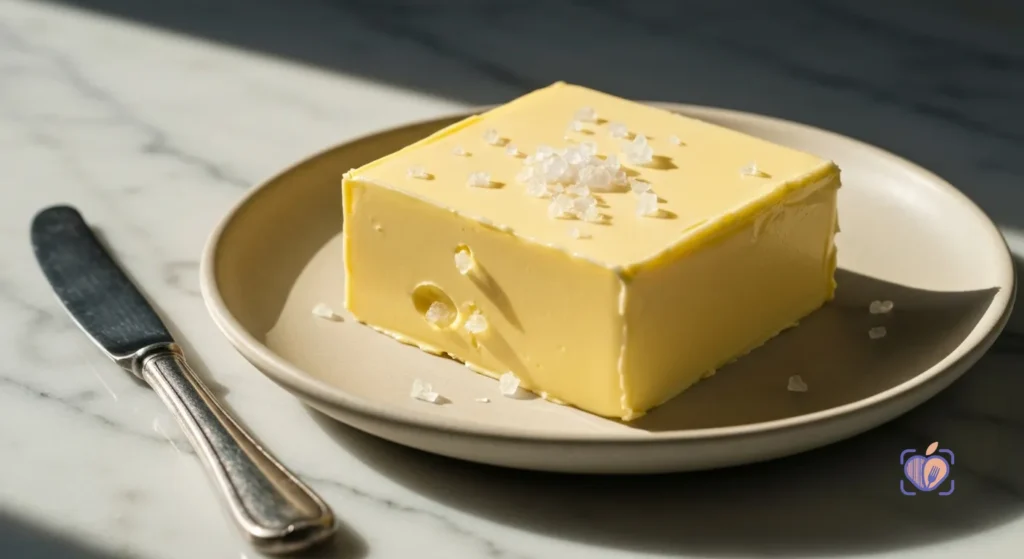
On average, salted butter contains between 1.6 to 1.75 grams of salt per 100 grams. This translates to roughly ¼ teaspoon of salt per ½ cup of butter, or about 90 milligrams of sodium per tablespoon.
But that number is just an introduction. It’s the handshake before the meeting. It’s what they’re willing to tell you. The real story, as always, is in the details they leave out.
The Numbers on the Label: A Starting Point, Not the Destination
They give you a simple product. Cream, salt. It feels nostalgic. Honest. But the modern grocery aisle is not a place for nostalgia; it’s a battleground for your attention and loyalty. The amount of salt isn’t a universal constant. It’s a choice made in a boardroom.
American vs. European Butter: A Tale of Two Tastes
- American-Style Salted Butter: Typically contains around 90-95 mg of sodium per tablespoon (about 1.7% salt by weight). It’s a straightforward product, designed for a consistent, familiar flavor.
- European-Style Salted Butter: Often has a higher fat content and can have a slightly lower or more variable salt level, sometimes using different types of salt crystals that change the perception of saltiness.
This variation is the first clue that the label is just part of the story. The type of salt, the churning process, the fat content—it all changes the equation. It’s a simple question that deserves a simple answer, but you’re not being given one.
Why Does Salt Content Matter? It’s Not About Taste. It’s About Time.
We add salt for flavor, for preservation. But at what cost? People are fond of saying you should moderate your intake. But you can’t moderate what you can’t measure.
The World Health Organization recommends a strict limit on daily sodium intake not to rob you of flavor, but to give you more time. More time for mornings with toast, for family dinners, for everything that matters. Managing sodium isn’t about sacrifice; it’s about control. And control begins with having the correct information, a principle that the experts at the Mayo Clinic will tell you is fundamental to managing your health.
Beyond ‘Salt’: The Hidden Sodium You’re Not Seeing
Here’s the truth they hope you’ll ignore: ‘salt’ is just one word. It’s the name on the door. But inside, there’s a whole party of sodium-based compounds you were never invited to meet. They hide in plain sight as preservatives and flavor enhancers, a common strategy in the world of ultra-processed foods that has quietly crept into even our most basic staples.
This is where the real discrepancy lies. Not in the salt you can taste, but in the sodium you can’t see.
That’s why we created Food Scan Genius. It’s a tool for people who believe they have a right to know what they’re eating. Our technology doesn’t just read the barcode; it deciphers the entire story. We parse over 200+ specific edge-case hidden labels for sodium and other additives that companies aren’t required to advertise.
Stop guessing. Stop taking their word for it. It’s time to demand certainty.
Get the truth in your hands. Download Food Scan Genius for free.
Download on Google Play | Download on the App Store
Your Questions About Salted Butter, Answered
How much sodium is in a tablespoon of salted butter?
A standard tablespoon of salted butter contains approximately 90 milligrams of sodium. However, this can fluctuate based on the brand, origin, and specific type of salt used.
Is sea salt in butter healthier than regular table salt?
While sea salt contains trace minerals, it has the same basic nutritional value and the same amount of sodium by weight as table salt. From a health perspective, the total amount of sodium consumed is the critical factor, not the type of salt.
Can I use salted butter instead of unsalted in baking?
Yes, but with caution. Most baking recipes are developed with unsalted butter to give the baker complete control over the salt content. If you use salted butter, you should reduce the amount of added salt in the recipe by approximately ¼ teaspoon for every ½ cup of butter used.
How can I find the exact sodium content in my specific brand of butter?
The nutrition label provides a baseline, but for a complete analysis that accounts for all sodium-containing ingredients, you need a more powerful tool. The Food Scan Genius app instantly analyzes labels to give you the precise data you need to make an informed choice, not just a guess.