Low-Salt Living for a Stronger Heart: How Retirees Can Outsmart Hidden Sodium at Kroger & Publix
Target Diet: Low-Salt | Narrative Angle: Heart Health
You’re standing in the familiar aisles of your local Kroger or Publix. Same stores you’ve shopped for years. Same brands. Same weekly routine. But now, after a heart checkup or a doctor’s reminder to “watch the sodium,” every label suddenly matters more.
You pick up a jar of pasta sauce. You flip it over. You squint at the Nutrition Facts. Sodium? Okay, manageable. Then you scan the ingredient list and see a name that sounds like chemistry class: sodium benzoate.
Is that something your heart-friendly, low-salt lifestyle should avoid? Or is it just another confusing food additive that wastes your time worrying?
If you’re a retired man in the USA focused on protecting your heart without giving up convenience or flavor, this article is written for you.
The Hidden Problem: Sodium Benzoate and the Low-Salt Confusion
When you’re following a low-salt diet for heart health, sodium becomes the enemy you’re trained to spot. But here’s the problem: not all “sodium” ingredients behave the same way.
Sodium benzoate is a preservative commonly used in foods like salad dressings, condiments, soft drinks, and shelf-stable sauces. Its job is to stop bacteria and mold so food lasts longer on the shelf.
In the United States, sodium benzoate is regulated by the FDA under 21 CFR § 184.1733, which classifies it as Generally Recognized as Safe (GRAS) when used according to good manufacturing practices, up to a maximum of 0.1% by weight.
The FDA’s own Substances Added to Food Inventory confirms that sodium benzoate is approved as an antimicrobial, antioxidant, and flavoring agent.
So what’s the issue for heart health?
- It contains the word “sodium,” which triggers concern for anyone on a low-salt diet.
- It often appears in processed foods that already have higher sodium levels.
- It’s rarely explained clearly on labels.
Here’s the key truth most shoppers never hear: sodium benzoate contributes only a tiny amount of sodium compared to table salt. The FDA does not classify it as a high-sodium additive or salt substitute, and there are no official FDA warnings specific to low-salt diets.
However, context matters.
According to the eCFR, its use is tightly controlled. And while the FDA has addressed concerns about benzene formation (when sodium benzoate combines with vitamin C in beverages), they confirm levels are below 5 parts per billion, posing no safety concern to consumers.
Still, as a retiree focused on heart health, you don’t just want “safe.” You want clarity.
The Solution: Food Scan Genius — Your Low Sodium Scanner for Real Life
This is where Food Scan Genius becomes a game changer.
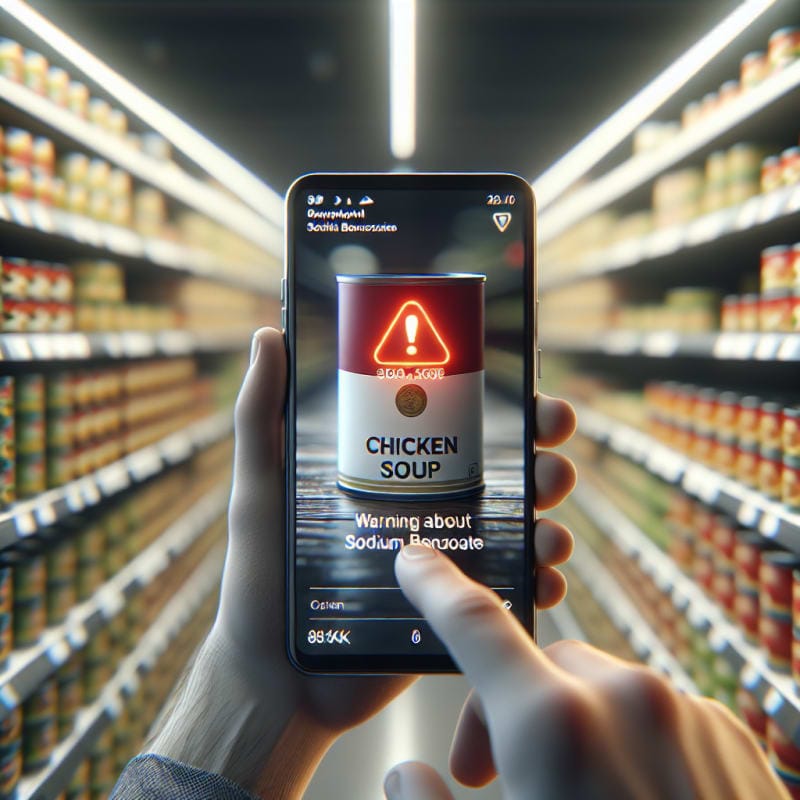
Instead of standing in the aisle at Kroger or Publix reading tiny print and guessing whether an ingredient matters for your heart, Food Scan Genius works as a low sodium scanner built for real shoppers — especially retirees who value simplicity.
Why retired men focused on heart health are switching to Food Scan Genius:
- You can add sodium benzoate (or any ingredient) to your personal dietary profile.
- The app scans barcodes instantly and flags ingredients based on your low-salt goals.
- It connects ingredient data with the Nutrition Facts label, so you see the full sodium picture.
- No guesswork. No Google searches in the aisle.
For a retiree, time and peace of mind matter. You want to shop efficiently, stick to your heart-friendly plan, and still enjoy food.
Food Scan Genius turns your phone into a trusted assistant — not a lecture.
Manual Label Reading vs. Food Scan Genius
| Feature | Manual Label Reading | Food Scan Genius |
|---|---|---|
| Time Spent in Aisle | Several minutes per item | Seconds with a scan |
| Understanding Sodium Sources | Confusing ingredient names | Clear explanations tied to heart health |
| Low-Salt Accuracy | Easy to miss hidden sodium | Personalized low-sodium alerts |
| Peace of Mind | Constant second-guessing | Confidence in every purchase |
What a Fellow Retiree Says
“After my cardiologist told me to cut back on salt, grocery shopping became stressful. I kept seeing ingredients like sodium benzoate and didn’t know what really mattered. With Food Scan Genius, I just scan and move on. It’s like having a nutrition expert in my pocket at Publix.”
— Robert, 68, Florida
Why This Matters for Long-Term Heart Health
According to a PubMed review, sodium benzoate has an acceptable daily intake of 0–5 mg per kg of body weight and is considered safe below that limit, with no evidence of general toxicity at FDA-regulated levels (PubMed Review).
That doesn’t mean you should ignore it — it means you should understand it in context.
Most heart health risks come from overall sodium intake, not trace preservatives. But those preservatives often appear in foods that are already pushing your daily sodium limits.
A smart low-salt strategy isn’t about fear. It’s about awareness.
And awareness is exactly what a low sodium scanner like Food Scan Genius provides.
Frequently Asked Questions
Bottom line: A heart-healthy, low-salt life doesn’t mean avoiding every unfamiliar ingredient. It means having the right tools to make confident decisions. With Food Scan Genius, your next trip to Kroger or Publix can feel simple again — and your heart will thank you for it.