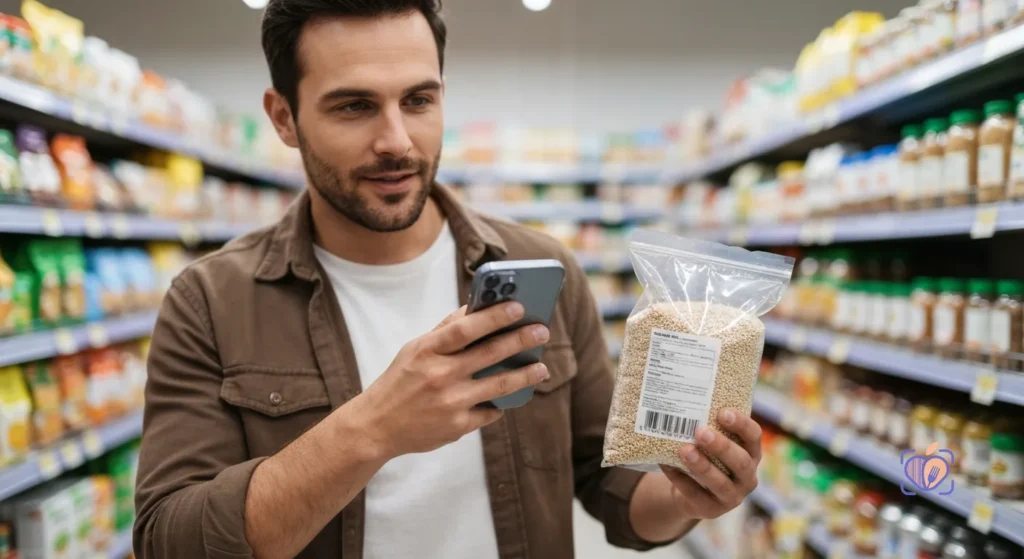
They say the future is supposed to feel different. We were promised flying cars. Instead, we got apps that scan receipts for expense reports. A dull, gray utility. A solution to a problem nobody feels passionate about.
But what if I told you the definition of a “scanner app” has changed? What if I told you it’s no longer about digitizing paper, but about decoding the very food you’re about to put in your body?
Forget scanning a receipt. Imagine this instead.
You’re in Aisle 4. Your child, the one with the severe peanut allergy and celiac disease, wants the new brand of macaroni and cheese. The box screams ‘Gluten-Free!’ in bright, friendly letters. But you’ve been burned before. You turn it over and scan the ingredient list, your eyes darting around for traps. You see the word ‘Spices’. You see ‘Natural Flavors’.
What does that mean? Is it safe? Is the cross-contamination risk from the factory acceptable? Your heart rate quickens. You’re not just a shopper anymore; you’re a detective, a chemist, and a risk assessor, all while a toddler is pulling at your sleeve.
This is the moment of truth for millions of families. This is the moment where a simple office utility is useless, and a new kind of tool becomes a literal, life-saving medical assistant.
You don’t need another app to scan a QR code for a restaurant menu. You need an app that scans the barcode on that box of macaroni and, in less than a second, gives you a definitive, confident answer: Yes, this is safe. Or No, put it back.
This isn’t the future. This is today. And the tool isn’t a toy. It’s Food Scan Genius.
Why 2026 is the Year of the “Food Scanner”
The world has become a more complicated place to eat. It’s not your imagination. The simple food pyramid we grew up with has been shattered into a million personalized, complex, and often intersecting dietary protocols.
Think about the conversations you have with your friends and family. One is Keto. Another is Paleo. Your brother is trying a low-FODMAP diet for his IBS. Your coworker avoids seed oils like the plague. Your sister-in-law is tracking her macros to the gram. And that’s before we even touch on the explosive growth of diagnosed food allergies and sensitivities: gluten, dairy, soy, nuts, corn, nightshades, nickel, salicylates… the list is endless and unforgiving.
This isn’t a fad. It’s a fundamental shift in our relationship with food, driven by a deeper understanding of biology and a desperate need for control in a world of processed ingredients. People are searching for clarity. They’re looking for things they can trust, for a bonafide bone broth that is exactly what it claims to be, with no hidden MSG disguised as ‘yeast extract’.
By 2026, this complexity will be the default. The idea of one-size-fits-all nutrition will be as archaic as a landline phone. This creates an information gap so vast that the human eye can no longer keep up. Reading a label is no longer enough. You need a processor. You need an analyst. You need a genius in your pocket that can cross-reference your family’s unique 39-point allergy profile against a database of 2 million products in the time it takes you to reach for the next item on your list.
The era of the generic ‘scanner app’ is over. The era of the Food Intelligence Scanner has begun.
The Failure of Generic QR/Barcode Apps
Let’s be clear about what most ‘scanner apps’ on the market actually do. They read a barcode—a simple string of numbers—and look it up in a database. They’ll tell you you’re holding a ’12oz box of Brand X Crackers’. Congratulations. You could have learned that by reading the front of the box.
A generic barcode reader is a dictionary. It tells you what something is. It cannot tell you what it means.
It can’t tell you that the ‘natural flavors’ in that supposedly bonafide bone broth are derived from corn, which triggers your son’s sensitivity. It can’t tell you that the ‘spices’ in that sausage contain hidden gluten from a filler agent. It can’t tell you that the ‘modified food starch’ is wheat-based, not corn-based, making it a landmine for someone with celiac disease.
These apps fail because they cannot interpret nuance. The food industry uses over 200 different names for sugar. There are dozens of derivatives for soy, dairy, and wheat that don’t contain the root word. A simple keyword search, which is all these generic apps are doing, is dangerously inadequate. It provides a false sense of security, which is more dangerous than no security at all.
Reading a label isn’t enough. You need to decode it. You need to understand the manufacturing processes, the sourcing, the potential for cross-contamination. You need a system built not by software engineers who like QR codes, but by a team of dietitians, nutritionists, and data scientists obsessed with a single mission: delivering the truth about what’s inside your food.
To trust a generic scanner with your family’s health is to play Russian Roulette in the grocery aisle. It’s time to demand a better weapon.
Yuka vs Fig vs Food Scan Genius: The Evolution of the Dietary Scanner
In the world of food intelligence, not all players are created equal. You’ve likely heard of the big names. Let’s put them in their proper place.
Yuka: The Beginner’s Scorecard
Yuka is popular, and for good reason. It’s simple. You scan a product, and it gives you a score: good, mediocre, or bad. It’s a great first step for someone just beginning to think about healthier choices. It flags obvious additives and high sugar content. We respect what they’ve started.
But for the user we’re talking about—the parent of a child with allergies, the person with a complex dietary protocol—Yuka is a blunt instrument. A ‘bad’ score doesn’t tell you why it’s bad for you. Is it bad because of sugar content, or because it contains a specific allergen that could send you to the hospital? Yuka’s simplicity is its greatest weakness. It’s a traffic light when you need a GPS with real-time hazard warnings.
Fig: The Worthy Contender
Fig (Food is Good) is a more serious tool. They understand the problem. They allow users to build a dietary profile and check for matches. They are, without question, a massive leap forward from generic scanners and a step up from Yuka’s oversimplified scoring.
But the question is never about who is good. It’s about who is the best. Fig’s approach can sometimes feel like a well-organized checklist. It’s functional, but where is the deep intelligence? How fast is it? How is the data verified? While they move in the right direction, they haven’t achieved the clinical-grade precision and speed required for absolute confidence. They are a promising blueprint. Food Scan Genius is the finished skyscraper.
Food Scan Genius: The Professional-Grade Solution
This is where the conversation ends. Food Scan Genius was built to be the final word in food safety and intelligence. We are not a wellness app; we are a medical-grade assistant. We didn’t just build a better checklist; we built a proprietary analysis engine.
While others give you a score or a simple match, we give you a detailed, multi-faceted report in under a second. We don’t just check for ‘nuts’; we differentiate between 12 different types of tree nuts and peanuts. We don’t just flag ‘gluten’; we identify oats processed on shared equipment. We don’t just tell you if a product fits your diet; we tell you why, down to the specific offending ingredient, and suggest a safer alternative in the same category.
We are the difference between a hunch and a diagnosis. We are the tool you graduate to when ‘good enough’ is no longer good enough for your family’s health.
How Food Scan Genius Processes a 39-Label Allergy Profile in Under 1 Second
People ask us how we deliver this level of detail so quickly. It’s not magic. It’s a relentless, obsessive investment in technology and human expertise.
It starts with our database. Unlike other apps that scrape public information or rely on user submissions, our database is built from the ground up. We license data directly from manufacturers and retailers. Every single ingredient list is ingested and parsed by our proprietary AI, named ‘The Chemist’.
‘The Chemist’ doesn’t just read words; it understands them. It knows that ‘lecithin’ is likely soy-derived unless specified otherwise. It knows that ‘casein’ is a milk protein. It maintains a constantly updated library of thousands of chemical synonyms, derivatives, and ‘hidden’ ingredients. When you’re looking for a truly bonafide bone broth, our system is the only one that can instantly verify if the ‘natural chicken flavor’ is pure or if it’s hiding MSG or yeast extract that violates your diet.
When you scan a barcode, here’s what happens in 900 milliseconds:
- The barcode is identified, pulling the product’s verified ingredient list from our secure servers.
- Your personal profile—which can include up to 39 distinct allergens, sensitivities, and dietary avoidances—is loaded.
- ‘The Chemist’ performs a multi-level analysis, cross-referencing every single ingredient against every single rule in your profile.
- The results are compiled into a simple, color-coded report: Green (Safe), Yellow (Caution – check details), or Red (Avoid).
- The report is delivered to your screen.
This isn’t just a database lookup. It’s a high-speed diagnostic analysis. It’s the kind of processing power you’d expect from a financial firm’s trading algorithm, applied to the safety of your food. That is our commitment. That is the Food Scan Genius difference.
Beyond Allergies: The Triple Score
While our foundation is built on providing life-saving allergy information, we understand that a healthy life is about more than just avoidance. It’s about making positive, informed choices for yourself and for the world.
That’s why every scan with Food Scan Genius also provides our signature Triple Score, giving you a complete, 360-degree view of your food.
- The Nutri-Score: This is a familiar, government-recognized A-to-E nutritional quality score. It gives you an at-a-glance understanding of the product’s health profile based on fats, sugar, salt, and fiber. It’s the simple truth about how nutritious a food is.
- The NOVA Score: This is the future of healthy eating. The NOVA classification system rates food based on its level of processing. A score of 1 is an unprocessed, whole food (an apple). A score of 4 is an ultra-processed product (a bag of cheese puffs). For those looking to eat cleaner, more natural foods, the NOVA score is an essential, eye-opening metric.
- The Eco-Score: We don’t live in a vacuum. Our food choices impact the planet. The Eco-Score rates products from A to E based on their environmental impact, considering factors like production methods, packaging, and transportation. It allows you to align your diet with your values.
With the Triple Score, Food Scan Genius becomes more than an allergy tool. It becomes a comprehensive wellness advisor, helping you make choices that are better for your body, your family, and the environment.
Why Your Health Data Shouldn’t Be Crowdsourced
There is a dangerous trend in the app world: crowdsourcing. Many food apps, including some of our competitors, build their databases on the back of user-submitted photos and corrections. They treat food data like a Wikipedia article, believing that the ‘wisdom of the crowd’ will eventually lead to accuracy.
Let me be painfully clear: This is unacceptable.
Would you trust a Wikipedia article to diagnose a medical condition? Would you let a crowd of anonymous strangers on the internet decide which medication you should take?
Of course not. So why on earth would you trust them with the ingredient list that could cause your child to go into anaphylactic shock?
Your family’s health is not a democracy. It is a dictatorship where accuracy is the only law. A single incorrect user submission, a single blurry photo of an old label, a single mistake that lingers uncorrected in the database can have catastrophic consequences.
At Food Scan Genius, our data policy is absolute. We have zero crowdsourced data.
Our information comes from one place: the source. We work with brands, manufacturers, and a team of registered dietitians who verify every single entry. Our system is a closed loop. It is a fortress. It is a laboratory. It is a place where you can be certain that the information you receive is the certifiable truth.
When you make a decision in Aisle 4, you need certainty. Not a consensus. Not a ‘best guess’. You need a guarantee. That is what we sell.
Stop Guessing. Start Knowing.
The grocery store doesn’t have to be a minefield. The anxiety you feel when reading a label can be a thing of the past. You can have confidence, clarity, and control over the food you buy.
You can stop being a detective and go back to being a parent. A provider. A person who enjoys food without fear.
This is your moment to change your relationship with food forever. Stop guessing. Stop worrying. Stop leaving your family’s health to chance.
Download Food Scan Genius right now. Your first scan will show you a new way to shop. Your first month will show you a new way to live.
For just $4.99/month or $49.99/year, you can have a team of dietitians and a supercomputer in your pocket. It’s less than the cost of one box of specialty gluten-free cookies. It’s the best investment you will ever make in your family’s well-being.
Download on the App Store (iOS)
Download on Google Play (Android)
Frequently Asked Questions
1. How does Food Scan Genius handle complex ingredient names like ‘hydrolyzed vegetable protein’ when my child is allergic to soy?
Our proprietary AI engine, ‘The Chemist’, maintains a database of thousands of ingredient synonyms and derivatives. It knows that ‘hydrolyzed vegetable protein’ is frequently derived from soy (as well as corn or wheat). When you add a ‘Soy Allergy’ to your profile, the app automatically flags not just ‘soy’ but all of its hidden variations, including ‘hydrolyzed vegetable protein’, ‘lecithin’, and ‘edamame’, providing a level of protection that simple keyword matching cannot offer.
2. My diet is very specific (low-FODMAP and nickel-free). Can the app handle multiple, intersecting dietary profiles at once?
Absolutely. Food Scan Genius was designed for complexity. You can create a single, unified profile that includes up to 39 distinct rules, from common allergies to complex dietary protocols like low-FODMAP, Paleo, AIP, and specific chemical sensitivities like nickel or salicylates. The app analyzes every product against your entire profile simultaneously, giving you a single, clear ‘Yes’ or ‘No’ answer based on all your criteria.
3. You say you don’t use crowdsourced data. Where does your information come from, and how is it verified?
Our data integrity is our highest priority. We source our data through three primary channels: direct data feeds from brand manufacturers, licensed information from leading retail data providers, and manual verification by our in-house team of registered dietitians. Every product entry is cross-referenced and validated before it enters our live database. This closed-loop, expert-driven system ensures the information you see is accurate, up-to-date, and trustworthy.
4. Is the $4.99/month subscription for one person, or can I share my allergy profiles with my family members?
Your Food Scan Genius subscription covers your entire household. With our ‘Family Sync’ feature, you can create and save multiple profiles—one for your child with a nut allergy, one for your spouse who is gluten-free, one for your own dietary goals—all under a single account. You can easily switch between profiles while shopping to ensure every item in your cart is safe and suitable for everyone at your dinner table.
Every scan is answered by NutriGraphAPI, our own catalogue of over 5 million barcode-indexed packaged products with allergen, additive and dietary data. Building a food or grocery app yourself? The same data is available as an API.