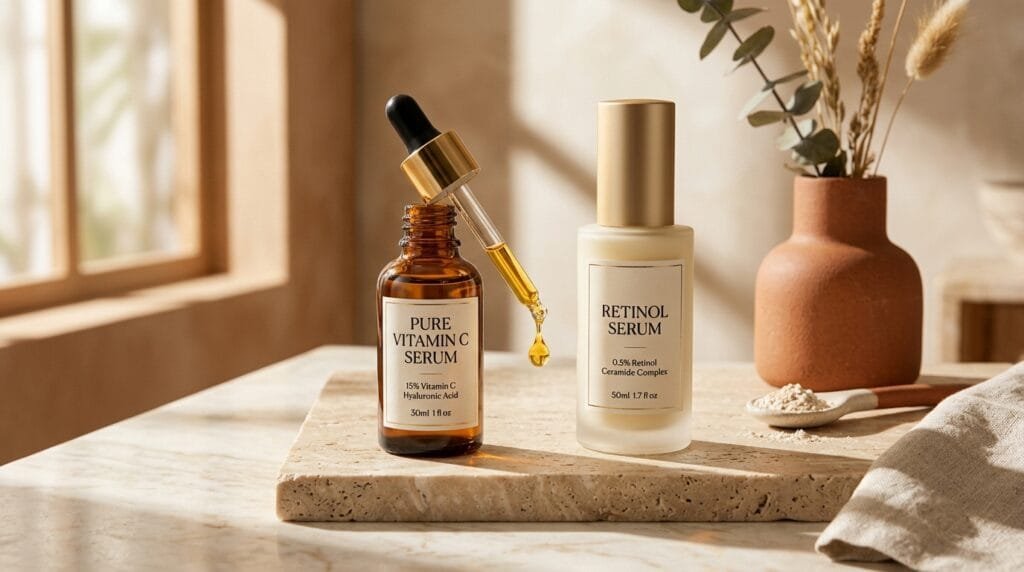
1. What CeraVe retinol actually is
The phrase refers to CeraVe’s retinol products: its retinol serums, creams and eye-area formulas, which combine encapsulated retinol with ceramides and niacinamide. They feel gentler than most retinoids, but retinol is still an active ingredient.
Retinol is a vitamin A derivative. Skin enzymes convert it in two steps, first to retinaldehyde and then to retinoic acid, the form that binds retinoic acid receptors (RAR-alpha and RAR-gamma) in keratinocytes and fibroblasts. That receptor activity speeds epidermal turnover, influences collagen-related gene expression and can reduce the look of fine lines, uneven tone and clogged pores over months of consistent use. Because the conversion is inefficient, retinol is considerably weaker than prescription tretinoin, which is retinoic acid itself. That is why it is sold over the counter and why results are slower.
What distinguishes the CeraVe approach is the supporting formula rather than a novel retinoid. The serum and cream formulas generally pair retinol with three ceramides (listed as ceramide NP, AP and EOP), cholesterol and, in several products, niacinamide. Ceramides and cholesterol are barrier lipids. Including them is a reasonable strategy to offset the dryness and tightness retinoids commonly cause, though it does not eliminate irritation. The encapsulation is designed to release retinol gradually and to protect an unstable molecule from air and light. That is a delivery claim about the formula, and it does not turn the product into a non-retinoid.
Lines and product names change by market and over time, so treat the ingredient list on your specific tube or bottle as the source of truth rather than the name on the front.
2. Strength, pH and what the label can and cannot tell you
CeraVe does not always print a retinol percentage on the front of the pack, and a percentage is not always disclosed at all. Do not assume a number. Instead, read the ingredient (INCI) list: ingredients are ordered by concentration down to roughly 1%, so look at where retinol sits relative to glycerin, niacinamide and the emollients. A retinol listed in the top third suggests a more meaningful dose than one sitting near the preservatives and fragrance, though position alone cannot give you a figure.
For context, over-the-counter retinol products generally fall in a range of about 0.01% to 1%. Many dermatology sources suggest people new to retinoids begin at the low end, around 0.1% to 0.3%, and build up. Where a product does state a percentage, that is the comparison point. Where it does not, assume you are starting with an unknown and introduce it slowly.
pH matters because retinol is both pH-tolerant and chemically fragile. It is generally formulated in the mildly acidic to near-neutral range, roughly pH 5 to 6, which suits the skin surface and avoids the stinging of low-pH acid products. Compare that with common exfoliating acids and vitamin C:
- Glycolic and lactic acid (AHAs): work best at about pH 3 to 4.
- Salicylic acid (BHA): typically pH 3 to 4 to remain effective.
- L-ascorbic acid (vitamin C): needs pH below about 3.5 to penetrate.
- Niacinamide: stable and comfortable around pH 5 to 7.
CeraVe generally does not publish product pH, so do not guess. If it matters to you, a pH strip test on a small amount of product gives a rough reading. The practical point is that stacking a pH 3 acid directly under a pH 5.5 retinol changes the skin’s surface conditions and can raise irritation, regardless of whether the two ingredients are chemically compatible in a bottle.
3. Interactions and layering order
Most retinol problems come from the routine around the product rather than the product itself. These are the combinations that matter most.
- Exfoliating acids (glycolic, lactic, mandelic, salicylic): both retinoids and acids increase turnover and thin the surface barrier. Using them in the same session is the most common cause of burning, flaking and a compromised barrier. Separate them by night: acid on one evening, retinol on another, with rest nights between.
- Benzoyl peroxide: an oxidizer that can degrade tretinoin and may degrade retinol as well. Adapalene is an exception because it is stable with benzoyl peroxide. With a retinol product, use benzoyl peroxide in the morning and retinol at night.
- Vitamin C (L-ascorbic acid): not dangerous with retinol, but the low pH and the added irritation make same-time use hard to tolerate. The standard split is vitamin C in the morning and retinol in the evening.
- Niacinamide: compatible, and often helpful. Niacinamide can support barrier function and may soften the irritation of a retinoid. Many CeraVe retinol formulas already contain it, so avoid adding a high-percentage niacinamide serum on top without reason.
- Other retinoids: adding adapalene, tretinoin or a second retinol product to a CeraVe retinol one is redundant and increases irritation without a clear benefit. If you are prescribed a retinoid, ask your prescriber before adding any over-the-counter one.
- Hyaluronic acid, peptides, ceramides, panthenol: low-risk partners that support hydration and the barrier.
Order, in practice. Retinol is a night-time step because it is photolabile and because it raises sun sensitivity. A sound sequence is: gentle cleanser, then dry or barely damp skin (damp skin increases penetration and irritation), then a pea-sized amount of retinol serum or cream across the face, avoiding the eyelids, corners of the nose and mouth, then a plain moisturizer if your skin needs it. If you are prone to irritation, apply moisturizer first, then retinol, then more moisturizer over the top (a so-called sandwich). In the morning, use a broad-spectrum SPF 30 or higher every day. Without sunscreen, a retinoid routine works against itself.
This is where checking your own stack helps. Skin Scan Genius reads a scanned barcode against the other products in your routine, so it can flag an exfoliating toner or a benzoyl peroxide wash that overlaps with a retinol before you find out through irritation.
4. Starting safely, and who should be cautious
Retinoid adaptation typically takes several weeks. A common schedule is two nights per week for the first two weeks, three nights for the next two, then every other night, moving to nightly only if the skin is comfortable. Mild dryness, tightness or minor flaking during the first four to twelve weeks is common and is usually called the retinization period. Persistent burning, swelling, a rash or severe peeling is not normal adaptation. Stop and reassess.
Skin type changes how this plays out:
- Dry or sensitized skin: choose a cream over a serum, use the sandwich method and begin once a week.
- Oily or acne-prone skin: tends to tolerate retinol well, but avoid layering it with several drying actives at once. An initial increase in breakouts can occur as turnover speeds up, though it should settle.
- Darker skin tones: irritation can lead to post-inflammatory hyperpigmentation, so a slow start and daily sunscreen matter even more.
Some situations call for professional guidance rather than self-management. If you have rosacea, eczema or atopic dermatitis, perioral dermatitis or melasma, see a dermatologist before introducing a retinoid, since the right approach depends on diagnosis and flare status. Oral vitamin A derivatives carry well-established pregnancy risks, and many clinicians advise avoiding topical retinoids too during pregnancy and while trying to conceive, so ask your doctor or midwife about this. The same applies if you are breastfeeding.
Finally, treat results realistically. Evidence for topical retinoids is strongest for acne and for photoaging over months of use, and non-prescription retinol produces more modest changes than prescription retinoids. A CeraVe retinol product can be a reasonable, well-tolerated entry point, as long as you read the actual label, build up slowly, and keep the rest of the routine simple.
Check it against your own routine. Skin Scan Genius reads a product’s full INCI list and flags conflicts with the actives you already use, by skin type and concern.
Frequently asked questions
Is CeraVe retinol strong enough to work?
It can, as it contains real retinol, but the percentage is not always stated, so check the ingredient list and judge by position. Over-the-counter retinol is weaker than prescription tretinoin and typically shows gradual changes over several months of consistent use.
Can I use CeraVe retinol with niacinamide or vitamin C?
Niacinamide is compatible, and many CeraVe retinol formulas already contain it. Vitamin C is better kept for the morning, with retinol at night, to reduce irritation and keep each product at its preferred pH.
How often should I use it when I start?
Many dermatology sources suggest two nights per week for the first couple of weeks, then increasing gradually if your skin is comfortable. Always apply sunscreen the next morning, and slow down if you see stinging, peeling or redness.
Can I use CeraVe retinol if I have rosacea, eczema or melasma, or if I am pregnant?
Speak to a dermatologist or your doctor first. These conditions and pregnancy change which retinoids are appropriate, and a professional can advise based on your diagnosis rather than a general guideline.