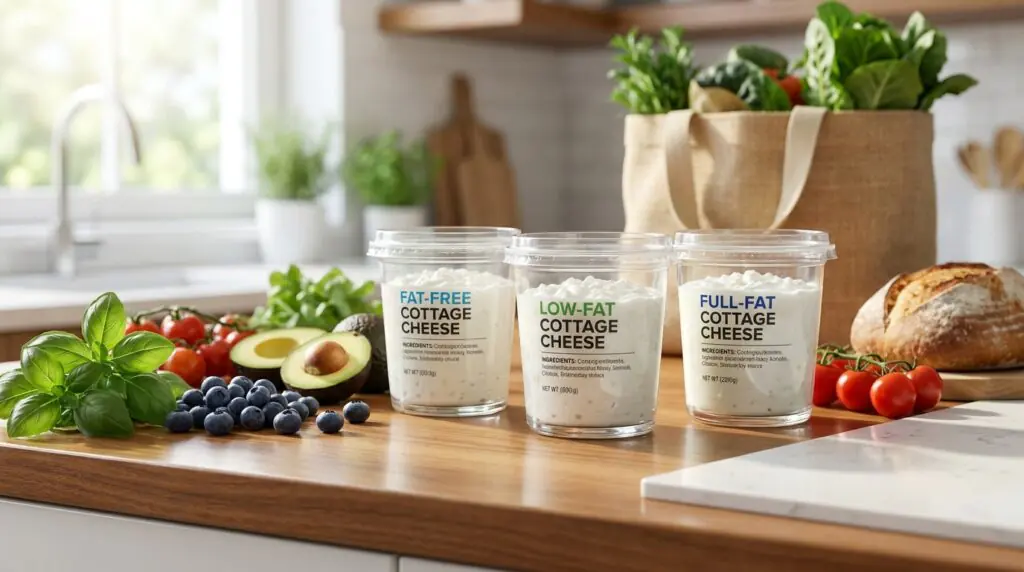
Fat-free cottage cheese contains under 0.5 grams of fat per serving (less than 0.5% milkfat). A standard half-cup serving gives you roughly 80 calories and 13 grams of protein, compared to 110–120 calories and 4.5 grams of fat in standard 4% full-fat tubs.
Fat-Free vs Low-Fat vs Full-Fat Cottage Cheese: What the Numbers Really Mean
When you walk into the dairy aisle, the wall of cottage cheese tubs can feel dizzying. You will see bright green, yellow, and red lids shouting about milkfat percentages: 0% (fat-free), 1% or 2% (low-fat), and 4% (regular or full-fat). Under United States federal rules, these numbers are strictly controlled. To be labeled fat-free cottage cheese, the product must contain less than 0.5 grams of total fat per reference serving, which works out to virtually zero milkfat. Traditional cottage cheese, by contrast, must contain at least 4% milkfat by weight to meet the legal standard of identity set by the government.
Understanding where that fat goes begins with how cottage cheese is made. Cheesemakers start by warming skim milk and adding friendly cultures or food-grade acid to curdle it. This separates the solid curds from the liquid whey. Once the curds are cut, cooked, and washed, they are completely fat-free curds. The difference between the tubs on your grocery shelf comes down to the “dressing” poured over those curds at the end. For full-fat cottage cheese, makers blend the curds with sweet cream. For fat-free styles, they dress the curds with skim milk or concentrated skim milk solids. Because cream brings richness and thickness, fat-free versions lose natural creaminess, often leaving them slightly looser or more watery unless the brand changes the recipe.
From a nutrition perspective, cutting out the cream cuts the calorie count significantly. A typical half-cup (113-gram) serving of 4% full-fat cottage cheese delivers around 110 to 120 calories and about 4.5 to 5 grams of total fat, of which roughly 3 grams are saturated. Fat-free cottage cheese drops those calories down to 80 while wiping out nearly all saturated fat. Many public health bodies, including the World Health Organization Guidelines on Healthy Diets & Saturated Fats, advise keeping saturated fat intake below 10 percent of your daily calories. Choosing non-fat dairy is an easy way for people watching their heart health or managing overall energy intake to hit their protein targets without extra fats.
However, taste and digestion are not just about numbers on a chart. Fat slows down digestion in your stomach, which helps you feel full and satisfied for longer after a meal. When dairy fat is completely removed, some people find they get hungry sooner. Furthermore, to make up for the missing creaminess, many manufacturers add thickeners like carrageenan, guar gum, locust bean gum, or modified corn starch. While these ingredients are widely studied, recent research, such as PubMed Research on Ultra-Processed Foods & Gut Microbiome Disruption, suggests that heavily modified texturizers in ultra-processed foods can sometimes cause mild bloating or digestive upset in sensitive stomachs. Looking past the front cover of the tub shows whether your fat-free choice is just milk and salt or a chemistry project designed to mimic cream.
Deciphering the Label: Real Brands, Thickeners, and Portion Sizes
Standing in front of the dairy case in Aisle 4 shouldn’t feel like taking a pop quiz. You are just trying to grab an easy, protein-rich snack for your family, but the packages make it hard to tell what is actually inside. One tub highlights “14g Protein!” in bold letters, while another says “Simple Ingredients,” and a third claims “No Added Hormones.” When you turn the tubs around to read the fine print, the differences between brands become stark. For example, Daisy Fat Free Cottage Cheese keeps its recipe stripped down to just skim milk, salt, and vitamin A palmitate. Because they do not use artificial gums, their fat-free curd often looks slightly separated or soupy until you stir it with a spoon.
In contrast, store brands or heritage brands like Breakstone’s or Hood often approach fat-free cottage cheese differently. To recreate the thick, clingy mouthfeel of 4% whole-milk cream, these brands frequently add ingredients like guar gum, mono- and diglycerides, carrageenan, and food starch. In Europe and the UK, these texturizers are reviewed under strict oversight by the European Food Safety Authority (EFSA) Additive Safety Regulations, and in the US they are recognized as safe by the FDA. But if your goal is clean, simple eating, you might be surprised to see five texturizing agents on the back of a tub you bought purely for healthy snacking. Meanwhile, modern brands like Good Culture offer a 0% fat version that avoids gums entirely, instead using live and active probiotic cultures to build body and clean flavor.
Another common trap is how portion sizes and sodium interact on the label. In the United States, the standardized serving size on the Nutrition Facts panel is a half-cup (113 grams). Across nearly every brand, cottage cheese carries a surprisingly high amount of salt—typically between 350 and 450 milligrams of sodium per serving. Cheesemakers rely on salt to stop bacterial growth and help the curds firm up. Interestingly, without the natural sweetness of dairy fat to coat your tongue, fat-free cottage cheese often tastes distinctly saltier than 2% or 4% cottage cheese, even when both tubs have the exact same milligram count on the panel. If you live in or buy dairy products from Europe, labels display nutrition per 100 grams rather than by domestic half-cup servings, making it easier to compare true percentage ratios across different styles.
This is also why allergen labeling matters so much on these tubs. Under the FDA Food Allergen Labeling & Consumer Protection Act (FALCPA), milk must always be declared clearly as a major allergen. But beyond milk, shoppers with delicate digestive tracts need to know if hidden corn derivatives or emulsifiers are present. Using Food Scan Genius (scangeni.us) gives you a frictionless, two-second sanity check right at the refrigerated shelf. Instead of squinting at tiny white text wrapped around a cold plastic tub while wrangling kids or rushing through your grocery run, a fast scan reads the manufacturer’s declared ingredients instantly. All product data in Food Scan Genius comes directly from what the food company printed on that physical package—giving you honest transparency based purely on the manufacturer’s official declarations so you can pick the right tub without second-guessing yourself.
| Style / Fat Level | Milkfat Standard (US) | Calories (per 1/2 cup / 113g) | Total Fat / Sat. Fat | Protein | Typical Sodium | Common Added Thickeners |
|---|---|---|---|---|---|---|
| Fat-Free (0%) | < 0.5% milkfat | 80 kcal | 0g / 0g | 13g – 15g | 350mg – 450mg | Guar gum, xanthan gum, carrageenan, modified starch (brand-dependent) |
| Low-Fat (2%) | 1.5% – 2.0% milkfat | 90 – 100 kcal | 2g – 2.5g / 1g – 1.5g | 12g – 14g | 340mg – 420mg | Occasional gums or starches in commercial lines; none in clean-label brands |
| Full-Fat (4% Regular) | ≥ 4.0% milkfat | 110 – 120 kcal | 4.5g – 5g / 2.5g – 3g | 11g – 13g | 350mg – 410mg | Rarely used; natural dairy cream provides texture |
Three Common Cottage Cheese Mistakes Most Shoppers Make
The biggest misstep shoppers make is assuming that “fat-free” automatically means cleaner or more natural. In reality, food science requires trade-offs. When dairy companies pull the sweet cream out of cottage cheese, they remove the ingredient that gives the cheese its velvety body and masks the tart acidity of the cultured curds. To prevent the cheese from turning into watery pebbles swimming in thin milk, many processors toss in modified corn starch, carrageenan, and chemical emulsifiers. If you are trying to cut back on heavily processed additives, reaching for a 2% low-fat or even a standard 4% tub with three simple ingredients (milk, cream, salt) is often much closer to real, whole food than a fat-free tub loaded with binders.
Another frequent misunderstanding involves sodium perception. Many consumers believe that because fat-free foods are marketed as diet-friendly, they must be low in salt as well. But cottage cheese is naturally a high-sodium food across the board. Curds require salt during processing to expel moisture and inhibit spoilage organisms. Because fat naturally coats the taste buds and softens harsh flavors, full-fat cottage cheese tastes mellow, buttery, and mild. Fat-free versions lack this protective lipid blanket, meaning the exact same 400 milligrams of sodium hits your tongue with full, sharp intensity. If you are watching your blood pressure, switching to fat-free won’t solve your sodium intake—you must specifically seek out tubs labeled “No Salt Added” or “Low Sodium.”
Finally, people often assume fat-free cottage cheese has substantially more protein than full-fat cottage cheese. While it is true that fat-free cottage cheese has slightly more protein per ounce (around 14 grams per half-cup versus 12 grams in whole-milk versions), the difference is modest. Because dairy fat is replaced with moisture and skim milk curds, the protein concentration ticks up only by one or two grams. Sacrificing the satiety and fat-soluble vitamin absorption (like natural vitamin A and D) that comes with healthy milk fats just to gain 10 extra calories of protein is rarely worth it if you dislike the chalky or watery texture of fat-free curds. Pick the style whose taste and ingredient list fit your actual daily meals.
Frequently asked questions
Does fat-free cottage cheese have more sugar or carbs than regular cottage cheese?
No, fat-free cottage cheese has roughly the same amount of naturally occurring sugar (lactose) as full-fat varieties, averaging about 3 to 5 grams of carbohydrates per half-cup serving. Unless a brand adds fruit purees or flavorings, neither version contains added cane sugars.
Why is fat-free cottage cheese often more watery or separated?
Fat-free cottage cheese curds are dressed in skim milk rather than rich cream. Without dairy fat to naturally emulsify the mixture, liquid whey separates more easily from the curds, resulting in a looser texture unless thickeners or starches have been added.
Can I substitute fat-free cottage cheese for regular cottage cheese in cooking and baking?
Yes, but with caution. Fat-free cottage cheese releases significantly more water when heated and lacks the fat needed to keep baked dishes tender, which can cause casseroles, lasagnas, or dips to turn runny or dry. Straining it through cheesecloth first helps reduce excess moisture.
Does fat-free cottage cheese have less calcium than whole-milk cottage cheese?
No, fat-free cottage cheese contains essentially the same amount of calcium as regular cottage cheese, delivering roughly 80 to 100 milligrams per half-cup serving. Calcium resides in the milk solids and proteins rather than the milkfat.
Why do some brands add Vitamin A Palmitate to fat-free cottage cheese?
When processors remove fat from whole milk to create skim milk, the natural fat-soluble vitamins (such as vitamin A) are stripped away. Under federal food labeling standards, many dairies fortify non-fat milk products with vitamin A palmitate to restore those lost nutrients.
References
- FDA Food Allergen Labeling & Consumer Protection Act (FALCPA)
- European Food Safety Authority (EFSA) Additive Safety Regulations
- PubMed Research on Ultra-Processed Foods & Gut Microbiome Disruption
- World Health Organization Guidelines on Healthy Diets & Saturated Fats
Related guides
- Best Food Allergy Scanner App – Scan Food Labels Instantly — Food Allergy & Sensitivity Scanner Hub
- The 7 Best Free Food Scanner Apps of 2026 — best free food scanner apps
- Choosing the Best Barcode Scan App for Your Health — guide to choosing a barcode scanner app
- Food Scan Genius: World’s #1 Food Ingredient Scanner App — Food Scan Genius scanner app
Check Any Label Against 5 Million Products — Free
Never second-guess confusing grocery labels again. Download Food Scan Genius to uncover hidden additives, toxic dyes, and allergens for the whole household before you buy.