
1. Navigating the Morning Routine: Why Finding Clean Dairy Free Creamers Is a Daily Challenge
For millions of families managing severe food allergies, autoimmune conditions, and metabolic health goals, the morning cup of coffee is far from a relaxing ritual. Instead, selecting among commercial dairy free creamers can feel like navigating an ingredient minefield. The modern grocery aisle presents a dizzying array of plant bases—almond, oat, coconut, soy, pea, and hemp—each wrapped in front-of-package marketing that boasts “plant-based,” “zero sugar,” or “barista blend.” Yet, behind these appealing labels lies an uncomfortable reality: finding an option that does not trigger an immune reaction, spike blood glucose, or cause gastrointestinal distress remains intensely difficult for complex households.
The clinical stakes are remarkably high. According to the Food Allergy Research & Education (FARE) Clinical Standards, undeclared dairy derivatives and cross-contact risks are among the leading triggers for preventable emergency room visits due to anaphylaxis. What frustrates consumers most is the FDA’s counterintuitive regulatory definition: products labeled “non-dairy” are legally permitted to contain milk derivatives like sodium caseinate, provided the ingredient list clarifies it as a milk protein. For a consumer managing an IgE-mediated dairy allergy or a parent shielding a child with multiple food protein-induced enterocolitis syndrome (FPIES), this semantic loophole transforms a simple creamer choice into a medical risk.
Simultaneously, health-conscious consumers pursuing low-sugar or ketogenic lifestyles face pervasive nutritional deception. In the rush to deliver the velvety, rich mouthfeel of traditional half-and-half, manufacturers frequently replace dairy lipids with hydrogenated or refined seed oils, maltodextrin, and synthetic emulsification matrices. As highlighted in PubMed Research on Ultra-Processed Foods & Gut Microbiome Disruption, regular exposure to industrial emulsifiers and ultra-processed additives can alter microbial composition and weaken the intestinal epithelial barrier, compounding chronic inflammation in susceptible individuals.
Managing these conflicting risks within a multi-person household requires an exhaustive, multi-step label audit. When one family member is managing celiac disease, another has a life-threatening cashew allergy, and an adult is monitoring prediabetes, analyzing the microscopic text of every bottle of creamer in the grocery aisle is emotionally draining and prone to human error. Shoppers need scientific clarity, not marketing spin, to protect their families every single morning.
Scan Any Label for Hidden Additives and Allergens — Free
Never second-guess confusing grocery labels again. Download Food Scan Genius to uncover hidden additives, toxic dyes, and allergens for the whole household before you buy.


2. Deceptive Labeling and Sneaky Ingredients in the Dairy-Free Creamer Aisle
Plant-based creamers represent one of the fastest-growing categories in modern food manufacturing, yet they are also among the most technologically manipulated ultra-processed foods on the shelf. Emulating the physical properties of dairy—specifically fat globule dispersion, heat stability against coffee acidity, and foamability—requires complex chemical formulations. Here are the most prevalent deceptive ingredients, hidden allergens, and regulatory loopholes consumers must watch out for:
- Sodium Caseinate (The Legal “Non-Dairy” Milk Protein): Under standard FDA labeling policies (21 CFR § 101.4(d)), creamers can prominently display the phrase “non-dairy” on the front panel while still using sodium caseinate as an emulsifier. While free from lactose, it contains the intact allergenic dairy protein, making it dangerous for individuals with IgE-mediated milk allergies.
- Stealth High-Glycemic Sweeteners (Maltodextrin & Rice Syrup Solids): Many creamers advertised as “unsweetened” or “keto-friendly” contain hydrolyzed starches, maltodextrin, or rice syrup solids to provide body. Maltodextrin possesses a glycemic index (GI) ranging from 110 to 185—significantly higher than pure sucrose (GI 65)—provoking acute postprandial glucose and insulin spikes without appearing on the panel as standard cane sugar.
- Industrial Emulsifiers and Hydrocolloids: Ingredients like dipotassium phosphate, polysorbate 60, mono- and diglycerides, gellan gum, and carrageenan are deployed to prevent “feathering” (coagulation when cold liquid hits hot, acidic coffee). The European Food Safety Authority (EFSA) Additive Safety Regulations continually re-evaluate these emulsifiers due to emerging evidence regarding intestinal mucosal disruption, yet domestic U.S. formulations continue to use them extensively.
- Refined Seed Oil Bases: Popular “Barista Edition” dairy free creamers achieve their rich micro-foam through high concentrations of refined rapeseed (canola) or sunflower oil. These formulas deliver an unnatural ratio of oxidized omega-6 fatty acids and high energy density without genuine nutritional value, running contrary to the World Health Organization Guidelines on Healthy Diets & Saturated Fats regarding quality lipid intake.
- Uncertified Oat and Grain Cross-Contamination: While oat creamers are naturally dairy- and nut-free, oats are notoriously co-harvested and processed on shared equipment with wheat, barley, and rye. Unless explicitly certified gluten-free, oat-based creamers pose a severe threat of cross-reactive intestinal inflammation for individuals with celiac disease or severe non-celiac gluten sensitivity.
- Unspecified “Natural Flavors” and Carrier Solvents: The catch-all term “natural flavors” frequently masks proprietary blends that utilize corn, soy, or botanical extracts suspended in propylene glycol or alcohol carriers, complicating safety for individuals with Mast Cell Activation Syndrome (MCAS) or rare sensitivities.
3. Precision Food Safety: Why Food Scan Genius Outperforms Legacy Scanners
| Feature / Capability | Food Scan Genius | Fig | Spoonful | Manual Label Reading |
|---|---|---|---|---|
| Pricing & Access Model | 100% Free Core Engine (Zero Paywalls) | Requires $59/yr subscription for full access | Severe monthly scan caps on free tier | Free, but high human cognitive cost |
| Multi-Person Household Profiling | Multi-Household Profiles (Named Fail Attribution) | Single-user focus; cumbersome switching | Single active profile per scan | High error rate balancing multiple diets |
| Database & Parsing Engine | NutriGraph (5M+ Barcodes, Recursive AST Engine) | Proprietary tag matching | Crowdsourced & diet-specific tags | Limited to printed label disclosures |
| Dietary Profiles & Custom Additives | 39 Built-in Profiles + Custom Sensitivity Engine | Extensive lists, but restricted editing | Covers common diets; weak custom rules | Dependent on individual memorization |
| Processing & Quality Transparency | ScanGenius AI + NOVA 1-4 + Nutri-Score | Color-coded traffic lights (Green/Yellow/Red) | Dietitian ratings without processing depth | None; reliant on front-of-pack claims |
While legacy scanning applications rely on surface-level keyword matching or restrict basic scanning behind paywalls like Fig’s $59/year subscription or Spoonful’s tight scanning limits, Food Scan Genius changes consumer food safety by deploying an enterprise-grade technical architecture. At the core is the NutriGraph Database, indexing more than 5,000,000 verified UPC/EAN barcodes. Rather than treating an ingredient label as a flat block of text, NutriGraph uses a recursive Abstract Syntax Tree (AST) parsing engine that systematically deconstructs compound parent ingredients into their atomic sub-components, tracing carrier solvents, hydrolysates, and obscure chemical derivatives back to their allergenic origins.
Instead of assigning a reductive, moralizing score that declares a food generically “good” or “bad,” the platform powers its analysis with ScanGenius AI Insight. This gives shoppers clear scientific context, showing the official NOVA 1-4 ultra-processing classification alongside Nutri-Score metrics. For complex households, the Multi-Household Family Profiles allow you to evaluate an entire family’s restrictions in a single scan. A quick two-second audit displays exact, named fail attribution—such as “Fails for Leo (Tree Nuts)” or “Fails for Sarah (Added Sugars & Canola Oil)”—with full real-time translation across 11 global languages. It delivers the speed and uncompromising accuracy needed to choose truly healthy, allergen-safe dairy free creamers with complete confidence.
4. Related Food Safety & Dietary Guides
- Best Food Allergy Scanner App – Scan Food Labels Instantly — Food Allergy & Sensitivity Scanner Hub
- The 7 Best Free Food Scanner Apps of 2026 — best free food scanner apps
- Choosing the Best Barcode Scan App for Your Health — guide to choosing a barcode scanner app
- Food Scan Genius: World’s #1 Food Ingredient Scanner App — Food Scan Genius scanner app
5. Scientific & Health Authority References
- Food Allergy Research & Education (FARE) Clinical Standards
- European Food Safety Authority (EFSA) Additive Safety Regulations
- PubMed Research on Ultra-Processed Foods & Gut Microbiome Disruption
- World Health Organization Guidelines on Healthy Diets & Saturated Fats
6. How to Scan in 3 Simple Steps
- Download Food Scan Genius completely free on iOS or Android with zero paywalls, subscription gates, or scan limits.
- Set up your household by selecting from 39 clinical dietary profiles (including Dairy-Free, Low-Sugar, and Celiac) and add custom sensitivities for specific additives like gellan gum, seed oils, or carrageenan.
- Scan any creamer barcode in the grocery aisle to receive a sub-second recursive NutriGraph audit showing individual family member safety, processing level (NOVA 1-4), and transparent nutritional insights.
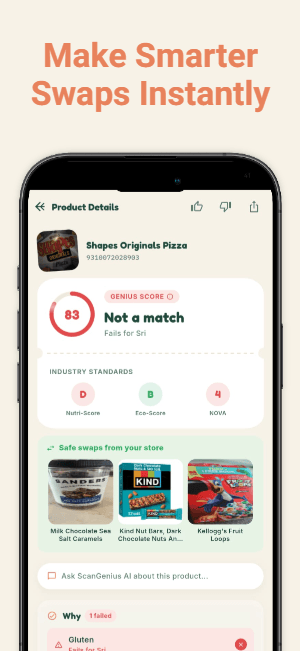
Instant Dairy-Free Audit Trail
7. Frequently Asked Questions (FAQ)
Why do some dairy free creamers trigger allergic reactions in milk-sensitive individuals?
Under FDA regulations (21 CFR § 101.4(d)), products labeled ‘non-dairy’ are legally permitted to contain sodium caseinate, a milk-derived protein fraction, provided it is listed on the ingredients panel. While free of milk sugar (lactose), sodium caseinate contains intact dairy proteins that can cause allergic reactions in individuals with IgE-mediated cow’s milk allergy. Food Scan Genius utilizes recursive AST parsing via the NutriGraph Database to immediately detect these hidden dairy derivatives.
How can I spot hidden sugars and glycemic spikes in ‘unsweetened’ dairy free creamers?
Food manufacturers frequently add bulking agents and texturizers such as maltodextrin, soluble corn fiber, or rice syrup solids to mimic the body of heavy cream. Ingredients like maltodextrin have a glycemic index of 110–185, which is higher than table sugar, causing significant glucose and insulin spikes without showing up as ‘added cane sugar’ on the label. Setting a custom sensitivity or low-sugar profile in Food Scan Genius automatically flags these high-glycemic starches.
Are ‘Barista Blend’ oat creamers safe for individuals with celiac disease or nut allergies?
Not always. While oats are inherently free of gluten and nuts, they are subject to severe agricultural cross-contact during harvesting, milling, and transport alongside wheat and barley. Furthermore, commercial barista oat blends often contain refined canola or sunflower oils and industrial dipotassium phosphate to facilitate foaming. Unless certified gluten-free, oat creamers pose risks for celiac patients. Food Scan Genius scans for verified gluten-free certifications and flags cross-contact risks immediately.
How does Food Scan Genius handle multi-allergy households shopping for dairy free creamers?
Unlike legacy apps that restrict you to one profile or lock family profiles behind a paywall, Food Scan Genius includes Multi-Household Family Profiles 100% free. You can input multiple dietary parameters across different family members (e.g., Mom: Keto/Low-Sugar, Child 1: Peanut/Tree Nut, Child 2: Dairy/Soy). Scanning a single creamer barcode instantly returns individual, named fail attribution—such as ‘Fails for Maya (Peanut Cross-Contact)’—so you can verify the safety of your entire family in two seconds.
Know What’s In Your Food Before You Buy — Scan Free Today
Never second-guess confusing grocery labels again. Download Food Scan Genius to uncover hidden additives, toxic dyes, and allergens for the whole household before you buy.