
1. Navigating Dairy-Free Ice Cream: The Modern Quest for Safe, Creamy Indulgence
Standing in the frozen dessert aisle when you or your child lives with a food allergy can feel less like grocery shopping and more like navigating a clinical minefield. The quest for the perfect dairy free ice cream is fraught with conflicting desires: you want the luscious, scoopable mouthfeel of traditional churned cream, but you are acutely aware that a single errant dairy derivative or cross-contaminated batch could trigger life-threatening anaphylaxis, acute gastrointestinal distress, or severe eczema flares. For years, dairy-free alternatives felt like a punitive compromise—rock-hard pints of frozen soy water, chalky ice crystals that shattered spoons, or bland almond mashes devoid of body. Today, while the supermarket freezer displays dozens of plant-based brands boasting decadent salted caramel and fudge swirl flavors, the modern safety landscape has grown exponentially more complicated.
From a food safety and immunology standpoint, dairy avoidance is rarely a mere lifestyle choice. Cow’s milk allergy remains one of the most prevalent and persistent immunoglobulin E (IgE)-mediated food allergies in children and adults worldwide. While the FDA Food Allergen Labeling & Consumer Protection Act (FALCPA) fundamentally transformed ingredient transparency by requiring manufacturers to explicitly declare major allergens such as milk in plain language, significant regulatory blind spots persist. Shared manufacturing lines, co-packing facilities that churn conventional ice cream alongside vegan lines, and voluntary advisory statements (such as ‘may contain traces of milk’) leave families trapped in an exhausting cycle of risk assessment, uncertainty, and constant manufacturer phone calls.
Furthermore, when commercial manufacturers engineer plant bases to mimic milk solids, they frequently substitute complex fat structures with refined tropical oils like coconut and palm kernel oil. While these lipids provide room-temperature stability and saturated fat structures that replicate heavy cream, they can pose significant metabolic trade-offs. The World Health Organization Guidelines on Healthy Diets & Saturated Fats emphasize keeping saturated fatty acid intake below 10% of total caloric consumption to mitigate cardiovascular strain. Consumers searching for healthy frozen treats often find that a single serving of commercial coconut-based ice cream delivers over 80% of their daily recommended saturated fat limit, coupled with synthetic thickeners that challenge sensitive digestions.
At Food Scan Genius, we recognize the deep emotional burden of this hunt. Food should be a source of shared joy, celebratory memories, and emotional comfort—never anxiety. Whether you are navigating an IgE-mediated milk protein allergy, lactose intolerance, eosinophilic esophagitis (EoE), or multi-allergen dietary barriers across several family members, choosing a safe, velvety, and delicious frozen dessert should not require a postgraduate degree in organic chemistry. With accurate, transparent ingredient intelligence, consumers can reclaim dessert with total peace of mind.
Scan Any Label for Hidden Additives and Allergens — Free
Never second-guess confusing grocery labels again. Download Food Scan Genius to uncover hidden additives, toxic dyes, and allergens for the whole household before you buy.


2. Deceptive Labeling, Precision Fermentation, and Sneaky Ingredients in Dairy-Free Pints
Formulating a stable frozen emulsion without milk requires heavy industrial intervention. Traditional ice cream relies on natural milk proteins (casein micelles and whey) and native milk fat globules to hold microscopic air bubbles, bind free water, and prevent crystallization at sub-zero temperatures. To replicate this physics without cows, food technologists utilize novel food engineering, precision-fermented proteins, and an arsenal of industrial hydrocolloids. Recent clinical research has underscored how such additives can alter human physiology; notably, PubMed Research on Ultra-Processed Foods & Gut Microbiome Disruption highlights how synthetic emulsifiers and thickeners can thin the protective intestinal mucus layer, potentially instigating dysbiosis and systemic inflammation in susceptible individuals. Even when certified under stringent frameworks like the European Food Safety Authority (EFSA) Additive Safety Regulations, ingredients permissible in small quantities can cause severe discomfort when consumed in ultra-processed frozen desserts.
Shoppers navigating the frozen aisle must remain vigilant against several critical formulation pitfalls and labeling loopholes:
- The ‘Non-Dairy’ vs. ‘Dairy-Free’ Legal Trap: The FDA strictly regulates the term ‘dairy-free,’ but historically permits products labeled ‘non-dairy’ to contain dairy derivatives such as sodium caseinate or calcium caseinate. While designed for lactose-intolerant consumers, these products are potentially fatal for someone with a true IgE-mediated milk protein allergy.
- Animal-Free Whey from Precision Fermentation: A revolutionary yet dangerous trap for milk-allergic shoppers: microbially brewed ‘animal-free’ dairy proteins (produced via genetically engineered fungi). While technically vegan and slaughter-free, these proteins are molecularly identical to bovine beta-lactoglobulin. They trigger full-scale allergic reactions in milk-allergic patients despite packaging shouting ‘Lactose-Free’ and ‘Plant-Based.’
- Industrial Emulsifiers & Gums (Polysorbate 80, CMC, & Carrageenan): Extensively used to prevent ice crystals in plant milk, carboxymethylcellulose (CMC), polysorbate 80, and carrageenan have been demonstrated to erode intestinal barrier integrity and trigger mucosal inflammation, particularly for individuals with inflammatory bowel disease (IBD) or IBS.
- Hidden Tree Nut Cross-Contact in Oat and Pea Bases: Brands producing creamy oat- or pea-based pints often process them in facilities alongside cashew and almond purees. Even without direct nut ingredients, shared packaging machinery presents severe cross-contamination risks that standard ingredient lists frequently omit.
- Excess Refined Saturated Fats: Fractionated coconut oil, hydrogenated palm kernel oil, and isolated palm fractions are heavily utilized to achieve melting consistency, vastly increasing atherogenic saturated fat profiles far beyond conventional whole-dairy products.
- Sugar Alcohols & Synthetic Sweeteners: Brands marketing low-calorie or ‘keto’ dairy-free pints routinely lean on erythritol, allulose, and maltitol. These sugar alcohols draw water into the large intestine, driving bloating, osmotic diarrhea, and microbiota disruption.
3. Head-to-Head Comparison: Food Scan Genius vs. Legacy Ingredient Checking
| Dimension | Food Scan Genius | Fig App | Spoonful | Manual Label Reading |
|---|---|---|---|---|
| Core Pricing Model | 100% Free Core Power (Zero Paywalls) | Aggressive $59/yr Paywall for Full Scans | Severely Limited Free Scans / Monthly Sub | Free (High Time & Error Cost) |
| Database Architecture | Enterprise NutriGraph (5M+ UPCs, Deep AST Parsing) | Proprietary DB (~1M items, Manual curation lag) | Smaller Retail DB (~300k items) | None (Dependent on small print printings) |
| Multi-Person Family Audits | Simultaneous Single-Scan (‘Fails for Sri (Gluten)’) | Manual Profile Switching Only | Single User Mode Only | Mental juggling prone to human fatigue |
| Dietary Profile Flexibility | 39 Clinical Profiles + Infinite Custom Sensitivities | Fixed Allergy List (Custom edits locked) | Pre-set Low-FODMAP / Allergen Sets | Unstructured personal mental checks |
| Processing & Health Insight | ScanGenius AI + NOVA 1-4 + Objective Nutri-Score | Binary Red/Green Ingredient Flags | Stoplight Color Highlights (No NOVA) | Zero processing classification context |
The technical architecture underpinning Food Scan Genius sets an entirely new clinical benchmark for consumers who cannot afford scanning errors. While conventional dietary apps rely on basic string-matching algorithms—often missing complex parenthetical sub-ingredients, international naming variants, or nested allergens—our enterprise NutriGraph Database operates via deep sub-ingredient recursive Abstract Syntax Tree (AST) parsing across more than 5,000,000 verified UPC/EAN barcodes globally. When analyzing a complicated plant-based frozen pint, NutriGraph doesn’t simply read ‘vegan flavor blend’; it deconstructs and cross-analyzes the recursive components of that blend (identifying hidden corn starches, seed oil carriers, or precision-fermented dairy proteins) against your household’s exact health tolerances.
Rather than reducing nutritional science to arbitrary, moralizing 1-to-100 scores that shame shoppers, our proprietary ScanGenius AI Insight presents actionable, scientifically rigorous context. It layers the internationally recognized NOVA 1-4 ultra-processing classification with the objective Nutri-Score algorithm, instantly revealing whether a pint is a minimally processed whole-food coconut cream or a heavily engineered ultra-processed matrix of isolated lipids and synthetic stabilizers. When screening for multiple family members simultaneously, Food Scan Genius checks every barcode against your personalized multi-household roster in a single tap—clearly surfacing named attributions like ‘Safe for Liam, Fails for Maya (Tree Nuts)’—and supports 11 global languages in real time so you can shop safely anywhere in the world.
4. Related Food Safety & Dietary Guides
- Best Food Allergy Scanner App – Scan Food Labels Instantly — Food Allergy & Sensitivity Scanner Hub
- The 7 Best Free Food Scanner Apps of 2026 — best free food scanner apps
- Choosing the Best Barcode Scan App for Your Health — guide to choosing a barcode scanner app
- Food Scan Genius: World’s #1 Food Ingredient Scanner App — Food Scan Genius scanner app
5. Scientific & Health Authority References
- FDA Food Allergen Labeling & Consumer Protection Act (FALCPA)
- European Food Safety Authority (EFSA) Additive Safety Regulations
- PubMed Research on Ultra-Processed Foods & Gut Microbiome Disruption
- World Health Organization Guidelines on Healthy Diets & Saturated Fats
6. How to Scan in 3 Simple Steps
- Download the Food Scan Genius mobile app completely free on iOS or Android with zero subscriptions, trial periods, or scanning limits.
- Configure your Household Profiles by choosing from 39 clinical dietary frameworks (such as Dairy-Free, Low-FODMAP, Nut-Free, or Vegan) or add specific Custom Sensitivities like carrageenan, seed oils, or precision-fermented whey.
- Scan any dairy-free ice cream barcode in under two seconds to receive an instant, multi-person safety audit, deep sub-ingredient breakdown, and objective NOVA ultra-processing classification.
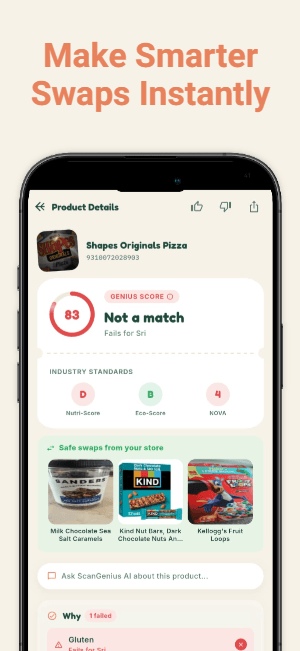
Instant Dairy-Free Audit Trail
7. Frequently Asked Questions (FAQ)
Is ‘non-dairy’ ice cream always completely safe for someone with a severe milk allergy?
No. Under FDA regulations, products labeled ‘non-dairy’ can legally contain milk derivatives such as sodium caseinate or calcium caseinate. While suitable for those avoiding lactose, these derivatives pose severe anaphylactic risks to individuals with IgE-mediated milk allergies. Always verify that products are explicitly certified ‘dairy-free’ and use Food Scan Genius to recursively audit the entire ingredient list for hidden milk fractions.
What is precision-fermented dairy protein, and can I eat it on a dairy-free diet?
Precision-fermented dairy protein (often marketed as ‘animal-free whey’ or ‘flora-based dairy’) is produced by bioengineered microflora rather than cows. While it is technically vegan and contains zero lactose, the resulting protein is molecularly identical to bovine whey. If you suffer from a true cow’s milk protein allergy, precision-fermented dairy will trigger an allergic reaction. Food Scan Genius detects these novel bio-identical allergens immediately.
How does Food Scan Genius identify cross-contamination risks and hidden dairy derivatives?
Food Scan Genius utilizes the enterprise NutriGraph Database with recursive sub-ingredient AST parsing across 5,000,000+ barcodes. It inspects nested ingredient declarations, natural flavor sources, and voluntary facility cross-contact warnings, matching them against 39 clinical dietary standards and your custom sensitivities to ensure no hidden derivative escapes detection.
Which plant milk bases provide the best texture in dairy-free ice cream without gut distress?
Whole coconut cream and cashew bases generally deliver the smoothest, creamiest texture due to their natural fat and lipid distributions, eliminating the need for heavy industrial gums. However, for those with nut allergies or coconut sensitivities, micro-milled whole oat milk or sunflower butter bases offer excellent richness. Food Scan Genius provides NOVA processing classifications to help you select whole-food bases over ultra-processed pints packed with synthetic emulsifiers.
Know What’s In Your Food Before You Buy — Scan Free Today
Never second-guess confusing grocery labels again. Download Food Scan Genius to uncover hidden additives, toxic dyes, and allergens for the whole household before you buy.