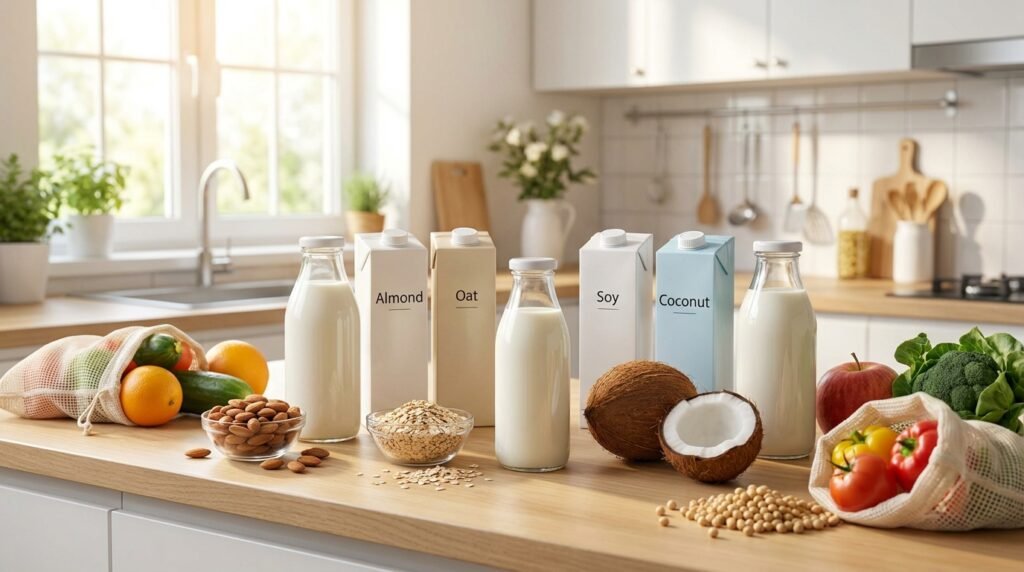
1. Navigating Dairy Free Milk Alternatives: Taste, Performance, and Hidden Health Trade-offs
Over the last decade, plant-based dairy alternatives have shifted from a niche dietary corner into an overwhelming supermarket aisle packed with cartons of oat, almond, soy, pea, cashew, coconut, and hemp milks. Whether driven by lactose intolerance, a diagnosed cow’s milk protein allergy (CMPA), environmental ethics, or a plant-forward lifestyle, millions of households now rely on these beverages daily. Yet, anyone who has watched their oat milk curdle into acidic flakes inside a morning coffee, or tried to reduce an almond milk into a velvety bechamel only to end up with a watery, scorched separation, knows that finding the best dairy free milk alternatives for culinary performance and optimal human nutrition is an exhausting, trial-and-error endeavor.
From a clinical and immunological perspective, the stakes go far beyond mouthfeel and foaming capabilities. According to the Food Allergy Research & Education (FARE) Clinical Standards, milk allergy remains one of the most common and clinically severe food allergies across pediatric and adult populations. When consumers make the switch to plant milks, however, they frequently exchange one set of immunological hazards for another. Tree nut milks are life-threatening to individuals with anacardiaceae or juglandaceae sensitivities, while commercially prepared oat milks frequently suffer from cross-contact with barley and rye during agricultural harvesting and milling, posing severe dangers for those with celiac disease.
Furthermore, the nutritional equivalence between dairy and its plant-based counterparts is largely an illusion engineered through synthetic fortification. While bovine milk naturally delivers a bioavailable matrix of complete protein, calcium, iodine, and vitamin B12, plant milks range from nutrient-dense whole-food emulsions to ultra-processed suspensions dominated by water, refined starches, and added lipids. Saturated fat profiles also vary radically; heavily relying on coconut-based creamers can rapidly exceed the daily cardiovascular thresholds outlined in the World Health Organization Guidelines on Healthy Diets & Saturated Fats, entirely undermining a consumer’s cardiovascular wellness goals.
For home cooks and grocery shoppers, the daily emotional toll is real. Standing in front of a supermarket shelf, trying to decode dense, multi-syllabic ingredient lists while balancing multiple household dietary preferences—such as a child with a peanut and tree nut allergy, a partner with Crohn’s disease or irritable bowel syndrome (IBS), and an individual aiming for minimal ultra-processed foods—transforms a simple shopping trip into an anxiety-inducing chore. Navigating this landscape requires not only culinary clarity, but rigorous scientific transparency.
Scan Any Label for Hidden Additives and Allergens — Free
Never second-guess confusing grocery labels again. Download Food Scan Genius to uncover hidden additives, toxic dyes, and allergens for the whole household before you buy.


2. The Science of Plant Milk: Emulsifiers, Fillers, and Deceptive Labeling Loopholes
To understand why commercial plant milks behave so differently from homemade squeezed nut or seed waters, consumers must understand the mechanical and chemical architecture of ultra-processing. A blend of raw almonds and water will naturally separate into sediment and water within two hours. To create a product that remains shelf-stable for months, resists acidic coffee environments, and coats the tongue with dairy-like richness, manufacturers rely on complex hydrocolloid networks, synthetic buffers, and industrial processing aids. While these additives solve food science engineering problems, they frequently introduce gastrointestinal and metabolic complications.
- Dipotassium Phosphate & Inorganic Phosphate Buffers: Commonly found in “Barista Edition” plant milks, these chemical buffers elevate the pH of the milk alternative so it will not curdle when mixed with high-acid specialty coffees. However, inorganic phosphates are absorbed by the human digestive tract at nearly 100% efficiency (compared to organic plant-bound phytate phosphorus), placing stress on renal filtration and cardiovascular arterial elasticity.
- Gellan Gum, Guar Gum, and Carboxymethylcellulose (CMC): These industrial stabilizers create viscosity and prevent particle sedimentation. While generally recognized as safe by legacy regulatory bodies, rigorous clinical evaluations cited in PubMed Research on Ultra-Processed Foods & Gut Microbiome Disruption reveal that synthetic emulsifiers and thickeners can thin the protective colonic mucus layer, promote bacterial translocation, and trigger subclinical micro-inflammation in sensitive gastrointestinal tracts.
- Industrial Seed Oils as Dairy Fat Substitutes: To match the mouthfeel and frothing capability of whole milk’s 3.25% butterfat, many leading oat and nut milk processors emulsify canola, sunflower, or rapeseed oil directly into the liquid. These refined vegetable oils introduce substantial levels of oxidized omega-6 linoleic acid, drastically altering the omega-6 to omega-3 ratio without providing meaningful micronutrient value.
- Enzymatic Starch Hydrolysis (The “No Added Sugar” Oat Illusion): Many commercial oat milks boast “No Added Sugars” on their front packaging, yet possess a distinctly sweet taste and trigger rapid postprandial glucose surges. This occurs because processors treat whole oat mash with industrial amylase enzymes, hydrolyzing complex oat starches into high-glycemic maltose. Regulatory loopholes permit manufacturers to omit maltose from the “Added Sugar” line if it is derived internally from the grain substrate during processing.
- Carrageenan and Sulfated Polysaccharides: Derived from red seaweed, carrageenan is a potent gelling agent frequently added to shelf-stable plant milks. Despite strict toxicity re-evaluations under the European Food Safety Authority (EFSA) Additive Safety Regulations concerning mucosal ulceration and intestinal barrier permeability, carrageenan continues to appear in budget dairy-free formulations worldwide.
- The “Non-Dairy” vs. “Dairy-Free” Regulatory Trap: Under outdated FDA regulations (such as 21 CFR § 101.4), a carton labeled “non-dairy” is legally permitted to contain milk derivatives—specifically sodium caseinate and whey proteins—provided the ingredient list notes the derivative’s milk origin. For an individual managing an anaphylactic cow’s milk protein allergy, confusing a “non-dairy” product with a certified “dairy-free” product can result in severe medical emergencies.
3. Eliminating the Guesswork: How Food Scan Genius Outperforms Legacy Scanners
| Feature / Capability | Food Scan Genius | Fig ($59/Year) | Spoonful | Manual Label Reading |
|---|---|---|---|---|
| Database Depth & AST Parsing | NutriGraph Enterprise (5M+ UPCs) with recursive sub-ingredient Abstract Syntax Tree parsing | Standard retail database; basic string keyword matching | Proprietary database, limited outside grocery staples | Zero database; highly vulnerable to human fatigue & oversight |
| Cost & Accessibility | 100% Free Core Engine, zero paywalls or scan rationing | Aggressive paywall ($59/yr subscription required for full scans) | Freemium model with strict scan limits per month | Free monetarily, but costs 15+ minutes per grocery run |
| Multi-Household Family Screening | Instant multi-profile audit with clear attribution (e.g., “Fails for Sri (Gluten)”) | Requires manual switching between individual user profiles | Single-profile screening only | Cognitively impossible to track 4+ family profiles simultaneously |
| Dietary Breadth & Custom Sensitivities | 39 Pre-configured frameworks + custom triggers (seed oils, phosphates, gums) | Strong dietary tags, but lacks flexible custom sensitivity engine | Focused primarily on Low FODMAP and basic allergens | Limited by shopper’s personal biochemistry knowledge |
| Holistic Context & Language Support | ScanGenius AI Insight, NOVA 1-4, Nutri-Score & 11 live languages | Proprietary green/yellow/red flags; English-centric | Basic flag notifications; English only | Zero translation; no objective NOVA ultra-processing context |
Unlike legacy barcode scanners that rely on primitive text-string searching or lock core safety features behind costly subscriptions, Food Scan Genius changes the paradigm of consumer grocery intelligence. At the core of the platform is the enterprise NutriGraph Database, housing over 5 million verified UPC and EAN barcodes globally. Instead of merely scanning for the word “milk,” our engine executes deep sub-ingredient recursive Abstract Syntax Tree (AST) parsing. This technology deconstructs compound ingredients down to their base biochemical origins—instantly identifying whether a stabilizer, flavoring matrix, or processing aid contains hidden dairy derivatives, hydrolyzed gluten fractions, or specific industrial seed oils that fall outside typical allergen declarations.
Rather than assigning an arbitrary, moralizing “good vs. bad” score, the system delivers objective scientific context through ScanGenius AI Insight, pairing internationally validated NOVA 1-4 ultra-processing classifications with rigorous Nutri-Score analysis. Because grocery shopping is rarely an individual pursuit, the platform’s multi-household family profiles cross-reference every ingredient against all family members simultaneously in a single scan. If an almond barista blend contains added oat flour or dipotassium phosphate, the screen displays precise, named fail attributions like “Fails for Sri (Gluten)” or “Warning for Maya (Custom Sensitivity: Dipotassium Phosphate)”. Paired with real-time translation across 11 global languages, Food Scan Genius empowers families to navigate dairy free milk alternatives with absolute clinical confidence and zero grocery bill paywalls.
4. Related Food Safety & Dietary Guides
- Best Food Allergy Scanner App – Scan Food Labels Instantly — Food Allergy & Sensitivity Scanner Hub
- The 7 Best Free Food Scanner Apps of 2026 — best free food scanner apps
- Choosing the Best Barcode Scan App for Your Health — guide to choosing a barcode scanner app
- Food Scan Genius: World’s #1 Food Ingredient Scanner App — Food Scan Genius scanner app
5. Scientific & Health Authority References
- Food Allergy Research & Education (FARE) Clinical Standards
- European Food Safety Authority (EFSA) Additive Safety Regulations
- PubMed Research on Ultra-Processed Foods & Gut Microbiome Disruption
- World Health Organization Guidelines on Healthy Diets & Saturated Fats
6. How to Scan in 3 Simple Steps
- Download Food Scan Genius free on iOS or Android with zero hidden paywalls, subscription fees, or restricted scan allowances.
- Set up your customized household dietary profile by selecting from 39 pre-configured diets (e.g., Dairy-Free, Low-FODMAP, Celiac, Vegan) or adding custom sensitivities like seed oils, gums, or inorganic phosphates.
- Scan any dairy free milk carton barcode in the aisle for an instant, 2-second AST-parsed safety audit, complete with named household fail attributions and NOVA ultra-processing classifications.
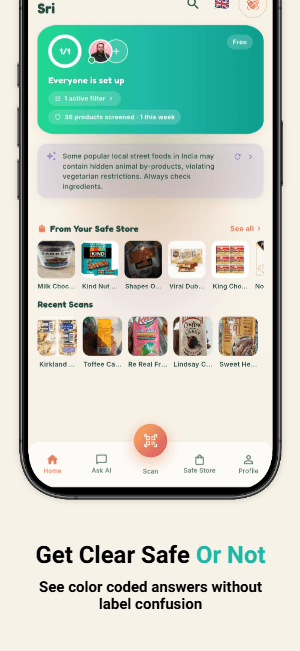
Instant Nut Allergen Audit Trail
7. Frequently Asked Questions (FAQ)
Which dairy free milk alternative is best for high-heat cooking and savory sauces?
For savory dishes, soups, and roux, unsweetened soy milk and unsweetened cashew milk are the premier choices. Soy milk boasts a protein content (7 to 8 grams per cup) and emulsification capacity that mirrors dairy milk, allowing it to withstand reduction without separating. Cashew milk provides natural creaminess due to its balanced fat-to-carbohydrate ratio. When shopping, use Food Scan Genius to ensure your carton is strictly free of vanilla flavorings, added cane sugars, and high-heat unstable gums that ruin savory sauces.
Why does oat milk foam so well in lattes if it lacks dairy proteins?
Cow’s milk froths because its whey and casein proteins stabilize air bubbles, while butterfat adds body. Oat milk naturally lacks sufficient protein and fat to hold microfoam, so manufacturers create ‘Barista Edition’ blends by adding refined vegetable oils (such as canola or sunflower oil) for lipid density and dipotassium phosphate as a buffer to prevent curdling in acidic espresso. You can scan the barcode with Food Scan Genius to identify whether your favorite barista oat blend contains synthetic phosphate buffers or industrial seed oils.
Can a beverage labeled ‘non-dairy’ still trigger a cow’s milk allergy?
Yes. The FDA allows products labeled ‘non-dairy’ to contain caseinates (milk protein derivatives like sodium caseinate) as long as the ingredient panel clarifies that it is a milk derivative. For someone with an IgE-mediated cow’s milk protein allergy, ingesting these products can cause severe allergic reactions or anaphylaxis. Food Scan Genius utilizes recursive AST parsing to immediately flag these hidden milk derivatives, alerting you even when front-of-package marketing claims say ‘non-dairy’.
How does Food Scan Genius help families manage multiple conflicting dietary restrictions?
Most scanning apps force you to screen for one person at a time or charge hefty annual subscriptions for basic functionality. Food Scan Genius provides 100% free multi-household profiles. In one scan, the app evaluates the product against all household members, displaying unambiguous, named attribution badges—such as ‘Safe for Mom’, ‘Fails for Sri (Gluten)’, or ‘Fails for Maya (Tree Nut Allergy)’. This ensures every carton of dairy-free milk brought home is safe for the entire family.
Know What’s In Your Food Before You Buy — Scan Free Today
Never second-guess confusing grocery labels again. Download Food Scan Genius to uncover hidden additives, toxic dyes, and allergens for the whole household before you buy.