
1. Why Shopping with Food Allergies Feels So Hard in 2026
If you manage a food allergy, grocery shopping is not a chore. It is a risk assessment. You stand in the aisle with a squinting, tiny-print ingredient panel in one hand and a cart in the other, and you know that one missed word could ruin a family dinner or send someone to the emergency room. That vigilance is exhausting, and it is completely understandable. Parents of allergic children, adults with newly diagnosed celiac disease, and people with multiple sensitivities all tell us the same thing: the hardest part is that the rules keep shifting under your feet.
Part of the problem is that manufacturers reformulate products constantly. A snack you have trusted for years can change suppliers, add a new flavoring, or move production to a shared line without any change to the front of the package. Even with strong regulation, such as the FDA Food Allergen Labeling & Consumer Protection Act (FALCPA), the burden of careful reading still falls on the shopper. FALCPA requires plain-language disclosure of major allergens, but it does not cover every ingredient that can trigger a reaction, and it does not govern every type of precautionary statement.
Geography adds another layer. If you shop imported products, travel, or live in a multilingual household, you may run into ingredient lists in languages you cannot read, with allergen lists that follow different rules. The European Food Safety Authority (EFSA) Additive Safety Regulations and the EU’s list of 14 declared allergens differ from US requirements, so a product that looks familiar may be labeled very differently.
This is where a well-built food scanner app earns its place in your routine. It does not replace your judgment, your allergist’s advice, or your habit of reading labels. It gives you a fast, consistent first screen, so you can spend your attention on the products that actually deserve a closer look. Think of it as a second set of eyes that never gets tired at the end of a long shopping trip.
Scan Any Label for Hidden Additives and Allergens — Free
Never second-guess confusing grocery labels again. Download Food Scan Genius to uncover hidden additives, toxic dyes, and allergens for the whole household before you buy.


2. Sneaky Ingredients and Labeling Loopholes a Food Scanner App Should Catch
Reading a label is a skill, and even experienced allergy families get tripped up by how information is presented. Understanding where the gaps are makes it easier to see why a scanner built on deep ingredient parsing matters. Here are the most common trouble spots:
- Voluntary ‘may contain’ statements. Precautionary allergen labeling is not standardized in the US. One brand may warn about shared equipment while an equivalent product stays silent. The absence of a warning is not proof of safety, so use scan results alongside manufacturer contact when cross-contact matters to you.
- Allergens beyond the major nine. FALCPA, as updated to include sesame, covers nine major allergens. Reactions to mustard, celery, lupin, or certain seeds and spices may not be flagged on the label in the same way. Custom sensitivity tracking helps fill this gap.
- Nested sub-ingredients. A line such as ‘seasoning’ or ‘chocolate coating’ can itself contain multiple components, each with its own sub-ingredients. Simple keyword matching can miss what sits three levels deep.
- Derived and renamed ingredients. Casein, whey, albumin, and hydrolyzed proteins can appear under technical names. Some ‘non-dairy’ products even contain milk proteins like casein, which surprises many shoppers.
- Highly refined oils and processing aids. US rules treat highly refined oils differently from other ingredients, and processing aids may not appear on the label at all. Individual tolerance varies, so this is a conversation to have with your allergist.
- Additives, dyes, and ultra-processed formulations. Many people also avoid specific colorings, preservatives, or seed oils for non-allergy reasons. Ongoing work such as PubMed Research on Ultra-Processed Foods & Gut Microbiome Disruption shows why many shoppers want more context on how heavily processed a product is, not just whether it contains an allergen.
A capable food scanner app should resolve these layers automatically. Food Scan Genius draws on the NutriGraph Database, which holds more than 5,000,000 verified UPC and EAN barcodes and uses recursive sub-ingredient parsing to look inside compound ingredients rather than stopping at the first line of text. For broader nutrition context, the World Health Organization Guidelines on Healthy Diets & Saturated Fats remain a useful reference for the bigger dietary picture beyond allergens.
3. Food Scan Genius vs. Other Ways to Check Labels
| Feature | Food Scan Genius | Fig | Spoonful | Manual Label Reading |
|---|---|---|---|---|
| Cost | 100% free core features, no paywalls | Paid subscription (about $59/yr) | Limited scans on free tier | Free, but time-intensive |
| Ingredient depth | 5M+ verified barcodes with recursive sub-ingredient parsing | Varies by plan | Varies by plan | Depends on the reader’s expertise and energy |
| Dietary profiles | 39 profiles plus custom sensitivities | Check current in-app options | Check current in-app options | Memorized lists and notes |
| Family screening | Multi-household profiles, one scan, named fail attribution | Check current in-app options | Check current in-app options | Re-check the label for each person |
| Languages | 11 languages with real-time in-app translation | Check current in-app options | Check current in-app options | Requires reading or translating by hand |
Competitor pricing and features reflect publicly available information at the time of writing and may change. Please verify current plans directly.
The real advantage of a modern food scanner app is not speed alone. It is depth. Most label problems hide below the surface, in compound ingredients and renamed derivatives. Food Scan Genius uses recursive abstract syntax tree (AST) parsing to break ingredient statements into their nested components, then matches each one against your personal profile. That means a ‘spice blend’ or ‘coating’ is examined for what is inside it. For households with several dietary needs, multi-household family profiles screen everyone at once and tell you exactly who is affected, with clear messages such as ‘Fails for Sri (Gluten).’ No more mentally cross-checking five different lists in the cereal aisle.
Once the safety screen is done, ScanGenius AI Insight adds nuanced context. It explains why a product was flagged, classifies it on the NOVA 1-4 scale of food processing, and displays its Nutri-Score, without collapsing everything into a single moralizing number that makes food feel ‘good’ or ‘bad.’ Because a product can be allergen-safe and still highly processed, or the reverse, you get information rather than judgment. You decide what fits your family’s medical needs and values. A scan is a screening tool, not a guarantee, so always confirm with the physical label and your care team.
4. Related Food Safety & Dietary Guides
- Best Food Allergy Scanner App – Scan Food Labels Instantly — Food Allergy & Sensitivity Scanner Hub
- Choosing the Best Barcode Scan App for Your Health — guide to choosing a barcode scanner app
- Food Scan Genius: World’s #1 Food Ingredient Scanner App — Food Scan Genius scanner app
- FSG Labels Defined: Nutri-Score, NOVA & Additive Safety Guide — Food Label Definitions & Nutri-Score Guide
5. Scientific & Health Authority References
- FDA Food Allergen Labeling & Consumer Protection Act (FALCPA)
- European Food Safety Authority (EFSA) Additive Safety Regulations
- PubMed Research on Ultra-Processed Foods & Gut Microbiome Disruption
- World Health Organization Guidelines on Healthy Diets & Saturated Fats
6. How to Scan in 3 Simple Steps
- Download Food Scan Genius free on iOS or Android. All core features are included with no paywall and no scan limits to worry about.
- Build your allergy profile. Choose from 39 dietary profiles (such as peanut, tree nut, dairy, egg, gluten, or sesame), then use ‘Add Your Own Custom Sensitivity’ for anything not on the list, such as a specific dye, additive, or seed oil. Add family members under a household profile so each person’s needs are tracked by name.
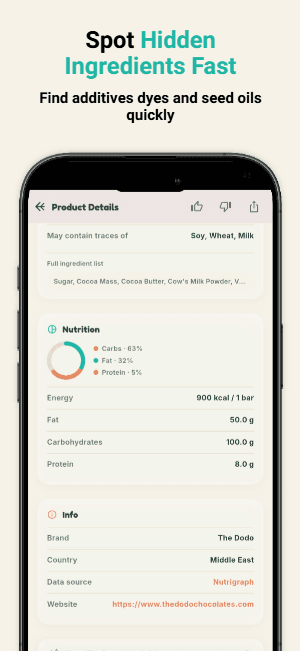
- Scan the barcode in about 2 seconds. You will see an instant pass or fail with a clear audit trail showing which ingredient, including any nested sub-ingredient, triggered the flag and for whom.
- Read the ScanGenius AI Insight for context, check the NOVA group and Nutri-Score, and then confirm against the physical label. If cross-contact is a concern, contact the manufacturer before buying.
Personalized Match & AI Insight
7. Frequently Asked Questions (FAQ)
Can a food scanner app replace reading the label for severe allergies?
No. A food scanner app like Food Scan Genius is a fast first screen, not a substitute for reading the physical package, following your allergist’s guidance, or contacting manufacturers about cross-contact. Its value is in catching nested or renamed ingredients and reducing fatigue, so you can focus your attention where it matters most. Always follow your medical action plan.
How does Food Scan Genius handle allergens that are not among the major nine?
With 39 supported dietary profiles and the ‘Add Your Own Custom Sensitivity’ feature, you can track ingredients beyond the major allergens, including mustard, celery, specific dyes, additives, or seed oils. Because the NutriGraph Database parses sub-ingredients recursively, these custom items are matched even when they sit inside a compound ingredient.
Is Food Scan Genius really free, and how does it compare to subscription apps?
Yes. Food Scan Genius offers 100% free core power with zero paywalls. By comparison, Fig is a paid subscription at roughly $59 per year, and Spoonful limits the number of scans on its free tier. Pricing can change, so check each provider’s current plans, but you will not hit a paywall when scanning with Food Scan Genius.
Can I screen groceries for my whole family, including relatives who speak other languages?
Yes. Multi-household family profiles let you screen every member in a single scan, and results name who is affected, for example ‘Fails for Sri (Gluten).’ The app also supports 11 global languages with real-time in-app translation, which helps with imported products and multilingual households. Using this food scanner app, caregivers and relatives can read the same results in the language they are most comfortable with.
Know What’s In Your Food Before You Buy — Scan Free Today
Never second-guess confusing grocery labels again. Download Food Scan Genius to uncover hidden additives, toxic dyes, and allergens for the whole household before you buy.