
1. Why Finding Safe Gluten Free Candy Is Still Harder Than It Should Be in 2026
If you have ever stood in a candy aisle with a phone in one hand and a bag of something colorful in the other, you know the particular exhaustion of it. Candy looks simple. It is sugar, color and flavor, so it should be easy to vet. But anyone managing celiac disease, non-celiac gluten sensitivity, or a wheat allergy knows that confection is one of the most unpredictable categories in the supermarket. A chocolate bar that was safe last Halloween may have a new wafer, a new facility, or a new supplier this year. That uncertainty is exhausting, and it is not your fault.
The stakes are real. For people with celiac disease, even small repeated exposures can trigger intestinal damage, whether or not obvious symptoms follow. The Celiac Disease Foundation Threshold Requirements and related guidance explain that in the United States, a product labeled gluten-free must contain less than 20 parts per million of gluten. That is a meaningful safety standard, but it only applies when a manufacturer chooses to make the claim. Plenty of candies have no gluten ingredients on paper and carry no claim at all, which leaves you to judge the risk yourself.
Seasonal and variety packaging adds another layer. Fun-size bags, holiday shapes, and limited-edition flavors are often made on different lines from the flagship product. Parents of kids with celiac disease feel this most at birthday parties, school events, and holidays, when the goal is simply to let a child enjoy a treat without a lecture about what they cannot have. Wanting that for your family is completely reasonable.
The good news is that a dependable gluten free candy routine is achievable. It takes a clear sense of where gluten hides in confectionery, a short list of trusted product styles, and a fast way to check every barcode against your own needs. The sections below cover all three.
Scan Any Label for Hidden Additives and Allergens — Free
Never second-guess confusing grocery labels again. Download Food Scan Genius to uncover hidden additives, toxic dyes, and allergens for the whole household before you buy.


2. Where Gluten Hides in Candy: Sneaky Ingredients and Labeling Loopholes
Candy makers use a surprising number of ingredients that can carry gluten, and the label does not always flag them in plain language. In the U.S., wheat is a major allergen that must be declared, but barley, rye, and some derived ingredients are not covered the same way. Ingredient naming also differs between regions, which matters if you buy imported sweets. Regulators such as those summarized in the European Food Safety Authority (EFSA) Additive Safety Regulations publish detailed additive rules, but those rules focus on additive safety, not on whether a carrier or processing aid might contain gluten. These are the usual culprits:
- Wheat flour and wheat starch in licorice and chewy candy: Traditional licorice twists are typically made with wheat flour as a structural ingredient, so most are off the table for gluten-free diets.
- Barley malt, malt extract, and malted milk: Malt flavoring gives crunch bars, malted milk balls, and some chocolate coatings their taste. Barley is a gluten grain, and malt may appear well down an ingredient list.
- Crisped rice, cookie pieces, and wafers: Chocolate bars with a crisp center often use a wafer or a rice crisp containing barley malt. The wrapper looks the same as a plain chocolate bar.
- Glucose syrup and dextrin from unclear sources: In the U.S., wheat-derived glucose syrup is highly refined and usually tests very low in gluten, but dextrin or maltodextrin without a stated source can still raise questions for cautious shoppers.
- Dusting agents and anti-sticking powders: Gummies and jelly candies are often dusted or oiled to prevent sticking, and the powder is sometimes wheat or oat based. Oats are a common cross-contact risk as well.
- Shared-line cross-contact: A product with a clean ingredient list can still be run on equipment shared with cookies or pretzel-coated items. Phrases like “may contain wheat” are voluntary, which is one of the biggest loopholes in the category.
With that in mind, here is how to think about picks. Hard candies and lollipops from brands that publish a gluten-free statement, such as Dum Dums and Smarties, are often a reliable starting point. Allergy-friendly brands like YumEarth and SurfSweets build their lines around allergen controls. Classic chocolate-and-caramel treats and fruit chews from big manufacturers are frequently made without gluten ingredients, but formulas change, so always confirm the current package. For shoppers who also care about what else is in their sweets, PubMed Research on Ultra-Processed Foods & Gut Microbiome Disruption is a helpful read on why ingredient quality matters alongside gluten status. Candy is a treat, not a health food, and context matters more than guilt.
3. Food Scan Genius vs. Other Ways to Check Candy for Gluten
| Dimension | Food Scan Genius | Fig | Spoonful | Manual Label Reading |
|---|---|---|---|---|
| Cost | 100% free core features, no paywalls | $59/yr for full access | Limited scans | Free, but time-consuming |
| Database & ingredient depth | NutriGraph: 5,000,000+ verified UPC/EAN barcodes with recursive sub-ingredient parsing | Ingredient-level screening | Ingredient-level screening | Only what you can read and recognize |
| Dietary profiles | 39 profiles plus custom sensitivities (dyes, additives, seed oils) | Preset diet and allergen list | Preset diet and allergen list | Whatever you remember |
| Family screening | Multi-household profiles; one scan with named results like “Fails for Sri (Gluten)” | Individual profile checks | Individual profile checks | Repeat the process for each person |
| Context & languages | ScanGenius AI Insight, NOVA 1-4, Nutri-Score, 11 languages with real-time translation | Varies by plan | Varies by plan | Depends on your own language skills |
The real advantage in the candy aisle is depth. Many tools stop at the first line of an ingredient list, but candy ingredients are often nested: a “natural flavor,” a coating, or a glaze can itself be made of several components. Food Scan Genius uses recursive parsing across the NutriGraph database to break those layers apart and check each against your profile. You can also add your own custom sensitivity, such as a specific dye or additive you want to avoid, so your list is not limited to what a preset menu allows. And when you are traveling or buying imported sweets, 11 supported languages with real-time translation mean a foreign-language wrapper is no longer a barrier.
Results also come with nuance. ScanGenius AI Insight explains why a product was flagged and what is uncertain, such as a possible cross-contact statement, rather than just giving a pass or fail. It pairs that with a NOVA 1-4 processing classification and a Nutri-Score so you can see the broader picture, without a simplistic moral score telling you a lollipop is “bad.” For context on balancing treats within an overall pattern, the World Health Organization Guidelines on Healthy Diets & Saturated Fats are a sensible, non-judgmental reference. Food Scan Genius screens ingredients and labels, so for celiac disease always give weight to a certified gluten-free claim and the manufacturer’s own cross-contact information.
4. Related Food Safety & Dietary Guides
- Best Food Allergy Scanner App – Scan Food Labels Instantly — Food Allergy & Sensitivity Scanner Hub
- The 7 Best Free Food Scanner Apps of 2026 — best free food scanner apps
- Choosing the Best Barcode Scan App for Your Health — guide to choosing a barcode scanner app
- Food Scan Genius: World’s #1 Food Ingredient Scanner App — Food Scan Genius scanner app
5. Scientific & Health Authority References
- Celiac Disease Foundation Threshold Requirements
- European Food Safety Authority (EFSA) Additive Safety Regulations
- PubMed Research on Ultra-Processed Foods & Gut Microbiome Disruption
- World Health Organization Guidelines on Healthy Diets & Saturated Fats
6. How to Scan in 3 Simple Steps
- Download Food Scan Genius free on iOS or Android. There is no paywall on core scanning, and you can choose any of 11 languages during setup.
- Set up your profile. Select the Gluten-Free or Celiac profile from 39 dietary options, add family members to your household so each person is screened at once, and add any custom sensitivities, such as artificial dyes or specific additives.
- Scan the candy barcode in about 2 seconds. You will see an instant audit trail with named results (for example, “Fails for Sri (Gluten)”), plus ScanGenius AI Insight, NOVA classification, and Nutri-Score so you can decide with confidence.
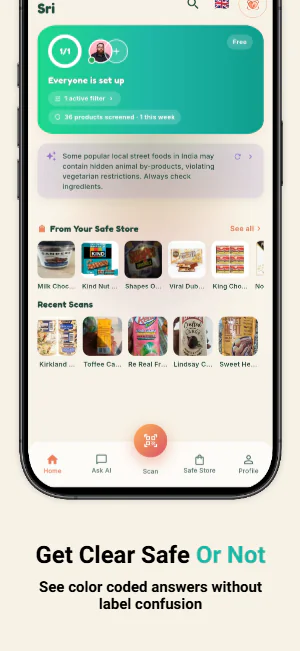
Instant Gluten-Free Audit Trail
7. Frequently Asked Questions (FAQ)
Is all candy without wheat in the ingredients safe for celiac disease?
Not necessarily. A candy can have no gluten ingredients and still be made on shared equipment, and cross-contact statements are often voluntary. In the U.S., foods labeled gluten-free must contain under 20 ppm of gluten. Food Scan Genius flags gluten-containing ingredients and sub-ingredients in your gluten free candy search, and AI Insight highlights cross-contact language, but a certified or clearly labeled gluten-free product remains the safest choice for celiac disease.
Which types of candy are most likely to contain gluten?
Licorice (often made with wheat flour), malted milk candies, crunch or wafer-filled chocolate bars, cookie-based confections, and some dusted gummies are the most common offenders. Hard candies, lollipops, and many fruit chews are more often free of gluten ingredients. Scanning with Food Scan Genius shows you the specific reason a candy fails, so you learn which formats to avoid.
Do I have to pay to scan candy with Food Scan Genius?
No. Core scanning is 100% free with no paywalls, including the NutriGraph database of 5,000,000+ verified barcodes, 39 dietary profiles, custom sensitivities, and family profiles. That contrasts with Fig’s $59 per year plan and Spoonful’s limited scans, which matters if you check a lot of seasonal and variety-pack candy.
Can I screen gluten free candy for my whole family at once?
Yes. With Multi-Household Family Profiles, one scan checks the candy against everyone in your household and names who it fails for, such as “Fails for Sri (Gluten).” That helps when one child needs gluten-free candy, another avoids a dye, and an adult is watching additives. It also makes trick-or-treat sorting and party shopping much faster.
Know What’s In Your Food Before You Buy — Scan Free Today
Never second-guess confusing grocery labels again. Download Food Scan Genius to uncover hidden additives, toxic dyes, and allergens for the whole household before you buy.