1. Navigating the Gluten-Free Cereal Aisle: The Battle for Safety, Taste, and Nutrition
Standing in the breakfast aisle on a busy weekday morning shouldn’t feel like navigating a high-stakes clinical minefield. Yet for millions of parents managing a child’s recent celiac diagnosis, or adults juggling non-celiac gluten sensitivity (NCGS) alongside autoimmune fatigue, selecting a reliable gluten free cereal is rarely as simple as grabbing a brightly illustrated box. Colorful mascots, bold banners proclaiming ‘Made with Whole Grains,’ and vague front-of-package declarations like ‘Wheat-Free’ create an illusion of health and safety that quickly dissolves under clinical scrutiny. The emotional toll of grocery shopping under these conditions is profound: the nagging fear of unintentional cross-contact, the guilt of serving ultra-processed empty calories just to find something your child will eat, and the frustration of deciphering confusing micro-print ingredient lists under fluorescent supermarket lighting.
The clinical reality of gluten ingestion is unforgiving. Under the Celiac Disease Foundation Threshold Requirements, foods carrying a gluten-free label must contain fewer than 20 parts per million (ppm) of gluten—a microscopic threshold established because even trace ingestion triggers mucosal blunting, villous atrophy in the small intestine, and systemic inflammation. However, agricultural grain cross-contact remains a constant threat. Grains like corn, rice, and particularly commercial oats are frequently harvested, transported in grain cars, and milled using the exact same machinery previously coated in dust from wheat, rye, and barley. When a cereal manufacturer does not commit to certified purity protocols, a seemingly harmless bowl of toasted oat rings can easily exceed safe biological thresholds, triggering painful gastrointestinal flares, behavioral shifts in children, and long-term intestinal permeability.
Equally concerning is the nutritional compromise that often defines the commercial gluten-free industry. When industrial manufacturers strip traditional wheat flour from breakfast cereals, they invariably lose the structural matrix that gluten provides. To engineer that familiar crunch, airy puff, and shelf-stable texture, food scientists frequently substitute refined starches—such as white rice flour, tapioca starch, and degermed yellow cornmeal—which lack natural dietary fiber, B vitamins, and trace minerals. To mask the resulting cardboard-like mouthfeel, processors load these products with refined cane syrups, fruit juice concentrates, and hydrogenated fats. This composition runs directly counter to the World Health Organization Guidelines on Healthy Diets & Saturated Fats, which emphasize whole, unprocessed grain matrices and the strict limitation of free sugars to support cardiometabolic resilience and pediatric development.
For households managing multiple dietary parameters simultaneously—where one sibling requires a strict celiac-safe diet, a parent monitors systemic inflammation by eliminating inflammatory seed oils, and a toddler experiences behavioral flares from artificial food dyes—the challenge multiplies exponentially. Traditional grocery shopping turns into an exhausting mental tax, forcing consumers to memorize dozens of alternate biochemical names for hidden wheat derivatives while sacrificing breakfast variety. Families deserve a definitive, clinically sound guide to finding cereals that achieve the trifecta of pediatric compliance: uncompromising immune safety, genuine micronutrient-dense fuel, and the delicious taste that makes morning breakfast rituals enjoyable again.
Scan Any Label for Hidden Additives and Allergens — Free
Never second-guess confusing grocery labels again. Download Food Scan Genius to uncover hidden additives, toxic dyes, and allergens for the whole household before you buy.


2. Deceptive Labeling and Hidden Gluten: What’s Really Inside Your Breakfast Bowl?
The modern cereal aisle is rife with regulatory loopholes and semantic gymnastics that leave even veteran gluten-free consumers vulnerable. A common misconception among shoppers is equating the label claim ‘Wheat-Free’ with ‘Gluten-Free.’ Under United States FDA regulations, a product may be technically devoid of wheat species while still packing significant levels of gluten derived from barley (hordein) or rye (secalin). Because the Food Allergen Labeling and Consumer Protection Act (FALPRA) mandates top-9 allergen disclosure exclusively for wheat, manufacturers are under zero legal obligation to highlight barley-derived flavorings or rye contaminants in their bolded allergen ‘Contains’ warnings.
Furthermore, evaluating a cereal requires looking beyond allergen safety to examine structural food processing. Emerging medical literature highlights the dangers of replacing whole grains with hyper-industrialized binders. A landmark study published in PubMed Research on Ultra-Processed Foods & Gut Microbiome Disruption demonstrates that heavily processed grain formulations—characterized by industrial extrusion, added refined starches, and artificial texturizers—can alter the mucosal lining of the gastrointestinal tract, degrade the protective mucus layer, and promote low-grade systemic inflammation. These physiological mechanisms are especially hazardous for individuals whose gut microflora is already compromised by celiac disease or inflammatory bowel disorders.
Additionally, European health agencies enforce far stricter scrutiny on additive toxicity than domestic standards. Consumers reviewing imported or internationally formulated cereals should note that under the European Food Safety Authority (EFSA) Additive Safety Regulations, food additives, synthetic surface coatings, and colorants are continually reassessed for cellular toxicity and neurobehavioral impacts in children—safeguards that standard American supermarket shelves often bypass. When scrutinizing cereal packaging, you must look out for these deceptive culinary culprits:
- Malted Barley Extract & Malt Flavoring: Found extensively in mainstream corn flakes and crisp rice cereals. This ingredient is extracted directly from sprouted barley and contains high concentrations of intact hordein proteins, rendering conventional household cereal staples completely unsafe for celiacs.
- Uncertified Commercial Oats: While oats are biologically gluten-free (containing the storage protein avenin), conventional oats are notoriously cross-contaminated at the agricultural level by neighboring wheat fields, combine harvesters, and shared grain silos. Only certified purity-protocol gluten-free oats guarantee consumer safety.
- Modified Food Starch (Unspecified Botanical Source): In domestically produced cereals, modified food starch usually originates from dent corn, waxy maize, or potato; however, imported cereals or unbranded generic formulations may utilize wheat starch without upfront disclaimers if the total formula sits under legal limits or originates from international supply chains.
- Caramel Color and Complex ‘Natural Flavors’: Commercial flavor houses often dissolve natural flavoring compounds, botanical extracts, and essential oils into grain alcohol or barley malt bases. Unless the manufacturer explicitly certifies the end product as gluten-free, these covert carriers represent a persistent source of micro-dosing contamination.
- Washed Wheat Starch (Codex Alimentarius Wheat Starch): Some processed cereals incorporate technologically de-glutenized wheat starch processed down to under 20 ppm. While technically permitted under certain celiac standards, individuals with true IgE-mediated wheat allergies or hyper-sensitive celiac profiles frequently experience severe immune responses to residual peptides.
- Synthetic Texturizers and Gums (Carboxymethylcellulose, Polysorbate 80): Frequently deployed in gluten-free baking to mimic the tensile elasticity and cellular aeration of gluten doughs, these synthetic emulsifiers can trigger tight-junction breakdown and epithelial distress in sensitive digestive tracts.
3. How NutriGraph Technology Unmasks Gluten-Free Cereals in Milliseconds
| Feature & Capability | Food Scan Genius | Fig App | Spoonful | Manual Label Auditing |
|---|---|---|---|---|
| Core Engine & Pricing Model | 100% Free Core Engine (Zero Paywalls) | Aggressive Paywall ($59/year Subscription) | Strict Scan Caps (Limited Free Daily Scans) | Free (High Cognitive Load & Time Cost) |
| Database Breadth & Sub-Parsing | NutriGraph 5M+ UPCs (Recursive AST Parsing) | Proprietary Grocery List (Slower Updates) | Curated ~500k Database (Frequent Misses) | Human Eye (Vulnerable to 4pt Font Fatigue) |
| Multi-Household Family Screening | Simultaneous 1-Scan Named Attribution (‘Fails for Leo: Gluten’) | Single User Focus (Manual Profile Toggling) | Single Profile per scan session | Mental juggling of multiple family allergies |
| Holistic Nutrition Assessment | ScanGenius AI + NOVA 1-4 + Nutri-Score (Objective) | Basic Ingredient Red/Green Flags | Diet-Specific Tagging (No Processing Depth) | Subjective guesswork on processing level |
| Global Language Translation | 11 Global Languages (Real-Time In-App Translation) | English Only | English Only | Requires third-party translator apps |
While legacy barcode utilities rely on rudimentary keyword matching that routinely overlooks nested derivatives, Food Scan Genius is built directly upon the enterprise-grade NutriGraph Database, spanning over 5,000,000 verified global UPC/EAN barcodes. The underlying architecture utilizes recursive Abstract Syntax Tree (AST) ingredient parsing. Rather than merely scanning for the standalone word ‘wheat,’ our algorithm breaks down nested parenthetical ingredient disclosures—such as ‘Crisp Rice (Rice, Sugar, Salt, Barley Malt Flavoring)’—dissecting every sub-ingredient layer to catch trace cross-reactive antigens before that box ever enters your shopping cart. Best of all, unlike platforms like Fig that gate essential safety features behind a restrictive $59/year paywall, or Spoonful with its frustrating scan quotas, Food Scan Genius provides its core safety scanning power 100% free.
Beyond allergen detection, Food Scan Genius introduces ScanGenius AI Insight, moving the consumer conversation away from moralizing, simplistic ‘good versus bad’ health scores. Our engine cross-references clinical data to deliver objective contextual insights, integrating the globally recognized NOVA 1-4 classification for ultra-processed foods alongside empirical Nutri-Score ratings. With support for 39 dietary profiles and the ability to define bespoke custom sensitivities—such as expeller-pressed seed oils, Red 40, or specific emulsifiers—a single scan instantly flags compatibility for your entire family. If a breakfast cereal passes nutritional muster for mom’s clean-eating goals but contains barley-derived caramel color, your scan delivers clear, immediate attribution: ‘Fails for Leo (Celiac / Gluten).’ Complete with real-time translation across 11 global languages, Food Scan Genius gives you total grocery clarity wherever you shop.
4. Related Food Safety & Dietary Guides
- Best Food Allergy Scanner App – Scan Food Labels Instantly — Food Allergy & Sensitivity Scanner Hub
- The 7 Best Free Food Scanner Apps of 2026 — best free food scanner apps
- Choosing the Best Barcode Scan App for Your Health — guide to choosing a barcode scanner app
- Food Scan Genius: World’s #1 Food Ingredient Scanner App — Food Scan Genius scanner app
5. Scientific & Health Authority References
- Celiac Disease Foundation Threshold Requirements
- European Food Safety Authority (EFSA) Additive Safety Regulations
- PubMed Research on Ultra-Processed Foods & Gut Microbiome Disruption
- World Health Organization Guidelines on Healthy Diets & Saturated Fats
6. How to Scan in 3 Simple Steps
- Download the Food Scan Genius app completely free on iOS or Android—with zero paywalls, zero scan limits, and immediate access to full scanning functionality.
- Customize your household profile by choosing from 39 clinical and lifestyle dietary settings (including Celiac Disease, Non-Celiac Gluten Sensitivity, Artificial Dye Free, and Low-Sugar), or set custom sensitivities for unique personal triggers.
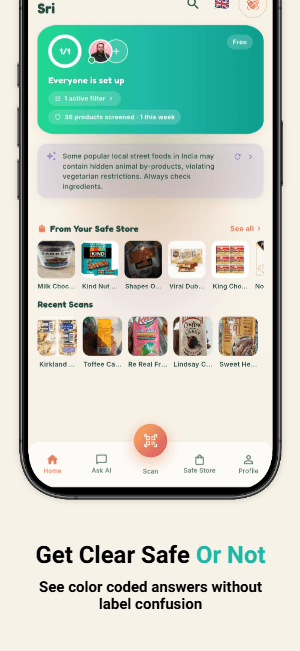
- Scan any cereal barcode in under two seconds to receive an immediate AST-parsed allergen breakdown, verified NOVA 1-4 processing level, and personalized multi-member family safety verdicts.
Instant Gluten-Free Audit Trail
7. Frequently Asked Questions (FAQ)
Are all oat-based cereals safe for someone with celiac disease?
No. While pure oats are naturally gluten-free, conventional commercial oats suffer from high rates of agricultural and manufacturing cross-contamination with wheat, rye, and barley. Individuals with celiac disease or severe gluten sensitivities should only consume cereals made with certified purity-protocol gluten-free oats. Using Food Scan Genius, you can instantly verify whether an oat-based cereal relies on certified gluten-free sourcing or flags a hidden cross-contamination risk.
How does Food Scan Genius catch hidden gluten better than manual label reading?
Manual reading requires consumers to catch nested sub-ingredients printed in tiny fonts, where gluten derivatives like ‘malted barley extract,’ ‘brewer’s yeast,’ or wheat-derived carrier starches hide in parenthetical statements. Food Scan Genius utilizes recursive Abstract Syntax Tree (AST) algorithmic parsing powered by the 5,000,000+ barcode NutriGraph Database. It unpacks every nested layer of an ingredient statement in milliseconds, cross-referencing your custom profile to catch hidden gluten that human eyes easily miss.
What is the difference between a cereal labeled ‘Wheat-Free’ versus ‘Gluten-Free’?
‘Wheat-Free’ simply means the formulation contains no ingredients derived from wheat species. However, it can still contain gluten proteins from barley (such as malt extract) or rye. A ‘Gluten-Free’ label legally requires the food to contain fewer than 20 ppm of total gluten from all sources under FDA and international guidelines. Food Scan Genius screens for all gluten-containing grains simultaneously, protecting you from misleading ‘Wheat-Free’ labeling traps.
How can I ensure a gluten free cereal is nutritionally balanced for my kids?
Many commercial gluten-free cereals replace gluten with refined starches and high amounts of added sugar to preserve texture and palatability. To pick a healthy option, look for a cereal with at least 3 grams of dietary fiber, less than 5 grams of added sugar per serving, and a NOVA 1 or 2 classification indicating minimal ultra-processing. Food Scan Genius analyzes every cereal’s Nutri-Score and NOVA rating instantly, helping you find celiac-safe options that also deliver genuine, sustained morning nutrition.
Know What’s In Your Food Before You Buy — Scan Free Today
Never second-guess confusing grocery labels again. Download Food Scan Genius to uncover hidden additives, toxic dyes, and allergens for the whole household before you buy.