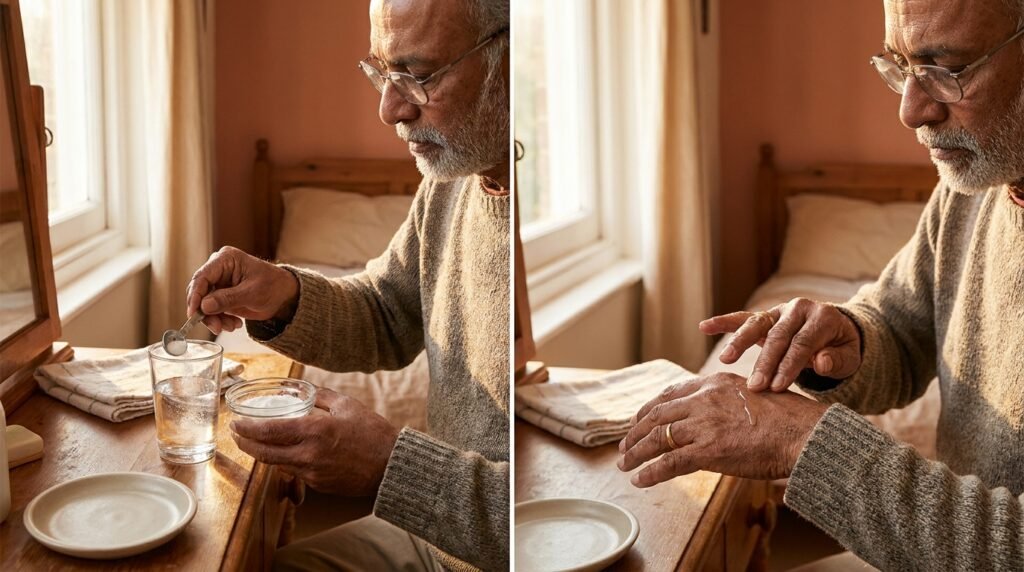
1. What hyaluronic acid powder actually is
Hyaluronic acid powder is a dried, purified form of hyaluronan, almost always sold as sodium hyaluronate and made by bacterial fermentation. You dissolve it in water to make a humectant serum, or add it to a formula.
Hyaluronan is a glycosaminoglycan found naturally in skin, where it helps hold water in the dermis. It is often cited as binding many hundreds of times its weight in water. The sodium salt is preferred in cosmetics because it is more stable and dissolves more readily than the free acid. On an ingredient list you may see it as sodium hyaluronate, hyaluronic acid, hydrolyzed hyaluronic acid or sodium acetylated hyaluronate. These are related but not identical, because they differ in molecular size and in how they behave on skin.
Grade matters. Cosmetic-grade powder is not the same as injectable-grade or food and supplement-grade material, and you should not substitute one for another. Reputable suppliers provide a certificate of analysis stating the INCI name, the molecular weight (in kDa or Da), and microbial limits. If a listing gives none of these, treat it as unverified.
The powder is also not a product you apply neat. It is extremely concentrated, it pulls water from whatever it touches, and the fine particles can be inhaled. Weigh and pour it gently, away from your face, and never put dry powder on skin or near eyes.
2. Molecular weight, concentration and what the evidence supports
The single most important number on a powder listing is molecular weight. Approximate bands used in cosmetic chemistry are:
- High (roughly 1,000-1,800 kDa): forms a hydrating film on the surface of the skin and gives the most slip and viscosity.
- Medium (roughly 100-1,000 kDa): a common middle ground between film-forming and smaller fractions.
- Low (roughly 20-50 kDa): thinner texture, and likely to reach the upper layers of the stratum corneum.
- Oligo or hydrolyzed (under about 10 kDa): very light, marketed for deeper delivery.
Suppliers’ band definitions vary slightly, so read the figure on the certificate rather than trusting the label "low" or "high".
For concentration, finished serums and DIY recipes generally sit between 0.1% and 2% by weight, and many people settle around 0.5-1%. Higher percentages of high-molecular-weight powder do not hydrate better. They tend to become stringy, tacky and prone to pilling under other products. Use a scale accurate to 0.01 g rather than measuring spoons, since 0.5 g in 100 g of water gives a 0.5% solution.
On the evidence, topical hyaluronic acid reliably increases surface hydration and temporarily softens the look of fine dehydration lines. Small studies, many of them manufacturer-funded, report improved skin hydration and elasticity over several weeks. Evidence that it penetrates deeply or rebuilds dermal hyaluronan is much weaker, because the stratum corneum is a barrier and larger molecules mostly stay at the surface. Some laboratory work also suggests that very small hyaluronan fragments can trigger inflammatory signalling. The clinical relevance for topical use is unclear, but if your skin is reactive, a medium or high molecular weight is a sensible starting point.
3. pH, preservation and the risks of DIY serums
Hyaluronic acid is stable across a fairly wide pH range, roughly 4 to 8. Prolonged storage below about pH 3 or above about pH 9 can degrade the chain, which thins the solution and reduces its effect. A finished serum at pH 5-6 suits most skin, and you can check this with calibrated pH strips or a meter. Do not adjust pH with kitchen acids by guesswork.
Preservation is the main problem with DIY. Any water-based mixture will grow bacteria and mould, and a hyaluronic acid gel is a good medium for them. Refrigeration slows this but does not make an unpreserved serum safe, and a tint, cloudiness or smell is a late warning. Home formulators use a broad-spectrum preservative at the supplier’s stated rate. Phenoxyethanol, for example, is capped at 1% in the EU, and preservatives have their own effective pH windows that you should read off the supplier’s data sheet. Using sterilized or distilled water and clean tools helps, but only a properly preserved formula is dependable.
The method matters too. Sprinkle the powder slowly over the surface of the water and let it hydrate undisturbed, from a couple of hours to overnight, rather than stirring hard, which causes clumps that never fully dissolve. Add preservative once the gel is uniform.
Also note that hyaluronate is anionic. It can precipitate or turn cloudy when combined with cationic ingredients such as benzalkonium chloride, cetrimonium compounds or chlorhexidine. High salt levels thin the gel, and high alcohol levels can make it separate. If a formula contains any of these, do not add powder to it. If this all sounds like more risk than benefit, a professionally formulated serum is a reasonable alternative, since stability and preservative testing have already been done.
4. Interactions and layering order
Hyaluronic acid is among the more compatible actives, so most problems come from order and from what you leave on top, not from chemical clashes. The general rule is to apply water-based products from thinnest to thickest, with the lowest-pH products first, then seal with a moisturizer. Applying hyaluronic acid to slightly damp skin gives it water to bind. A bare, dry-skinned application in a very dry environment, with no occlusive layer on top, may leave skin feeling tighter, so always follow with a cream or lotion.
- Vitamin C (L-ascorbic acid, usually 10-20% at pH below 3.5): apply the vitamin C first and let it settle, then a hyaluronic acid serum at pH 5-6. Do not stir powder into a low-pH vitamin C serum, because the acidity can degrade it and the texture usually suffers.
- AHAs and BHAs (glycolic acid 5-10%, salicylic acid 0.5-2%, typically pH 3-4): use the exfoliant first, then hyaluronic acid afterward to soften dryness. They are compatible when layered, but not when mixed in one bottle.
- Retinoids (retinol, adapalene, tretinoin): hyaluronic acid does not deactivate them. Many people layer it under the retinoid or after it to reduce dryness. Follow the instructions of whoever prescribed a prescription retinoid.
- Niacinamide (commonly 2-5%, up to 10%): compatible. If niacinamide stings, the cause is usually the concentration or other ingredients in the formula, not the hyaluronic acid.
- Benzoyl peroxide: compatible. Hyaluronic acid can be applied before your moisturizer to offset drying.
Where it gets complicated is stacking. A routine with an acid, a retinoid, a vitamin C and two "hydrating" serums often contains several hyaluronate forms and a cationic ingredient you did not expect. This is where checking the actual formula helps. Skin Scan Genius lets you scan a product’s barcode and see how the formula fits your skin type, concerns and what you already use, including active-to-active interactions, before it goes on your face.
If you have rosacea, eczema, melasma or any condition that flares with new products, see a dermatologist before adding a new active or a DIY formula. Patch test any new product on a small area for several days first, and stop if you develop burning, swelling or a rash.
Check it against your own routine. Skin Scan Genius reads a product’s full INCI list and flags conflicts with the actives you already use, by skin type and concern.
Frequently asked questions
Can I put hyaluronic acid powder directly on my skin?
No. Dry powder draws moisture from the skin surface, can irritate, and the fine particles are easy to inhale. It should be dissolved in water at about 0.1-2%, preserved properly, and applied as a finished serum or gel.
Is hyaluronic acid powder the same as sodium hyaluronate?
Usually, yes. Most cosmetic powders sold as hyaluronic acid are sodium hyaluronate, the more stable salt. Check the INCI name and molecular weight on the certificate of analysis, since the size of the molecule changes how it feels and behaves.
How long does a homemade hyaluronic acid serum last?
Without a broad-spectrum preservative, it is unsafe to keep beyond a very short time, even refrigerated, because water-based gels grow microbes. A correctly preserved serum can last longer, but the shelf life depends on the preservative system and your hygiene, so follow the supplier’s data.
Can I mix hyaluronic acid with vitamin C and retinol?
You can use them in the same routine, but layer them rather than mixing them in one container. Apply the low-pH vitamin C first, then hyaluronic acid at pH 5-6, and use retinol at a separate time of day or according to your prescriber’s or product’s directions if your skin is sensitive.