1. Why Spotting Food Dyes Is Harder Than It Should Be in 2026
You pick up a box of cereal, a bottle of salad dressing, or a pouch of fruit snacks. You flip it over and squint at a block of tiny type. Somewhere in there may be a synthetic color, but it might be listed as ‘Red 40,’ ‘FD&C Red No. 40 Lake,’ ‘Allura Red AC,’ ‘E129,’ or just ‘color added.’ If you’ve ever felt that reading labels is a second job, you are not imagining it, and you are not alone. For parents of a child who gets hyperactive or irritable after certain snacks, for people with color-related sensitivities, and for anyone who simply prefers fewer synthetic additives, this confusion is a real daily burden.
Part of the difficulty is that the rules for declaring colors differ from the rules for other high-stakes ingredients. The FDA Food Allergen Labeling & Consumer Protection Act (FALCPA) requires the major allergens to be declared in plain language, which is why ‘contains milk’ is so easy to find. There is no equivalent plain-language ‘contains synthetic dye’ statement. You have to know the names, the abbreviations, and the loopholes, and that knowledge is rarely taught to anyone.
Regulation is also shifting underneath shoppers. In the United States, FDA has moved to revoke authorization of FD&C Red No. 3 in food, and several states and the federal government have signaled pressure on petroleum-based colors more broadly. Meanwhile, the European Food Safety Authority (EFSA) Additive Safety Regulations take a different path. Additives get E-numbers, undergo periodic re-evaluation, and some dyes require a warning about possible effects on children’s activity and attention. The same product can carry a different color formula on each side of the Atlantic, and an imported snack may use either system’s vocabulary.
It also helps to keep the bigger picture in view. Most brightly colored foods are also highly processed, and a dye is often a clue to the overall food rather than the whole story. Research such as this PubMed Research on Ultra-Processed Foods & Gut Microbiome Disruption reflects the growing scientific attention on ultra-processed eating patterns, and the World Health Organization Guidelines on Healthy Diets & Saturated Fats remind us that overall dietary pattern matters more than any single ingredient. Our goal is not to scare you away from the grocery store. It is to make the information visible so you can decide what fits your household.
Scan Any Label for Hidden Additives and Allergens — Free
Never second-guess confusing grocery labels again. Download Food Scan Genius to uncover hidden additives, toxic dyes, and allergens for the whole household before you buy.


2. Where Food Dyes Hide: Naming Tricks and Labeling Loopholes
In the U.S., FDA-certified synthetic colors must be listed by name, such as FD&C Yellow No. 5 or Blue No. 1. Colors that are exempt from certification, which includes many from plant, mineral, or insect sources, can often be declared more loosely. Add in naming conventions, sub-ingredients, and marketing language, and you get the pitfalls below. Knowing them turns a confusing panel into a readable one.
- Numbered names and their aliases: The common certified dyes are Red 40 (Allura Red AC, E129), Yellow 5 (tartrazine, E102), Yellow 6 (Sunset Yellow, E110), Blue 1 (Brilliant Blue FCF, E133), Blue 2 (Indigo Carmine, E132), and Green 3. Red 3 (erythrosine, E127) is being phased out of U.S. food. Search for both the ‘FD&C’ version and the E-number, especially on imported products.
- ‘Lake’ versions: ‘FD&C Red No. 40 Aluminum Lake’ is the same dye bound to aluminum for use in coatings, sprinkles, and dry mixes. Shoppers who scan only for ‘Red 40’ sometimes miss the word ‘Lake’ trailing it.
- ‘Color added’ and ‘artificial color’: Exempt-from-certification colors may be listed generically. That can cover natural-origin options like annatto, beet juice, or paprika oleoresin, but the phrase alone does not tell you which one, or whether it is synthetic.
- Dyes inside sub-ingredients: A coating on a cereal, a filling in a pastry, or a ‘seasoning blend’ can contain its own color. These nested components are easy to overlook, which is why deep sub-ingredient parsing matters.
- Look-alike ‘natural’ colors with their own concerns: Carmine (cochineal extract) is derived from insects and must be declared by name, which matters for vegetarians and for people with sensitivities to it. Caramel color comes in several types, and titanium dioxide, once a common whitener, is no longer authorized as a food additive in the EU.
- ‘No artificial colors’ claims: The front of the package can say this while the ingredient list still contains colors from other sources, or the product may use a different additive you care about. The claim is accurate within its own narrow definition, so the ingredient list is the final word.
Dyes also show up outside obvious candy aisles: pickles, flavored yogurt, cake mixes, drink powders, chips, cheese snacks, chewable vitamins, and even pet foods and medications. Because EU rules require a warning on products containing certain dyes, a product bought abroad may carry a clue like ‘may have an adverse effect on activity and attention in children.’ That is useful context, but it is not a substitute for reading the full ingredient list.
3. Food Scan Genius vs. Other Ways to Check for Dyes
| Dimension | Food Scan Genius | Fig | Spoonful | Manual Label Reading |
|---|---|---|---|---|
| Cost | 100% free core features, no paywalls | About $59/yr for full access | Limited scans | Free, but costs time |
| Database & parsing depth | NutriGraph: 5M+ verified UPC/EAN barcodes with recursive sub-ingredient parsing | Ingredient-based matching | Ingredient-based matching | Depends on your memory of aliases |
| Custom dye sensitivities | 39 dietary profiles plus ‘Add Your Own Custom Sensitivity’ for specific dyes, seed oils, and additives | Preset diet and allergen filters | Preset filters | Fully manual |
| Family screening | Multi-household profiles in one scan with named fail attribution | Single-profile focus | Single-profile focus | Re-check per person |
| Languages | 11 global languages with real-time in-app translation | Check app for supported languages | Check app for supported languages | Only the language printed on the package |
The core problem with dyes is that the name on the label rarely matches the name you’re looking for. Food Scan Genius is built on the NutriGraph Database, which links more than 5,000,000 verified UPC/EAN barcodes to full ingredient data. Its recursive parsing reads inside sub-ingredients, so a dye tucked into a coating, filling, or seasoning blend is flagged rather than missed. Because you can add a custom sensitivity, you can track Red 40, Yellow 5, carmine, caramel color, or any additive you choose, whatever alias the manufacturer uses.
Flagging an ingredient is only half of the job, so ScanGenius AI Insight adds nuanced context: what the additive is, why it appears in this type of product, and how the item sits on the NOVA 1-4 processing scale and Nutri-Score. We deliberately avoid a single moralizing ‘good or bad’ number, because a dye in an occasional birthday treat is a different decision from a dye in a daily staple. If you shop for a household, family profiles let one scan show results like ‘Fails for Sri (Red 40)’ so everyone’s needs are covered at once. All of this is free.
4. Related Food Safety & Dietary Guides
- Sulphite Sensitivity & Preservative Checker — Sulphite Sensitivity Scanner Guide
- Sugar Sensitivity & Sweetener Guide — Sugar Sensitivity Scanner Guide
- FSG Labels Defined: Nutri-Score, NOVA & Additive Safety Guide — Food Label Definitions & Nutri-Score Guide
- Spanish Yellow & Tartrazine Allergy Dangers — tartrazine (Yellow 5) allergy risks
5. Scientific & Health Authority References
- FDA Food Allergen Labeling & Consumer Protection Act (FALCPA)
- European Food Safety Authority (EFSA) Additive Safety Regulations
- PubMed Research on Ultra-Processed Foods & Gut Microbiome Disruption
- World Health Organization Guidelines on Healthy Diets & Saturated Fats
6. How to Scan in 3 Simple Steps
- Download Food Scan Genius free on iOS or Android. There is no paywall on core features, and you can choose from 11 languages with real-time in-app translation.
- Set up your profile: pick from 39 dietary profiles, then use ‘Add Your Own Custom Sensitivity’ to enter specific dyes such as Red 40, Yellow 5, Blue 1, carmine, or caramel color. Add family members under your household so each person’s needs are screened together.
- Scan any barcode in about two seconds. You get an instant audit trail showing exactly which ingredient or sub-ingredient triggered a flag, who in your household it fails for, plus ScanGenius AI Insight, NOVA 1-4 and Nutri-Score context.
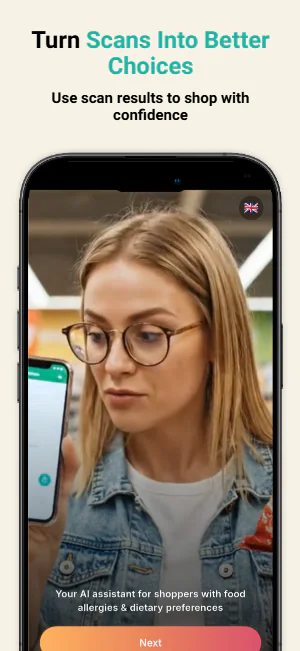
Instant Dye & Additive Audit Trail
7. Frequently Asked Questions (FAQ)
What are food dyes, and why are they added to products?
Food dyes are color additives used to make food look brighter, more uniform, or more appealing, or to restore color lost during processing. They fall into two broad groups: synthetic dyes (such as Red 40, Yellow 5, and Blue 1) and colors derived from plants, minerals, or insects (such as annatto, beet juice, turmeric, and carmine). Dyes add no nutritional value. With Food Scan Genius, you can scan a product and see which colors it contains, and ScanGenius AI Insight explains why they appear in that type of food.
How can I tell if a product contains artificial dyes just by reading the label?
Look in the ingredient list for names like ‘FD&C Red No. 40,’ ‘Yellow 5,’ ‘Blue 1,’ ‘Lake,’ or E-numbers such as E102 and E129. Be aware that generic terms like ‘color added’ or ‘artificial color’ can hide the specific source, and that dyes can appear inside sub-ingredients such as coatings and fillings. Food Scan Genius automates this: NutriGraph’s recursive sub-ingredient parsing checks nested components, and your custom sensitivities flag the exact dye you want to avoid.
Does ‘no artificial colors’ on the front of a package mean the product is dye-free?
Not necessarily. It means no artificial colors, as defined by regulators, were added, but the product may still contain colors from natural sources like annatto, paprika, or carmine. Those might matter if you avoid a specific color for allergy, dietary, or personal reasons. Scanning the barcode with Food Scan Genius shows you the full ingredient picture and your personal flags, so you don’t rely on the front-of-pack claim alone.
Can I screen for dyes for my whole family at once, even if we have different needs?
Yes. Food Scan Genius supports multi-household family profiles, so one scan checks every family member’s profile and names who it fails for, such as ‘Fails for Sri (Gluten)’ or a custom dye sensitivity. That is helpful when one child avoids Red 40, another follows a gluten-free diet, and a parent tracks seed oils. The core features are 100% free, and the app works in 11 languages with real-time translation for relatives or caregivers who read a different language.
Know What’s In Your Food Before You Buy — Scan Free Today
Never second-guess confusing grocery labels again. Download Food Scan Genius to uncover hidden additives, toxic dyes, and allergens for the whole household before you buy.