
1. Red 40 Explained: Why This Dye Is So Hard to Avoid in 2026
Red 40 = Allura Red AC = FD&C Red No. 40 = E129, a synthetic, petroleum-derived azo dye used to color foods, drinks, and medicines red. It adds no flavor, nutrition, or preservation. Its only job is to make products look brighter, riper, or more appealing. The FDA approved it in the early 1970s as a replacement for older red dyes, and it is now the most widely used synthetic food dye in the United States. In Europe it is labeled E129.
If you are a parent, a caregiver, or simply someone who prefers fewer additives, the hard part is not understanding the definition. It is finding the dye. Red 40 turns up in the obvious places, like candy, drink mixes, and frosting. It also appears in cereals, flavored yogurts, sauces, pickles, snack coatings, and children’s medications. Many families spend years reading labels without realizing how often it appears under different names.
The science is more nuanced than either side of the online debate suggests. U.S. regulators consider Red 40 safe at current intake levels. The European Food Safety Authority (EFSA) Additive Safety Regulations also permit it, with an acceptable daily intake of 0 to 7 mg per kg of body weight. At the same time, the EU requires products with certain dyes to carry the warning “may have an adverse effect on activity and attention in children.” That requirement followed a 2007 University of Southampton study, and California’s 2021 state health assessment reached a similar conclusion about behavior in sensitive children. Both findings are about some children, not all.
Red 40 is also not one of the nine major allergens covered by the FDA Food Allergen Labeling & Consumer Protection Act (FALCPA). It therefore never gets the bolded “Contains” statement, and a shopper with a sensitivity has to find it in the ingredient list. Red 40 is also a reliable marker of ultra-processing. Diets built on such foods are the subject of PubMed Research on Ultra-Processed Foods & Gut Microbiome Disruption. That research is about the broader food pattern, not Red 40 alone. Even so, it is why the World Health Organization Guidelines on Healthy Diets & Saturated Fats steer people toward minimally processed foods.
Scan Any Label for Hidden Additives and Allergens — Free
Never second-guess confusing grocery labels again. Download Food Scan Genius to uncover hidden additives, toxic dyes, and allergens for the whole household before you buy.


2. Where Red 40 Hides: Naming Quirks, Labeling Gaps, and Regulatory Splits
Red 40 is rarely hidden on purpose. It is usually disclosed, but it appears in many forms, in nested ingredient lists, and in product categories most people do not think to check. Here are the most common ways it gets missed:
- Multiple names for one dye: Red 40, FD&C Red No. 40, Allura Red AC, Red 40 Lake, and E129 all refer to the same colorant. Someone scanning for “Red 40” can miss the others.
- Lake versions: “Red 40 Aluminum Lake” is the dye bound to aluminum for use in coatings, sprinkles, and dry mixes. It is the same colorant with a different carrier, and it is often listed separately.
- Compound ingredients: When a product contains sprinkles, icing, seasoning blends, or a flavored coating, the dye may sit inside a parenthetical sub-list. Those sub-ingredients are easy to skim past.
- Health-halo products: Fruit snacks, flavored oatmeal, yogurt tubes, protein bars, and gummy vitamins are marketed as wholesome but often contain synthetic dyes.
- Non-food sources: Liquid medicines, chewable tablets, toothpaste, and mouthwash frequently use Red 40, and those labels are formatted differently from food labels.
- Regulatory splits: The same brand may sell a Red 40 version in the U.S. and a beet- or paprika-colored version in Europe. This follows from the warning-label rules in the EFSA framework, and it shows that the dye is a choice rather than a necessity.
A related point of confusion is carmine (cochineal), a red pigment made from insects. It is a different substance from Red 40. It must be declared by name under a separate FDA rule, because FALCPA covers only the nine major allergens. Vegans and people with sensitivities need to tell the two apart.
On safety, three things are worth knowing. First, JECFA and EFSA both set the acceptable daily intake at 0 to 7 mg per kg of body weight, and typical dietary exposure is generally below that. Second, the 2007 Southampton trial found small increases in hyperactivity in some children after a mixture of dyes plus a preservative. That is not proof that Red 40 causes ADHD, and it is not proof that the dye is harmless to sensitive children. Third, policy is shifting. The FDA revoked authorization for Red 3 in January 2025 and announced a plan to phase out petroleum-based dyes, and several U.S. states have passed school-food restrictions. Early animal studies on gut inflammation are still preliminary and not established in humans. Most people tolerate Red 40 without noticeable effects, and some individuals clearly do not.
3. Head-to-Head: Finding Red 40 in Seconds Instead of Minutes
| Dimension | Food Scan Genius | Manual Label Reading | Fig | Spoonful |
|---|---|---|---|---|
| Cost | 100% free core features, no paywalls | Free, but costs time | About $59/yr | Limited scans |
| Catches alternate names (Allura Red, E129, Lake) | Yes, via recursive sub-ingredient parsing | Depends on memory and attention | Varies by plan | Varies by plan |
| Custom sensitivities | 39 profiles plus “Add Your Own” (e.g., Red 40) | Not applicable | Limited | Limited |
| Family screening | Whole household in one scan, with named results | One person at a time | Varies | Varies |
| Languages | 11 languages with real-time in-app translation | Only what is printed on the package | Varies | Varies |
Food Scan Genius runs on the NutriGraph Database, which covers more than 5,000,000 verified UPC/EAN barcodes. Its recursive parsing reads inside compound ingredients, so a dye tucked into a sprinkle topping or a seasoning blend is still found. You can pick one of 39 dietary profiles or use “Add Your Own Custom Sensitivity” to flag Red 40, Allura Red, E129, or any other additive you want to track.
The ScanGenius AI Insight then explains the finding in context rather than issuing a verdict. It shows the NOVA 1-4 classification and the Nutri-Score alongside the dye flag, so you can see whether Red 40 is one detail in a minimally processed food or one of many markers in an ultra-processed one. With Multi-Household Family Profiles, one scan screens everyone at once and names who is affected, for example “Fails for Sri (Red 40).” There is no fear-based score. You get information to decide with.
4. Related Food Safety & Dietary Guides
- Sulphite Sensitivity & Preservative Checker — Sulphite Sensitivity Scanner Guide
- Sugar Sensitivity & Sweetener Guide — Sugar Sensitivity Scanner Guide
- FSG Labels Defined: Nutri-Score, NOVA & Additive Safety Guide — Food Label Definitions & Nutri-Score Guide
- Spanish Yellow & Tartrazine Allergy Dangers — tartrazine (Yellow 5) allergy risks
5. Scientific & Health Authority References
- FDA Food Allergen Labeling & Consumer Protection Act (FALCPA)
- European Food Safety Authority (EFSA) Additive Safety Regulations
- PubMed Research on Ultra-Processed Foods & Gut Microbiome Disruption
- World Health Organization Guidelines on Healthy Diets & Saturated Fats
6. How to Scan in 3 Simple Steps
- Download Food Scan Genius free on iOS or Android. Core features have no paywall and no scan limits, so you can check as many products as you like.
- Set up your profile. Choose from 39 dietary profiles, then use “Add Your Own Custom Sensitivity” to add Red 40 (and its aliases, Allura Red AC and E129). Add each family member under your household so every person is screened.
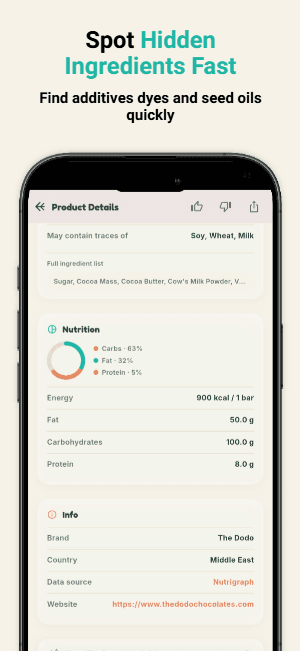
- Scan any barcode. In about two seconds you get an instant audit trail showing where the dye appears, including inside sub-ingredients, plus named fail attribution and the ScanGenius AI Insight in any of 11 languages.
Personalized Match & AI Insight
7. Frequently Asked Questions (FAQ)
What is Red 40 made from?
Red 40 (Allura Red AC) is a synthetic azo dye made from petroleum-derived chemicals. It does not come from plants or insects. The FDA certifies each batch for purity before it can be used in food, drugs, or cosmetics. Food Scan Genius can flag Red 40 and its alternate names, including Allura Red AC, FD&C Red No. 40, and E129, anywhere in a product’s ingredient list.
Is Red 40 banned in Europe?
No. Red 40 (E129) is permitted in the EU, but products containing it must carry the warning that it “may have an adverse effect on activity and attention in children.” Many manufacturers reformulate European versions with plant-based colors to avoid the label. Food Scan Genius’s 11-language support lets you check products bought abroad in your own language.
Does Red 40 cause ADHD or hyperactivity?
Evidence does not show that Red 40 causes ADHD. Some controlled studies, including the 2007 Southampton trial and California’s 2021 state health review, suggest certain synthetic dyes may worsen attention or behavior in a subset of sensitive children. Most children show no noticeable effect. If you are unsure, track your child’s reactions and talk to a pediatrician, and use a custom sensitivity in Food Scan Genius to avoid the dye while you test.
How can I avoid Red 40 for my whole family?
Read ingredient lists for every alias, check medications and vitamins, and watch for sub-ingredients in sprinkles, coatings, and seasonings. A faster route is to add Red 40 as a custom sensitivity in Food Scan Genius and set up Multi-Household Family Profiles. One free scan will then show which family members are affected, using named fail attribution, and the AI Insight will explain the context without moralizing.
Know What’s In Your Food Before You Buy — Scan Free Today
Never second-guess confusing grocery labels again. Download Food Scan Genius to uncover hidden additives, toxic dyes, and allergens for the whole household before you buy.