1. Is Milk Chocolate Gluten-Free? Why the Answer Depends on the Bar in Your Hand
Plain milk chocolate (cocoa + cocoa butter + sugar + milk + lecithin) is naturally gluten-free, but milk chocolate containing malt, wheat, biscuit pieces or shared-line cross-contact is not guaranteed safe, so verify every label.
That one-line answer hides the real problem. Chocolate itself doesn’t contain gluten. The trouble is that ‘milk chocolate’ on a package describes a base recipe, not the whole product. Manufacturers add barley malt for flavor, fold in crisped cereal, wafers or cookie crumbs, and often make several products on the same lines. Two bars with nearly identical wrappers can be completely different for someone with celiac disease or non-celiac gluten sensitivity. If you have ever stood in a store reading the same ingredient panel three times and still felt unsure, your caution is reasonable.
The stakes are clinical. For people with celiac disease, even small repeated exposures can trigger intestinal damage, whether or not symptoms appear. In the US and EU, a product labeled ‘gluten-free’ must contain less than 20 parts per million (20 ppm) of gluten, which is the benchmark explained in the Celiac Disease Foundation Threshold Requirements. A bar with no gluten ingredients but no gluten-free claim has simply not been held to that standard. It might be fine, but nobody has promised it.
Chocolate is also a food people turn to for comfort and celebration, which makes the uncertainty feel heavier. Treats are part of a balanced life, and the World Health Organization Guidelines on Healthy Diets & Saturated Fats frame sugary, fatty foods as items to enjoy in moderation, not to fear. Your goal is to enjoy chocolate safely. The rest of this guide shows you how to read the label, recognize the ingredients and situations that introduce gluten, and confirm a bar in seconds.
Scan Any Label for Hidden Additives and Allergens — Free
Never second-guess confusing grocery labels again. Download Food Scan Genius to uncover hidden additives, toxic dyes, and allergens for the whole household before you buy.


2. Hidden Gluten in Milk Chocolate: Ingredients and Label Loopholes to Watch
Most gluten exposure from chocolate comes from the margins of the label: the inclusions, the flavorings and the facility. These six situations account for the majority of surprises.
- Barley malt, malt extract and malt flavoring: Malted milk, ‘malted’ bars and many crunchy or toffee-style chocolates use barley-derived malt. Barley is a gluten grain, but in the US it is not a major allergen, so it will not appear in a ‘Contains’ statement. You have to find it in the ingredient list.
- Crisped rice and cereal pieces: Crispy milk chocolate bars often use rice crisps sweetened with barley malt. Rice is gluten-free, but the malt is not. Always check the inclusion, not just the chocolate.
- Wafers, cookies, biscuits and pretzels: These contain wheat flour or wheat starch. In the US, wheat must be declared as an allergen, which helps, but you still need to look for it before you buy.
- Wheat-derived glucose syrup or dextrin: Highly refined wheat-based ingredients can test below 20 ppm and may legally appear in gluten-free products. The ingredient list may still show ‘wheat’, which can leave a shopper with celiac disease guessing. Check for a gluten-free claim or contact the maker.
- ‘May contain’ and shared-line warnings: Precautionary statements are voluntary and not standardized. A bar with no warning is not proven safe, and a bar with one has not necessarily been tested. Chocolate manufacturers often run wafer, cookie and plain-chocolate products through shared equipment.
- Seasonal, fun-size and variety-pack versions: Mini bars, holiday shapes and assortment boxes can use different recipes, suppliers or factories than the flagship bar. Never assume a safe full-size bar means safe minis. Read the exact package you are holding.
Emulsifiers such as soy lecithin and PGPR do not contain gluten. They are common in milk chocolate and are evaluated under frameworks like the European Food Safety Authority (EFSA) Additive Safety Regulations. Additive safety and gluten safety are separate questions, so a clean additive profile says nothing about cross-contact. Your best signals are a certified or clearly worded gluten-free claim, a short ingredient list with no malt, wheat, barley or rye, and a manufacturer who answers allergen questions plainly.
3. Food Scan Genius vs. Other Ways to Check Chocolate for Gluten
| Dimension | Food Scan Genius | Manual Label Reading | Fig | Spoonful |
|---|---|---|---|---|
| Cost | 100% free core features, no paywalls | Free, but costs time | Around $59/yr for full access | Limited scans on free tier |
| Ingredient depth | NutriGraph Database with 5,000,000+ verified barcodes and recursive sub-ingredient parsing | Depends on your own knowledge of terms like malt | Barcode-based ingredient screening | Barcode-based ingredient screening |
| Diet profiles | 39 dietary profiles plus custom sensitivities | Whatever you remember | Fixed set of diets and allergens | Fixed set of diets and allergens |
| Family screening | Multi-household profiles with named results, such as ‘Fails for Sri (Gluten)’ | Re-read for each person | Primarily individual profiles | Primarily individual profiles |
| Context and languages | ScanGenius AI Insight, NOVA 1-4, Nutri-Score, 11 languages with real-time translation | None, and foreign labels are hard to read | Varies by plan | Varies by plan |
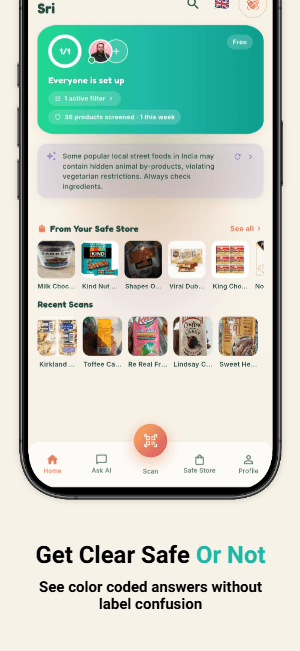
A milk chocolate label is a short puzzle: malt may be listed as ‘malt extract’, an inclusion may carry its own sub-ingredients, and a precautionary line may sit far from the ingredient panel. Food Scan Genius is powered by the NutriGraph Database, which uses recursive parsing to break compound ingredients into their components. A crunchy inclusion or a flavoring blend is checked down to its parts instead of being skimmed as one line. You set your profile once, from 39 supported dietary profiles or your own custom sensitivity, then scan. You get a clear pass or fail in about two seconds, with the exact ingredient or statement that triggered it. For households, the scan screens everyone at once and names who is affected, for example ‘Fails for Sri (Gluten)’. The app also translates in real time across 11 languages, which helps when you buy imported chocolate.
The ScanGenius AI Insight explains why a result matters without a simplistic good-or-bad score. It shows where the product falls on the NOVA 1-4 scale and its Nutri-Score, so you can weigh gluten safety alongside processing level. Many milk chocolates are ultra-processed (NOVA 4), and PubMed Research on Ultra-Processed Foods & Gut Microbiome Disruption is one place to read about the wider conversation. An honest caveat: a barcode scan reads label and database information. It cannot measure ppm in your specific bar, so for celiac disease, favor products with a clear gluten-free claim and contact the manufacturer when a result is uncertain.
4. Related Food Safety & Dietary Guides
- Best Food Allergy Scanner App – Scan Food Labels Instantly — Food Allergy & Sensitivity Scanner Hub
- The 7 Best Free Food Scanner Apps of 2026 — best free food scanner apps
- Choosing the Best Barcode Scan App for Your Health — guide to choosing a barcode scanner app
- Food Scan Genius: World’s #1 Food Ingredient Scanner App — Food Scan Genius scanner app
5. Scientific & Health Authority References
- Celiac Disease Foundation Threshold Requirements
- European Food Safety Authority (EFSA) Additive Safety Regulations
- PubMed Research on Ultra-Processed Foods & Gut Microbiome Disruption
- World Health Organization Guidelines on Healthy Diets & Saturated Fats
6. How to Scan in 3 Simple Steps
- Download Food Scan Genius free on iOS or Android. The core features have no paywall and no scan limits to worry about.
- Set up your profile: choose the Gluten-Free profile, then add custom sensitivities such as barley malt or oats if you react to them. For a family, add each member so one scan screens everyone.
- Scan the chocolate’s barcode. In about 2 seconds you get a pass or fail, the exact ingredient or statement behind it, and a ScanGenius AI Insight with NOVA and Nutri-Score context. Confirm a gluten-free claim on the package before you buy.
Instant Gluten-Free Audit Trail
7. Frequently Asked Questions (FAQ)
Is milk chocolate gluten free by default?
The base ingredients are naturally gluten-free: cocoa, cocoa butter, sugar, milk and lecithin. But a finished product may include barley malt, wheat-based inclusions or be made on shared equipment. So the answer to ‘is milk chocolate gluten free’ is ‘plain recipes usually are, but only a gluten-free claim (under 20 ppm) is a real guarantee.’ Food Scan Genius checks the ingredients of each barcode against your profile.
Does ‘no gluten ingredients’ mean the same as ‘gluten-free’ on a chocolate label?
No. A bar can have no gluten ingredients and still carry cross-contact risk. A ‘gluten-free’ claim means the product meets the under-20-ppm standard. Without it, you rely on the maker’s practices. Food Scan Genius shows both the ingredient result and any precautionary statements it finds, so you can see the full picture.
Are ‘may contain wheat’ and ‘made in a facility with wheat’ warnings reliable?
They are voluntary and not standardized, so they vary. Some manufacturers use them for real risk and others use them out of caution, and a missing warning does not prove safety. People with celiac disease generally treat these statements seriously and prefer products clearly labeled gluten-free. Food Scan Genius flags precautionary wording so you can decide with that information.
Can Food Scan Genius check milk chocolate for my whole family at once?
Yes. With Multi-Household Family Profiles, one scan screens every member and names who is affected, such as ‘Fails for Sri (Gluten)’. You can use any of 39 dietary profiles or add a custom sensitivity, and the app works in 11 languages. It is free at its core. It reads label and database information and cannot lab-test a bar for gluten, so confirm with the manufacturer for severe sensitivities.
Know What’s In Your Food Before You Buy — Scan Free Today
Never second-guess confusing grocery labels again. Download Food Scan Genius to uncover hidden additives, toxic dyes, and allergens for the whole household before you buy.