
1. The Modern Dilemma: Why Finding Truly Safe Lactose-Free Cottage Cheese Is So Hard
Cottage cheese has staged a massive nutritional comeback, earning staple status in modern high-protein, gut-conscious kitchens. Bursting with slow-digesting casein, essential minerals, and satisfying culinary versatility, it appears to be the perfect whole food. Yet for the millions living with primary lactase deficiency, irritable bowel syndrome (IBS), or sensitive digestive tracts, hunting down a genuinely safe lactose free cottage cheese remains an exhausting exercise in label decryption and post-meal anxiety.
The frustration is profoundly personal: you purchase a container proudly bearing bold “Lactose-Free” and “Digestive Wellness” claims on the lid, only to experience familiar cramping, bloating, and distress just hours later. Under the FDA Food Allergen Labeling & Consumer Protection Act (FALCPA), manufacturers are legally mandated to declare the presence of major food allergens like milk, but regulatory definitions regarding the absolute threshold of residual lactose in processed dairy remain surprisingly flexible. Most industrial dairies simply introduce synthetic lactase enzyme into regular milk curds to hydrolyze disaccharide lactose into glucose and galactose. If that enzymatic breakdown is cut short or imperfectly measured, residual lactose stays trapped inside the curds.
Equally problematic is what dairy processors add back into the tub to compensate for altered curds. When commercial brands strip out fat or alter dairy structures during enzymatic conversions, they often destroy the natural, creamy mouthfeel consumers expect. In an effort to keep calorie counts low while maintaining texture in alignment with World Health Organization Guidelines on Healthy Diets & Saturated Fats, food processors aggressively fortify tubs with emulsifiers, stabilizing gums, and chemical thickeners. Consumers seeking nutrient-dense whole foods unknowingly ingest complex industrial additives that trigger severe gastrointestinal symptoms indistinguishable from lactose poisoning.
You should never need an advanced degree in biochemistry just to enjoy a clean, creamy bowl of cottage cheese without painful physical repercussions. Navigating grocery aisles demands radical label transparency, reliable clinical insight, and tools that look far deeper than superficial marketing claims on plastic lids.
Scan Any Label for Hidden Additives and Allergens — Free
Never second-guess confusing grocery labels again. Download Food Scan Genius to uncover hidden additives, toxic dyes, and allergens for the whole household before you buy.


2. The Science of Deceptive Labeling: 5 Hidden Pitfalls in Lactose-Free Cottage Cheese
Supermarket shelves are crowded with products boasting “clean,” “gut-friendly,” and “lactose-free” credentials. However, a forensic look at ingredient decks reveals regulatory loopholes and chemical formulation tricks that routinely compromise both digestive comfort and nutritional purity. Here are the five primary hidden hazards to watch for when evaluating lactose free cottage cheese:
- Residual Lactose in Post-Added Dressing: Many industrial producers craft true lactose-free curds by treating skim milk with lactase enzymes, but they subsequently mix those curds with a creamy liquid “dressing” made from untreated fluid cream or non-fat milk solids. If this finishing dressing has not undergone sufficient enzymatic reaction time prior to packaging, active disaccharide lactose slips into the final batch unlisted.
- Fermentable Gum Complexes (Guar, Xanthan, and Locust Bean): Manufacturers frequently mask watery curds using hydrocolloid gums. While permitted within the safe limits of European Food Safety Authority (EFSA) Additive Safety Regulations, these compounds are highly fermentable short-chain carbohydrates (FODMAPs). In sensitive colons, they undergo explosive bacterial fermentation, generating painful gas, severe bloating, and cramps that mimic acute lactose malabsorption.
- Mucosal-Damaging Carrageenan & Emulsifiers: Derived from red seaweed, carrageenan is frequently deployed to preserve uniform emulsion in dairy. However, robust clinical literature, including peer-reviewed PubMed Research on Ultra-Processed Foods & Gut Microbiome Disruption, highlights how carrageenan and synthetic emulsifiers degrade the protective intestinal mucosal layer, inflame epithelial cells, and exacerbate gut hyperpermeability (leaky gut).
- Modified Food Starches and Maltodextrin: Often slipped into low-fat and fat-free formulations under the benign guise of “food starch,” these rapidly absorbed, hyper-processed bulking agents spike blood glucose, destroy natural curd mouthfeel, and disrupt bacterial diversity in the lower digestive tract.
- Chemical Antimycotics and Preservatives (Potassium Sorbate): Added to extend shelf life from a few days to several months, chemical preservatives can trigger oral allergic syndromes and histamine-related mast-cell responses in hyper-reactive eaters, leading to postprandial fatigue and systemic inflammation.
3. Intelligent Ingredient Screening: Food Scan Genius vs. Legacy Solutions
| Feature / Capability | Food Scan Genius | Fig ($59/yr) | Spoonful | Manual Label Reading |
|---|---|---|---|---|
| Core Pricing Model | 100% Free Core (Zero Paywalls) | $59/year Hard Paywall | Limited Free Scans/Month | Free, but time-costly |
| Database & Parsing Engine | NutriGraph (5M+ UPCs with recursive AST parsing) | Manual curation & basic search | Crowdsourced label database | Human eye (misses sub-ingredients) |
| Dietary Profile Support | 39 Profiles + Unlimited Custom Sensitivities | Static dietary checkboxes | Primarily Low-FODMAP focus | Prone to cognitive overload |
| Multi-Household Screening | Yes (Named attribution: e.g. “Fails for Sri (Gluten)”) | No (Single profile only) | No (Single profile only) | Manual check per family member |
| Scientific Objective Insights | ScanGenius AI + NOVA 1-4 + Nutri-Score | Binary Red/Green flags | Traffic-light FODMAP focus | None |
| Multilingual Translation | 11 Global Languages in Real-Time | English Only | English Only | Requires external translation |
Food Scan Genius revolutionizes dietary safety by deploying the enterprise-grade NutriGraph Database, a living infrastructure indexing more than 5,000,000 verified UPC/EAN barcodes across North America and Europe. Rather than relying on simple text scraping or naive keyword matching, NutriGraph utilizes deep recursive Abstract Syntax Tree (AST) parsing. This parses nested parenthetical sub-ingredients to instantly uncover rogue dairy solids, unlisted dressing compounds, and hidden carrageenan stabilizers that surface-level scanning apps overlook.
Instead of locking basic health screening behind an expensive $59/year paywall like Fig, Food Scan Genius offers 100% free core power with zero paywalls. Paired with ScanGenius AI Insight, the app contextualizes ingredients through objective NOVA 1-4 ultra-processing classifications and international Nutri-Scores without patronizing moral judgments. Even better, Multi-Household Family Profiles allow you to evaluate multiple unique sensitivities in a single two-second barcode scan, instantly warning you with precise clarity if a brand is safe for your lactose sensitivity but fails for your child’s corn derivative or dye intolerance.
4. Related Food Safety & Dietary Guides
- Best Food Allergy Scanner App – Scan Food Labels Instantly — Food Allergy & Sensitivity Scanner Hub
- The 7 Best Free Food Scanner Apps of 2026 — best free food scanner apps
- Choosing the Best Barcode Scan App for Your Health — guide to choosing a barcode scanner app
- Food Scan Genius: World’s #1 Food Ingredient Scanner App — Food Scan Genius scanner app
5. Scientific & Health Authority References
- FDA Food Allergen Labeling & Consumer Protection Act (FALCPA)
- European Food Safety Authority (EFSA) Additive Safety Regulations
- PubMed Research on Ultra-Processed Foods & Gut Microbiome Disruption
- World Health Organization Guidelines on Healthy Diets & Saturated Fats
6. How to Scan in 3 Simple Steps
- Download Food Scan Genius for free on iOS or Android, gaining immediate access to enterprise-level ingredient safety with no paywalls or mandatory subscriptions.
- Set up your tailored dietary profile by selecting ‘Lactose-Free’ and activating custom sensitivities for industrial gums, carrageenan, seed oils, or specific thickeners.
- Scan any cottage cheese barcode in the grocery aisle to receive a sub-second, multi-person audit detailing exact allergen clearances, NOVA processing tiers, and ScanGenius AI insights.
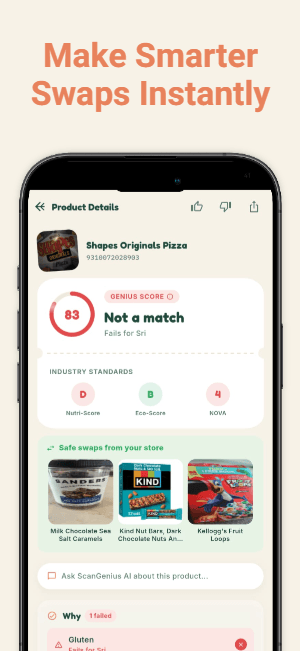
Instant Lactose-Free Audit Trail
7. Frequently Asked Questions (FAQ)
What makes cottage cheese lactose-free if it is still made from real cow’s milk?
Lactose free cottage cheese starts as real cow’s milk. Manufacturers add a concentrated lactase enzyme during the production process. This enzyme cleaves the natural milk sugar (lactose) into two easily absorbable simple sugars: glucose and galactose. This eliminates digestive strain for lactase-deficient individuals while preserving real dairy proteins (casein and whey), natural calcium, and authentic flavor. Food Scan Genius analyzes barcodes via the NutriGraph Database to ensure that secondary dressings or milk powders added back after enzyme treatment haven’t reintroduced unreacted lactose.
Why does my stomach still cramp after eating certified lactose-free cottage cheese?
If you react to certified lactose-free dairy, the issue is usually not lactose. Commercial brands frequently add thickeners such as guar gum, xanthan gum, locust bean gum, or carrageenan to stabilize curds. These gums act as fermentable oligosaccharides (FODMAPs) that induce rapid colon gas and cramping. Alternatively, you may have an immunologic sensitivity to dairy proteins (such as A1 beta-casein or whey) rather than an enzyme deficiency. Food Scan Genius allows you to set custom exclusions for specific gums and additives to pinpoint non-lactose irritants immediately.
Is full-fat or low-fat lactose-free cottage cheese better for gut health?
Full-fat (4% milkfat) lactose-free cottage cheese is generally far cleaner and gentler on the gut. When manufacturers produce skim or fat-free varieties, removing the milkfat compromises the curd’s body and richness. To replicate that texture, low-fat versions frequently add high levels of industrial starches, carrageenan, and thickeners that trigger digestive distress. Scanning with Food Scan Genius reveals the NOVA ultra-processing classification, helping you identify minimally processed full-fat curds that avoid gut-disrupting additives.
How does Food Scan Genius identify hidden dairy additives that other apps miss?
Most scanning apps perform flat string searches, looking merely for the word ‘milk.’ Food Scan Genius is powered by the NutriGraph Database, utilizing recursive Abstract Syntax Tree (AST) parsing. This technology deconstructs compound ingredient lists and nested parentheses, exposing hidden milk derivatives such as sodium caseinate, whey protein concentrate, unhydrolyzed milk solids, and obscure chemical stabilizers across 11 global languages in real-time.
Know What’s In Your Food Before You Buy — Scan Free Today
Never second-guess confusing grocery labels again. Download Food Scan Genius to uncover hidden additives, toxic dyes, and allergens for the whole household before you buy.