1. Why Building a Plant-Based Cart Is Harder Than It Looks in 2026
You decide to eat more plants. You picture a cart full of color, then you stand in the aisle reading a veggie burger label with 28 ingredients, and you wonder whether any of it is actually what you were hoping for. If that has happened to you, you are not being overly cautious. The plant-based aisle has grown quickly, and label literacy has not kept up. Shoppers in 2026 face more products, more marketing language, and more processing than a decade ago.
The clinical picture adds to the confusion. A diet built around legumes, whole grains, vegetables, fruit, nuts, and seeds is consistently linked with better cardiometabolic outcomes. The World Health Organization Guidelines on Healthy Diets & Saturated Fats emphasize more vegetables, fruit, legumes, nuts, and whole grains while limiting saturated fat, free sugars, and salt. But “plant-based” on a package is a marketing claim, not a nutritional guarantee. A cookie made without eggs can still be loaded with refined starch, added sugar, and emulsifiers.
So a useful list of plant based food has to answer two questions at once. Is it free of animal-derived ingredients, and is it a food you actually want to build meals around? Plenty of people ask the second question for medical reasons. Some are managing cholesterol or blood pressure, some are supporting a child’s elimination diet, and some are cooking for a household where one person is vegan, another is gluten-free, and a third is allergic to tree nuts. That is a lot to hold in your head in a busy store.
Here are the staples worth anchoring your cart around. Choose dried or canned beans, lentils, and chickpeas; oats, brown rice, quinoa, and whole-wheat pasta; fresh or frozen vegetables and fruit; raw nuts and seeds; tofu and tempeh; nut butters with short ingredient lists; and fortified unsweetened plant milks. Nutritional yeast, tahini, and canned tomatoes are also useful. Because vitamin B12 is not reliably present in unfortified plant foods, most people eating fully plant-based should talk with a clinician or dietitian about supplementation. Single-ingredient staples rarely hide surprises. The trouble starts once foods are packaged, flavored, or “alternative.”
Scan Any Label for Hidden Additives and Allergens — Free
Never second-guess confusing grocery labels again. Download Food Scan Genius to uncover hidden additives, toxic dyes, and allergens for the whole household before you buy.


2. Sneaky Ingredients and Labeling Gaps in the Plant-Based Aisle
Part of the problem is regulatory. In the United States, FDA Food Allergen Labeling & Consumer Protection Act (FALCPA) requires plain-language disclosure of major allergens such as milk, egg, fish, shellfish, tree nuts, peanuts, wheat, and soy, with sesame added later. That is valuable, but it is an allergen law, not a vegan standard. Many animal-derived ingredients, such as gelatin, carmine, or shellac, fall outside it, and “vegan” has no single, strictly enforced federal definition for most packaged foods.
Processing level matters too. Reviews such as PubMed Research on Ultra-Processed Foods & Gut Microbiome Disruption are part of a growing body of work examining how ultra-processed diets affect eating behavior and health. A plant-based label does not exempt a product from that conversation. Additive rules also differ by region, and the European Food Safety Authority (EFSA) Additive Safety Regulations assess additives differently than US frameworks, so the same snack can carry different ingredients depending on where it was made. These are the usual culprits to watch for:
- Casein and whey in “non-dairy” products: Some non-dairy creamers and cheese alternatives contain milk proteins, and the “non-dairy” claim can still be legal.
- Vague “natural flavors”: This umbrella term can include flavor compounds from animal or plant sources, and the label alone rarely tells you which.
- Carmine (cochineal) and shellac: Red and pink colors or glossy candy and fruit coatings may come from insects. They can appear as “carmine,” “E120,” “confectioner’s glaze,” or “resinous glaze.”
- Gelatin and isinglass: Gummies, marshmallows, some yogurts, and some clarified drinks use collagen or fish-bladder derivatives for texture or clarity.
- Vitamin D3 and omega-3 sources: Fortified plant milks and cereals may use D3 from lanolin, and omega-3 additions can come from fish oil.
- Sub-ingredients inside ingredients: A seasoning blend, bread improver, or sauce base may carry its own components, such as whey, honey, or L-cysteine from feathers, that never appear as a headline ingredient.
None of this means you should fear every package. It means a quick glance at the front is not enough, and reading every back panel by hand does not scale across a weekly shop.
3. Food Scan Genius vs. Other Ways to Check a Plant-Based Cart
| Dimension | Food Scan Genius | Fig | Spoonful | Manual Label Reading |
|---|---|---|---|---|
| Cost | 100% free core features, zero paywalls | $59/yr for premium | Limited scans | Free, but costs time |
| Ingredient depth | NutriGraph: 5M+ verified UPC/EAN barcodes with recursive sub-ingredient parsing | Ingredient-level screening | Ingredient-level screening | Only what you spot and recognize |
| Dietary profiles | 39 profiles plus custom sensitivities (seed oils, dyes, additives) | Preset profiles | Preset profiles | Whatever you remember |
| Family screening | Multi-household profiles, one scan, named fail attribution | Individual-focused | Individual-focused | Repeat the process per person |
| Languages | 11 global languages with real-time in-app translation | Varies | Varies | Requires reading the foreign label yourself |
The core advantage is the NutriGraph Database. It holds more than 5,000,000 verified UPC/EAN barcodes, and each ingredient list is parsed recursively through an abstract syntax tree. In practice, that means a “seasoning blend” or “bread conditioner” is opened up and its own components are checked, rather than being treated as one opaque word. For anyone building a list of plant based food, this is where hidden whey, carmine, or gelatin tends to get caught. With 39 supported dietary profiles and the option to add your own custom sensitivity, such as seed oils, a specific dye, or an additive your doctor flagged, the screening reflects your rules rather than a generic definition of “healthy.”
Then comes context. ScanGenius AI Insight explains why a product passed or failed, and it pairs that with a NOVA 1-4 classification and a Nutri-Score, so you can see both the ingredient story and the processing level. It does not hand you a single moralizing number. A plant-based frozen meal can pass your vegan profile and still be NOVA 4, and you deserve to see both facts and decide for yourself. For households, Multi-Household Family Profiles screen everyone in a single scan and name who is affected, for example “Fails for Sri (Gluten),” so a shared cart does not turn into a guessing game.
4. Related Food Safety & Dietary Guides
- Best Food Allergy Scanner App – Scan Food Labels Instantly — Food Allergy & Sensitivity Scanner Hub
- The 7 Best Free Food Scanner Apps of 2026 — best free food scanner apps
- Choosing the Best Barcode Scan App for Your Health — guide to choosing a barcode scanner app
- Food Scan Genius: World’s #1 Food Ingredient Scanner App — Food Scan Genius scanner app
5. Scientific & Health Authority References
- FDA Food Allergen Labeling & Consumer Protection Act (FALCPA)
- European Food Safety Authority (EFSA) Additive Safety Regulations
- PubMed Research on Ultra-Processed Foods & Gut Microbiome Disruption
- World Health Organization Guidelines on Healthy Diets & Saturated Fats
6. How to Scan in 3 Simple Steps
- Download Food Scan Genius free on iOS or Android. There are no paywalls on the core features, so you can scan as many plant-based products as you like.
- Set up your profile: choose the vegan or plant-based dietary profile from the 39 available, add any allergies or household members, and enter custom sensitivities such as carmine, seed oils, or a particular dye. Pick your preferred language from the 11 supported.
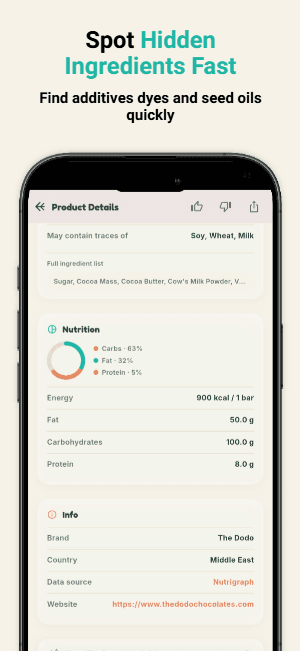
- Scan any barcode in about 2 seconds. You get an instant audit trail showing which ingredient or sub-ingredient triggered a flag, the NOVA 1-4 class, the Nutri-Score, and ScanGenius AI Insight context, so you can decide whether it belongs in your cart.
Personalized Match & AI Insight
7. Frequently Asked Questions (FAQ)
What should be on a basic list of plant based food?
A solid foundation includes legumes (beans, lentils, chickpeas), whole grains (oats, brown rice, quinoa), vegetables and fruit (fresh or frozen), nuts and seeds, tofu and tempeh, and fortified unsweetened plant milks. Single-ingredient staples are the easiest to trust. For packaged items, scan the barcode with Food Scan Genius, which checks the full ingredient list, including sub-ingredients, against your chosen plant-based profile.
Are all products labeled plant-based actually free of animal ingredients?
Not necessarily. Terms like plant-based and non-dairy are not uniformly defined or verified on packaging, and animal-derived ingredients such as casein, gelatin, carmine, or shellac can appear in products that look plant-based. Food Scan Genius uses recursive sub-ingredient parsing across the NutriGraph Database of 5M+ barcodes to surface these, and ScanGenius AI Insight explains which ingredient caused a flag.
Is a plant-based food automatically healthy?
No. A product can be vegan and still be high in refined starch, added sugar, sodium, or saturated fat, and many meat and dairy alternatives are ultra-processed. Food Scan Genius shows the NOVA 1-4 classification and the Nutri-Score next to the dietary result, so you can see how processed a food is without a single oversimplified good-or-bad score.
Can I screen a plant-based cart for a family with different dietary needs?
Yes. Multi-Household Family Profiles let you save each person’s needs, such as one vegan, one gluten-free, and one with a nut allergy. A single scan checks them all and names who is affected, for example Fails for Sri (Gluten). You can also add custom sensitivities, and everything is free, with real-time translation across 11 languages if you shop abroad.
Know What’s In Your Food Before You Buy — Scan Free Today
Never second-guess confusing grocery labels again. Download Food Scan Genius to uncover hidden additives, toxic dyes, and allergens for the whole household before you buy.
Photo by Fuzzy Rescue on Pexels