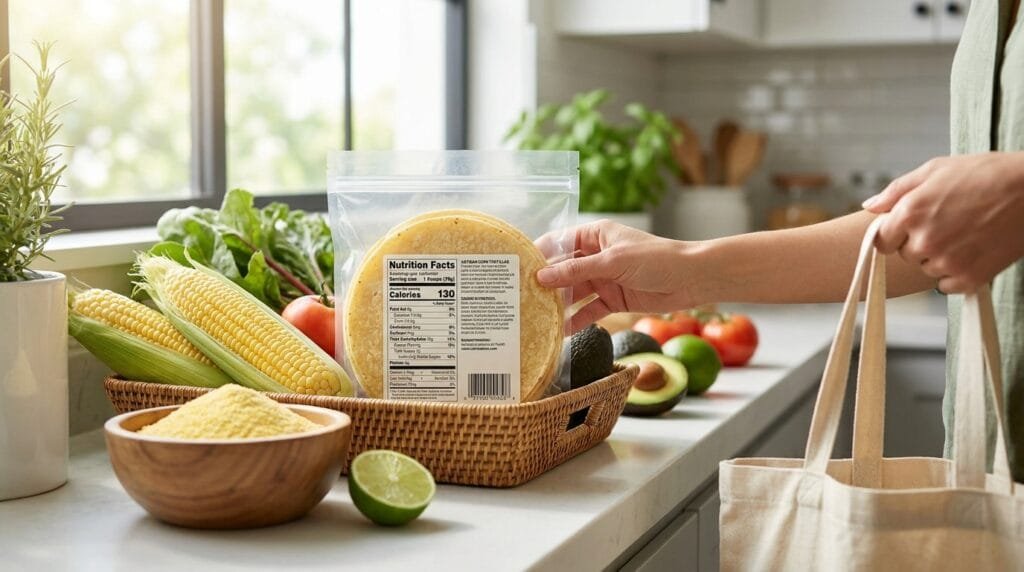
One standard 6-inch yellow corn tortilla (about 25 grams) has roughly 50 to 60 calories, 1 gram of fat, 11 to 12 grams of carbohydrates, 1.5 to 2 grams of dietary fiber, and 1 to 2 grams of protein.
How Traditional Nixtamalization Shapes Corn Tortilla Nutrition
A classic corn tortilla is naturally simple, made from ground field corn, water, and a mineral called calcium hydroxide (also known as slaked lime or pickling lime). This ancient preparation method, called nixtamalization, completely changes the nutritional value of raw corn. Steeping whole kernels in an alkaline water bath softens the tough outer hull and frees up bound niacin (vitamin B3). Without this step, your digestive system cannot easily absorb the natural vitamins tucked inside the grain. Nixtamalization also gives corn tortillas their pliable texture, earthy aroma, and a notable boost in bioavailable calcium.
Because authentic corn tortillas rely on whole ground kernels, they are naturally considered a whole-grain staple. Unlike stripped white flour products, corn retains its germ and bran, supplying slow-digesting complex carbohydrates alongside plant-based dietary fiber. Global health organizations consistently emphasize the daily role of whole-grain staples; for example, the World Health Organization Guidelines on Healthy Diets & Saturated Fats highlight whole grains as essential foundations for lowering cardiovascular disease risk and managing steady energy levels throughout the day.
However, when looking closely at modern supermarket shelves, not all corn tortillas share this exact ancient recipe. Traditional recipes use just three simple ingredients: ground corn, water, and lime. But shelf-stable packaged varieties sitting at room temperature often add vegetable gums (like cellulose gum or guar gum) to prevent tearing, along with preservatives such as propionic acid, sodium propionate, or fumaric acid to hold off mold. These additions are verified for consumer use under the European Food Safety Authority (EFSA) Additive Safety Regulations, yet they can alter digestion for sensitive individuals compared to fresh, warm stone-ground tortillas picked up directly from a local tortilleria counter.
Reading the Nutrition Facts: What Real Tortilla Labels Show
When you pick up a bag of Mission Yellow Corn Super Soft tortillas in an American grocery store, the Nutrition Facts panel immediately reveals a trap: serving sizes. The front of the bag might advertise low calories, but the official serving size is listed as 2 tortillas (50g), delivering 100 calories, 1.5 grams of total fat, 22 grams of total carbohydrates, 3 grams of dietary fiber, and 2 grams of protein, with zero added sugars. If you only eat a single taco, you are getting 50 calories; if you eat three street tacos, you have consumed 150 calories and 33 grams of carbohydrates. In contrast, smaller street-taco sizes like Guerrero Mini Corn Tortillas list a serving size of 3 mini tortillas (64g) for 120 calories and 25 grams of carbs.
If you purchase corn tortillas in Europe or the United Kingdom, such as Old El Paso Gluten Free Corn Tortillas, the label will look completely different. European labeling laws mandate values per 100 grams alongside optional per-unit values. On a 100-gram scale, standard corn tortillas register roughly 210 to 220 calories, 42 to 45 grams of carbohydrates, 5 to 6 grams of fiber, and 4 to 5 grams of protein. Shoppers traveling abroad or buying imported Mexican brands often mistake the 100g bolded calorie count (over 200 calories) for the energy in a single piece, not realizing that a single tortilla weighs only about 25 grams.
Sodium is another figure that demands a careful look. Plain nixtamalized corn contains almost zero natural sodium (often under 5 milligrams per tortilla). However, mass-market commercial brands frequently add salt for flavor preservation. A single mass-market tortilla can hold between 10 milligrams and 125 milligrams of sodium depending on whether salt appears on the ingredient list. When reviewing ingredients, look at how the manufacturer lists the grain: phrases like ‘whole grain corn’ or ‘corn masa flour treated with lime’ confirm traditional processing, whereas blends labeled ‘corn and wheat flour mix’ introduce gluten and significantly alter the carbohydrate-to-fat balance.
| Tortilla Type & Size | Serving Weight | Calories | Carbs | Fiber | Fat | Calcium |
|---|---|---|---|---|---|---|
| Standard Yellow Corn (6-inch, 1 piece) | 25g – 28g | 50 – 60 kcal | 11g – 12g | 1.5g – 2g | 0.5g – 1g | 40mg – 50mg |
| White Corn Tortilla (6-inch, 1 piece) | 24g – 26g | 50 – 55 kcal | 10g – 11g | 1.5g | 0.5g | 35mg – 45mg |
| Street Taco Mini Corn (1 piece) | 18g – 21g | 35 – 40 kcal | 8g | 1g | 0.5g | 25mg – 30mg |
| Blue Corn Tortilla (6-inch, 1 piece) | 26g – 30g | 55 – 65 kcal | 11g – 13g | 2g | 1g | 40mg – 50mg |
| Standard Flour Tortilla (for comparison, 8-inch) | 45g – 49g | 140 – 150 kcal | 24g – 25g | 1g | 3.5g – 4g | 50mg – 80mg |
Why Shopping for Corn Tortillas Shouldn’t Be This Hard
Standing in the bread aisle after a long workday, holding three different bags of tortillas while kids pull at your sleeve, can feel overwhelming. One package proudly claims ‘All Natural’, another says ‘Gluten-Free’, and a third highlights ‘Low-Fat’, but the text on the back is printed in microscopic, faint ink across folded plastic seams. Real shoppers do not have fifteen minutes to squint at tiny numbers, calculate how many tortillas are in a 58-gram serving, or cross-reference whether an emulsifier could upset a sensitive stomach. This is why having Food Scan Genius on your phone makes sense. With a quick two-second scan of the barcode right in Aisle 4, you get an immediate sanity check showing the true calories, net carbs, and declared allergen warnings from the manufacturer’s label before tossing the bag into your cart.
It is also crucial to remember that Food Scan Genius relies strictly on the physical ingredient and nutrition declarations printed directly on the product’s packaging by the manufacturer. If a brand does not declare an ingredient, allergen trace, or specific nutrient value on its wrapper, that information cannot appear in our database. The manufacturer holds sole legal and practical responsibility for their packaged declarations. Our tool simply reads and presents their printed data clearly and instantly so you never have to do math while trying to get taco night on the table.
A widespread mistake consumers make in the tortilla aisle is assuming every corn tortilla is naturally 100% gluten-free. While pure corn contains zero gluten, several commercial brands manufacture corn tortillas on shared conveyor belts and baking presses that also process wheat flour tortillas. Families managing celiac disease or severe wheat allergies should always check for physical packaging statements certified under Food Allergy Research & Education (FARE) Clinical Standards. Another common pitfall is ignoring the difference between minimally processed tortillas and those with extensive industrial additive lists; exploring PubMed Research on Ultra-Processed Foods & Gut Microbiome Disruption reminds us why short, recognizable ingredient lists with minimal synthetic texturizers remain the gold standard for gut comfort.
Frequently asked questions
Are corn tortillas healthier than flour tortillas?
For most people, corn tortillas offer distinct advantages over flour tortillas. A 6-inch corn tortilla typically contains half the calories (50-60 kcal versus 120-150 kcal) and about a third of the fat of an equivalent flour tortilla, while providing more whole-grain fiber and no trans fats.
Do corn tortillas spike blood sugar quickly?
Corn tortillas have a low-to-moderate glycemic index, usually between 46 and 52. Because authentic corn tortillas are whole grains packed with natural fiber and complex starches, they release glucose into the bloodstream far more gradually than refined white flour products.
How many net carbs are in a regular corn tortilla?
A standard 6-inch yellow corn tortilla has about 9.5 to 10.5 grams of net carbohydrates. You find this number on the label by taking the total carbohydrates (approximately 11 to 12 grams) and subtracting the dietary fiber (about 1.5 to 2 grams).
Why do corn tortillas have so much calcium?
The calcium comes from the traditional preparation process called nixtamalization, in which raw field corn is soaked and cooked in water containing calcium hydroxide (slaked lime). The corn absorbs this mineral, providing roughly 40 to 50 milligrams of calcium per single tortilla.
Are white, yellow, and blue corn tortillas nutritionally different?
Nutritionally, they are very similar, but blue corn tortillas naturally contain anthocyanins (the same antioxidants found in blueberries) and offer slightly more protein and a slightly lower glycemic index. Yellow corn tortillas carry more beta-carotene (vitamin A precursors) than white corn varieties.
References
- Food Allergy Research & Education (FARE) Clinical Standards
- European Food Safety Authority (EFSA) Additive Safety Regulations
- PubMed Research on Ultra-Processed Foods & Gut Microbiome Disruption
- World Health Organization Guidelines on Healthy Diets & Saturated Fats
Related guides
- Best Food Allergy Scanner App – Scan Food Labels Instantly — Food Allergy & Sensitivity Scanner Hub
- The 7 Best Free Food Scanner Apps of 2026 — best free food scanner apps
- Choosing the Best Barcode Scan App for Your Health — guide to choosing a barcode scanner app
- Food Scan Genius: World’s #1 Food Ingredient Scanner App — Food Scan Genius scanner app
Check Any Label Against 5 Million Products — Free
Never second-guess confusing grocery labels again. Download Food Scan Genius to uncover hidden additives, toxic dyes, and allergens for the whole household before you buy.