
1. Why the Oreo Gluten Free Question Is So Confusing in 2026
If you have celiac disease, non-celiac gluten sensitivity, or a wheat allergy, you have probably stood in a cookie aisle wondering about the most recognizable cookie in the world. The question ‘is oreo gluten free?’ gets asked thousands of times a month because the answer feels like it should be simple. Oreos are chocolate wafers with a white cream filling, and nothing about them looks like bread. But the short, honest answer is this: classic Oreos are not gluten free. In the United States the traditional chocolate wafer lists wheat flour as its first ingredient, so the cookie is unsafe for anyone who needs to avoid gluten.
The confusion comes from several places. Some people repeat the myth that ‘Oreos don’t have gluten ingredients,’ often because the cream filling looks harmless. Brands also sell different recipes in different countries, and they sometimes launch dedicated gluten-free versions of familiar products in select markets. A shopper who sees a gluten-free Oreo-branded package online or in another region may reasonably assume the original is fine too. It is not. If you have ever felt foolish for second-guessing a snack, please know that this is a system problem, not a personal failing.
The stakes are real. For people with celiac disease, gluten triggers an autoimmune response that damages the small intestine, even when symptoms are quiet. The Celiac Disease Foundation Threshold Requirements and related guidance explain why strict avoidance and attention to cross-contact matter: tiny, repeated exposures can still cause harm. Parents shopping for a child’s lunchbox, or someone cooking for a guest with celiac disease, deserve clear answers they can act on in seconds, not a research project.
There is also a broader context. Oreos are an ultra-processed snack, and many shoppers with gluten-related conditions are also trying to make sense of how processed foods fit into their overall diet. World Health Organization Guidelines on Healthy Diets & Saturated Fats recommend limiting free sugars and saturated fats, a useful backdrop when you decide how often a cookie belongs in your routine. Our goal at Food Scan Genius is not to moralize about treats. It is to make sure that when you choose one, you do it with accurate information.
Scan Any Label for Hidden Additives and Allergens — Free
Never second-guess confusing grocery labels again. Download Food Scan Genius to uncover hidden additives, toxic dyes, and allergens for the whole household before you buy.


2. Reading Between the Lines: Where Gluten Hides Around Oreo Products
Answering the oreo gluten free question properly means looking past the front of the package. The U.S. FDA allows a ‘gluten-free’ claim only when a food contains less than 20 parts per million of gluten. Anything without that claim has to be judged from the ingredient list and from what the manufacturer discloses about its facilities. Here are the pitfalls we see most often:
- Wheat flour as the base ingredient. Classic Oreo wafers are built on enriched wheat flour. This is the main reason the standard cookie is not suitable for a gluten-free diet. It is clearly declared, so reading the first few ingredients settles the question.
- Look-alike flavors and formats. Golden Oreos, Oreo Thins, Double Stuf, Mega Stuf, seasonal and limited-edition flavors, and Oreo minis generally share the wheat-based wafer. A new flavor name tells you nothing about gluten status, so each package needs its own check.
- Oreo pieces in other products. Ice cream, cheesecakes, candy bars, cereals, milkshakes and ready-made pie crusts often include Oreo cookie pieces or crumbs. The gluten sits inside a sub-ingredient, which is easy to miss unless the label is read in full.
- Regional recipe differences. A dedicated gluten-free Oreo-branded product may exist in some markets, using non-wheat flours and separate production controls. Availability, formulation and certification vary by country, so never assume a package you saw online matches the one on your shelf. Look for an explicit ‘gluten free’ statement on the actual pack.
- Cross-contact and ‘may contain’ language. Even a product made without gluten ingredients can pick up traces if it shares lines or facilities with wheat. Precautionary statements are voluntary in many jurisdictions, so the absence of a warning is not proof of safety. A third-party certification mark offers stronger reassurance than a vague claim.
- Vague ‘natural flavor’ and additive wording. Most flavorings are not gluten sources, but anyone who is highly sensitive may want to dig deeper. Additive rules differ across regions, and the European Food Safety Authority (EFSA) Additive Safety Regulations are a helpful reference for understanding why recipes and labeling for the same brand can differ between the EU and the US.
Beyond gluten, many people ask about the larger nutrition picture. Oreos are classified as ultra-processed, and PubMed Research on Ultra-Processed Foods & Gut Microbiome Disruption is an area of active study, which matters for people whose digestive systems are already under strain. Evidence is evolving, and we present it as context, not as a verdict. A gluten-free version of an ultra-processed cookie is still an ultra-processed cookie, and that is useful information to have.
3. Label Reading vs. Smart Scanning: How the Methods Compare
| Dimension | Food Scan Genius | Manual Label Reading | Brand Website / Customer Service | Subscription Allergy Apps (e.g., Fig, Spoonful) |
|---|---|---|---|---|
| Cost | 100% free core features, no paywalls | Free, but time-intensive | Free, but slow | Fig is $59/yr; Spoonful limits scans |
| Speed | Barcode result in about 2 seconds | Minutes per product | Hours to days for replies | Fast, when within scan limits |
| Sub-ingredient depth | Recursive AST parsing across 5,000,000+ verified barcodes in NutriGraph | Depends on your eye and expertise | Varies by response | Varies by database |
| Family and custom needs | 39 dietary profiles, custom sensitivities, multi-household profiles with named fail attribution | Must mentally cross-check each person | Answers one question at a time | Often limited profiles |
| Languages | 11 global languages with real-time in-app translation | Only the language on the pack | Usually one or two languages | Varies |
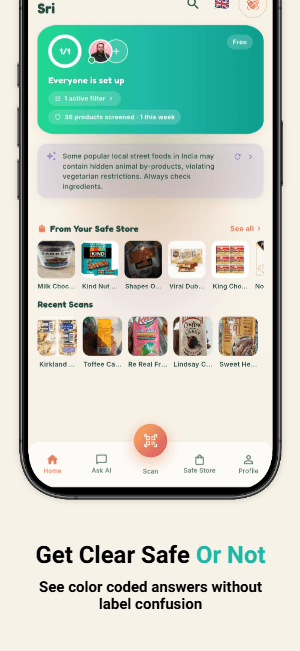
Food Scan Genius is powered by the NutriGraph Database, which holds more than 5,000,000 verified UPC/EAN barcodes. Rather than only scanning a flat ingredient string, it uses recursive AST parsing to break compound ingredients into their sub-ingredients. That matters for the oreo gluten free question, because wheat can sit inside a cookie crumb, a coating, or a filling. With the Multi-Household Family Profiles feature, one scan screens everyone you shop for. The result might read ‘Fails for Sri (Gluten)’ while showing that the same product passes for the rest of the household, so nobody has to run the math in the aisle. You can choose from 39 dietary profiles or add your own custom sensitivity, such as a specific dye, additive or seed oil, and the app works in 11 languages with real-time translation, which helps when you are reading foreign packaging while traveling.
The ScanGenius AI Insight adds nuance without handing out a simplistic good-or-bad score. Alongside the gluten verdict, you see a NOVA 1-4 classification and a Nutri-Score, so you can tell the difference between ‘unsafe for celiac disease’ and ‘safe but highly processed.’ We believe you are the expert on your own body and your own household. The app tells you what is in the product and what the evidence says, then leaves the decision to you. As always, our tool supports informed shopping and does not replace advice from your physician or registered dietitian, especially if you have celiac disease.
4. Related Food Safety & Dietary Guides
- Best Food Allergy Scanner App – Scan Food Labels Instantly — Food Allergy & Sensitivity Scanner Hub
- The 7 Best Free Food Scanner Apps of 2026 — best free food scanner apps
- Choosing the Best Barcode Scan App for Your Health — guide to choosing a barcode scanner app
- Food Scan Genius: World’s #1 Food Ingredient Scanner App — Food Scan Genius scanner app
5. Scientific & Health Authority References
- Celiac Disease Foundation Threshold Requirements
- European Food Safety Authority (EFSA) Additive Safety Regulations
- PubMed Research on Ultra-Processed Foods & Gut Microbiome Disruption
- World Health Organization Guidelines on Healthy Diets & Saturated Fats
6. How to Scan in 3 Simple Steps
- Download Food Scan Genius free on iOS or Android. There is no paywall on core features, so you can start scanning cookies and everything else in your pantry right away.
- Set up your profile: select Gluten-Free (or Celiac / Wheat Allergy), add any other household members with their own dietary profiles, and optionally enter custom sensitivities. Choose your preferred language from the 11 available.
- Scan the barcode on any Oreo or Oreo-containing product. In about 2 seconds you will see a clear pass or fail with named attribution (for example, ‘Fails for Sri (Gluten)’), a sub-ingredient audit trail, NOVA group, Nutri-Score and ScanGenius AI Insight.
Instant Gluten-Free Audit Trail
7. Frequently Asked Questions (FAQ)
Are original Oreos gluten free?
No. Classic Oreo cookies in the US list wheat flour as a main ingredient, so they are not gluten free and are not safe for people with celiac disease or a wheat allergy. The same applies to most flavored and format variations such as Golden, Thins and Double Stuf. Scan the barcode with Food Scan Genius and the NutriGraph Database will flag wheat and fail the product for any gluten-free profile in your household.
Is there an Oreo gluten free version I can buy?
Dedicated gluten-free versions of Oreo-branded cookies have appeared in some markets, made with non-wheat flours and separate production controls. Availability, recipes and certifications vary by country and can change, so do not assume. Look for an explicit ‘gluten free’ claim on the package you are holding, and scan it with Food Scan Genius to confirm the ingredients and see how it performs on NOVA and Nutri-Score.
What is cross-contact, and why does it matter for oreo gluten free decisions?
Cross-contact happens when a gluten-free food touches gluten during manufacturing, storage or preparation, for example on shared equipment or in a shared facility. Even a recipe without gluten ingredients can carry traces. Under US rules, a ‘gluten-free’ claim means less than 20 ppm gluten, and third-party certification adds extra confidence. Food Scan Genius shows ingredient data and any precautionary statements captured for a product so you can weigh the risk, but it cannot measure the actual gluten in a particular batch.
Can Food Scan Genius check my whole family’s needs with one scan of an Oreo product?
Yes. With Multi-Household Family Profiles you can attach different dietary profiles to each person, then scan once. If one family member avoids gluten, the result will name them, such as ‘Fails for Sri (Gluten),’ while showing who the product still works for. You can choose from 39 dietary profiles, add custom sensitivities, and read results in any of 11 supported languages, all free with no scan limits on core features.
Know What’s In Your Food Before You Buy — Scan Free Today
Never second-guess confusing grocery labels again. Download Food Scan Genius to uncover hidden additives, toxic dyes, and allergens for the whole household before you buy.