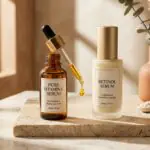
1. Mechanism of Retinol Formulations for the Body
A retinol lotion for the body is an emulsion delivering vitamin A derivatives to accelerate epidermal cellular turnover, stimulate dermal fibroblasts, and smooth hyperkeratinized tissue across broad, non-facial skin regions like the limbs, chest, and back.
While facial skin is frequently exposed to environmental insults, extrafacial skin presents distinct physiological challenges. The stratum corneum on the extremities is significantly thicker than on the face, with a slower baseline desquamation rate. This disparity frequently manifests as dullness, xerosis, and stubborn textural irregularities. When applied topically, retinol penetrates the stratum corneum, undergoes intracellular enzymatic conversion into retinaldehyde, and subsequently converts into all-trans retinoic acid. Retinoic acid binds to nuclear retinoic acid receptors (RAR) and retinoid X receptors (RXR), directly upregulating genes responsible for keratinocyte proliferation, structural protein synthesis, and glycosaminoglycan production.
In body formulations, the vehicle plays an essential pharmacological role. Because the surface area of the body is substantially larger than the face, systemic tolerability and cutaneous barrier preservation require sustained-release mechanisms. Standard formulations integrate lipophilic carriers such as squalane, caprylic/capric triglycerides, or shea butter to mitigate transepidermal water loss (TEWL) while the active compound undergoes biological conversion. Without this balanced lipid matrix, broad-surface application of vitamin A risks significant localized barrier breakdown, characterized by severe erythema, itching, and widespread peeling.
2. Formulation Science: Molecular Forms, Percentages, and pH
Body-grade retinoid formulations vary widely in their active chemical profiles, potency, and biochemical delivery systems. Identifying the specific molecule on an ingredient label dictates expected clinical outcomes and skin tolerance:
- Pure Retinol: Highly effective and backed by decades of clinical data. In body treatments, therapeutic concentrations typically range from 0.05% to 0.5%. Formulations exceeding 0.1% require cautious introduction due to retinization potential across large surface areas.
- Encapsulated Retinol: Retinol trapped within phospholipid or cyclodextrin microspheres. This system protects the unstable molecule from oxidative degradation while enabling time-released penetration, markedly reducing local irritation while maintaining receptor binding efficacy.
- Hydroxypinacolone Retinoate (HPR): A cosmetic retinoid ester that binds directly to cellular retinoic acid receptors without requiring metabolic conversion. It provides superior stability and lower erythema indices, typically formulated between 0.05% and 0.2%.
- Retinyl Palmitate: A weaker ester combining retinol and palmitic acid. It requires three enzymatic conversion steps (to retinol, retinaldehyde, and retinoic acid), serving primarily as an antioxidant with minimal impact on structural collagen remodeling.
Formulation chemistry also demands strict parameter controls. Retinol degrades rapidly when exposed to ultraviolet light, heat, and oxygen, necessitating airless or opaque, UV-shielded packaging. The chemical stability of pure retinol in an oil-in-water or water-in-oil emulsion requires a strictly neutral-to-slightly alkaline formulation pH, typically maintained between 5.5 and 6.5. If the pH drops below 5.0, the ester bonds and polyene chain of the retinol molecule become prone to rapid isomerization into inactive cis-conformations, rendering the product biologically ineffective.
3. Target Indications: Photoaging, Keratosis Pilaris, and Texture
Extrafacial retinoids address structural and textural cutaneous changes that standard moisturizing creams cannot resolve. The primary target indication is solar elastosis and actinic damage of the decollete and dorsal hands. The skin overlying the sternum has lower sebaceous gland density than facial skin, rendering it vulnerable to rapid collagen depletion, pigmentary mottling, and thinning. Daily or alternate-evening application of a low-dose retinol lotion stimulates procollagen type I synthesis and reorganizes degraded elastin fibers in these fragile zones.
Another primary clinical application is follicular hyperkeratosis, commonly known as keratosis pilaris. This hereditary keratinization defect causes dead corneocytes to plug hair follicles, producing rough, erythematous papules along the triceps, anterior thighs, and buttocks. By normalizing follicular desquamation, retinol prevents the accumulation of cohesive squames within the infundibulum. While mild cases respond well to cosmetic retinoid emulsions, patients presenting with severely inflamed, coalescing papules, deep cystic lesions, or extensive plaques suggestive of eczema or psoriasis should be evaluated by a board-certified dermatologist for specialized interventions.
Furthermore, regular use improves localized post-inflammatory hyperpigmentation (PIH). Whether triggered by body acne (common on the upper back and chest) or superficial micro-abrasions, retinoid-mediated desquamation accelerates the shedding of melanized basal keratinocytes, disperses clustered melanosomes, and yields a more uniform epidermal tone across expansive skin surfaces.
4. Routine Integration, Active Interactions, and Layering Rules
Proper application sequencing is critical to achieving therapeutic benefits without triggering systemic barrier failure. Retinol body lotions must always be applied in the evening onto completely dry skin. Applying retinoids to damp skin post-shower exponentially increases transdermal flux, causing rapid, uncontrolled penetration that provokes acute irritant contact dermatitis. Patients should bathe with a gentle, non-stripping syndet bar or lipid-replenishing wash, pat dry, wait 10 to 15 minutes for cutaneous equilibrium to restore, and then apply the retinoid lotion uniformly.
Managing active ingredient collisions is where consumers make the most damaging errors. Body care routines frequently feature leave-on acids, high-strength cleansers, and physical scrubs:
- Alpha and Beta Hydroxy Acids (AHAs/BHAs): Glycolic acid (typically 8% to 15% in body lotions) and lactic acid operate at an acidic pH range of 3.0 to 3.8. Layering these directly over or under a retinol lotion destabilizes the retinoid molecule and disrupts stratum corneum cohesion. Separate their use by alternating nights or using chemical exfoliants on designated evenings.
- Benzoyl Peroxide: Commonly used for truncal acne, benzoyl peroxide acts as a potent oxidizing agent that oxidatively degrades pure retinol, rendering both compounds biologically inert. Use benzoyl peroxide washes in the morning and reserve retinol for evening application.
- Physical Scrubs: Loofahs, dry brushes, and granular scrubs create micro-fissures in the barrier. Pairing mechanical abrasives with topical vitamin A dramatically elevates the risk of secondary infections and severe inflammation.
- Heavy Occlusives (Petrolatum): Slugging the entire body over a high-strength retinol traps the active under an impermeable barrier, heightening irritation through increased percutaneous absorption.
If you are combining multiple active products—such as an active acne wash followed by an anti-aging body treatment—it is prudent to use Skin Scan Genius to audit the combined formulas. Scanning both product barcodes ensures you are not unknowingly stacking compounding irritants or destabilizing molecular pH balances within the same routine.
5. Mitigating Retinization Across Large Body Surface Areas
Retinization on the body can present differently than on the face. Because clothing applies continuous friction to the limbs and torso, early retinoid dermatitis can present as stinging, severe xerosis, or sandpaper-like roughness rather than localized facial flaking. This is especially true around dynamic flexural zones, including the antecubital fossae, popliteal spaces, and the axillae. Retinol lotions should generally bypass these high-friction, intertriginous areas to avoid severe mechanical and chemical abrasion.
To build tolerance safely, follow a conservative titration protocol:
- Weeks 1 to 2: Apply the formula two non-consecutive evenings per week. Monitor skin responses for 48 hours following each application.
- Weeks 3 to 4: Increase application frequency to three evenings per week if there is no persistent erythema or stinging during bathing.
- Weeks 5 and beyond: Transition to nightly use only if the skin barrier demonstrates full homeostasis and zero baseline dryness.
Barrier fortification during this introductory period is mandatory. The formula you choose should contain native stratum corneum lipids: a physiological 3:1:1 ratio of ceramides (especially Ceramide NP, AP, and EOP), cholesterol, and free fatty acids. Supporting actives like niacinamide (2% to 4%) help stimulate endogenous ceramide synthesis, while panthenol, glycerin, and colloidal oat calm active hyperreactivity. Before adding an unverified treatment to your regimen, running it through Skin Scan Genius allows you to cross-reference the exact lipid composition of the lotion with your personal tolerance profile, ensuring your barrier remains structurally sound throughout the adaptation phase.
Check it against your own routine. Skin Scan Genius reads a product’s full INCI list and flags conflicts with the actives you already use, by skin type and concern.
Frequently asked questions
Can I use facial retinol on my body instead of a dedicated body lotion?
Yes, facial retinol works biologically on extrafacial skin, but it is rarely practical. Facial formulations are packaged in small volumes (typically 30 ml) and are cost-prohibitive for broad application, while lacking the richer emollient bases required to hydrate thicker body skin.
Is retinol body lotion safe to use on keratosis pilaris every day?
Daily use should not be started immediately. Even though retinol helps unclog the follicular hyperkeratosis characteristic of keratosis pilaris, you must titrate usage starting at twice weekly to prevent localized retinoid dermatitis. If irritation occurs, frequency must be reduced.
Do I need to wear sunscreen on my body if I apply retinol only at night?
Yes, photoprotection remains essential. Retinoids increase cellular turnover and thin the superficial stratum corneum, elevating cellular vulnerability to UV damage. Broad-spectrum SPF 30 or higher must be applied to all exposed areas previously treated with retinol, such as the neck, chest, and arms.
Can retinol lotion be applied immediately after shaving or waxing?
No, you should never apply retinol immediately after hair removal. Shaving and waxing temporarily compromise the stratum corneum and induce micro-trauma. Applying vitamin A to sensitized skin causes acute burning, marked erythema, and heightened risk of contact dermatitis; wait at least 24 to 48 hours.