1. What RoC’s Retinol Correxion Deep Wrinkle night cream actually is
RoC’s Retinol Correxion Deep Wrinkle night cream is an over-the-counter retinol moisturiser. It is mild to moderate in strength, aimed at fine lines, and best used slowly, at night, with daily sunscreen.
The active is retinol, a vitamin A alcohol. It is not a prescription retinoid. Skin enzymes convert retinol to retinaldehyde and then to retinoic acid, the form that binds retinoic acid receptors and changes gene expression in keratinocytes and fibroblasts. Each conversion step loses potency, so retinol is gentler and slower than prescription tretinoin. That trade-off is why it is sold without a prescription.
RoC markets the line around a stabilised retinol system. The percentage is generally not printed on the pack, and I will not guess it. Over-the-counter retinol products usually fall between about 0.01% and 1%. The brand’s own product page or the packaging is the only reliable source for your regional version, because formulations differ between the US, UK and EU.
Retinol is unstable in light and air, so check how the product is packaged. Tubes and airless pumps protect it better than open jars, which expose the formula to air every time you use it. Also note that this is the night product. RoC sells separate daytime moisturisers with sunscreen, and the night cream should not be treated as sun protection.
2. What the evidence supports, and what it does not
Topical retinoids are among the best-studied ingredients for photoaged skin. Controlled trials show that retinol, used consistently over about 12 weeks or longer, can improve the appearance of fine lines, roughness and uneven pigmentation. Histological studies show increased epidermal thickness and collagen-related changes. Results build gradually, and most visible change comes after months rather than weeks.
There are limits to what this means for a single product:
- Deep wrinkles respond less than fine lines. Creases formed by repeated muscle movement and volume loss are not meaningfully erased by a cosmetic retinol. Expect softer-looking fine lines, not removal of deep folds.
- Concentration and delivery both matter. A modest retinol in a well-formulated base can outperform a higher percentage that has degraded on the shelf.
- Brand claims are not trial data. Look for the study design behind any percentage-improvement claim, including sample size, duration and whether there was a vehicle control.
The base formula matters as much as the active. Read the ingredient list for humectants such as glycerin, emollients such as dimethicone or ceramides, and an antioxidant stabiliser such as tocopherol. A good base lowers the dryness that makes people quit retinoids before they see any benefit. Fragrance is worth noting if your skin is reactive, because it is a common contact allergen.
3. Layering order and which actives clash with it
Retinol rarely fails because of the molecule. It fails because of what is stacked around it. The principles are simple: apply thinnest to thickest, keep strongly acidic products away from it, and do not stack several irritants on the same night.
A workable evening order:
- Cleanse with a gentle, low-foaming cleanser (pH roughly 5 to 6 is kinder to the barrier than high-pH soaps).
- Apply any water-based hydrating serum, such as hyaluronic acid or 2 to 5% niacinamide, to damp skin.
- Apply a pea-sized amount of the retinol cream to the whole face, avoiding the eyelids, corners of the nose and mouth.
- Seal with a plain moisturiser or ceramide cream if your skin feels tight.
Some people apply retinol to fully dry skin to limit penetration and irritation. Others use the sandwich method, with moisturiser before and after. Both are reasonable if your skin is dry or reactive.
Interactions to manage:
- Exfoliating acids. Glycolic acid (commonly 5 to 10% at pH 3 to 4) and salicylic acid (0.5 to 2%) both remove surface cells. Used on the same night as retinol, they raise the chance of irritation. Alternate nights instead.
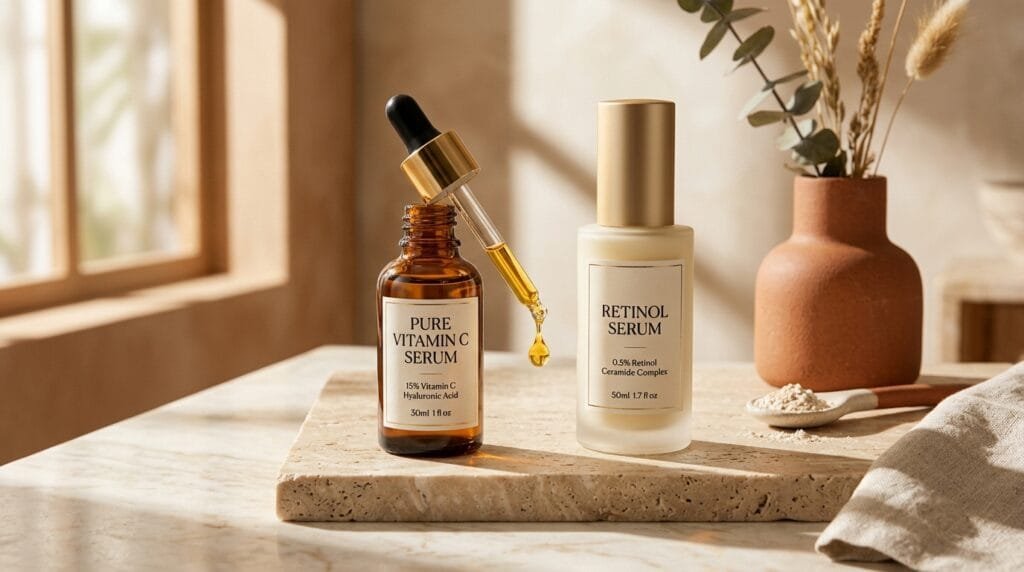
- Vitamin C. L-ascorbic acid works best at 10 to 20% and below pH 3.5. That is a very different environment from retinol, which is happier in a milder pH. Most people use vitamin C in the morning and retinol at night, which avoids the problem.
- Benzoyl peroxide (2.5 to 10%). It is an oxidiser and can degrade retinoids. Use it in the morning or on separate nights, unless a clinician has told you otherwise.
- Niacinamide and peptides. These pair well with retinol and may help tolerance.
- Prescription retinoids. Do not double up on tretinoin, adapalene or tazarotene with an over-the-counter retinol without medical guidance.
4. How to start, who it suits and when to stop
Begin with two nights a week for the first two weeks. If your skin is comfortable, move to three or four nights, then to nightly use over four to six weeks. Some dryness, mild peeling and tightness in the first weeks is common and is often called retinisation. Burning, persistent redness, swelling or stinging with moisturiser are signs to stop and reassess.
This type of cream tends to suit normal, dry or mature skin and people new to retinoids, because the emollient base cushions the active. If your skin is oily or acne-prone, a heavy cream may feel occlusive, so check the ingredient list for rich oils and waxes you know you react to. If you have a known barrier problem such as eczema, or a diagnosed condition such as rosacea or melasma, see a dermatologist before starting. Retinoids can aggravate some of these conditions, and melasma in particular needs a supervised plan with strict sun protection.
Retinoids are generally avoided in pregnancy and while trying to conceive, so check with your doctor or pharmacist before using one.
Wear broad-spectrum SPF 30 or higher every morning. Retinol does not make the skin burn in the way some people fear, but it thins the outer layer temporarily and sun exposure undoes the benefit you are trying to build.
If you are unsure how this cream fits with the acids, serums and prescription products already on your shelf, Skin Scan Genius can read the barcode and check the formula against your routine and skin type. It flags overlapping or conflicting actives before you combine them. A scan is no substitute for a dermatologist’s advice on a diagnosed condition, but it catches the stacking mistakes that cause most irritation.
Check it against your own routine. Skin Scan Genius reads a product’s full INCI list and flags conflicts with the actives you already use, by skin type and concern.
Frequently asked questions
Is RoC Retinol Correxion strong enough to work?
It is a legitimate over-the-counter retinol, so it can improve fine lines and texture with consistent use over around 12 weeks or more. It is weaker than prescription tretinoin, and the exact retinol percentage is not always printed on the pack, so check the brand’s information for your region.
Can I use RoC retinol cream with vitamin C?
Yes, but in separate routines. Use vitamin C (L-ascorbic acid usually works at 10 to 20% and below pH 3.5) in the morning and the retinol cream at night. This avoids pH conflicts and reduces the risk of irritation.
How often should I apply it?
Start with two nights a week for about two weeks, then increase to every other night and then nightly if your skin tolerates it. Pause or drop back if you get stinging, persistent redness or flaking that does not settle with moisturiser.
Can I use it with salicylic or glycolic acid?
Avoid applying them on the same night, especially while your skin is adjusting. Alternate evenings, for example acid on one night and retinol on the next, and stop adding actives if your skin becomes tight, sore or red.