
1. The Rise of Seed Oil Awareness in Modern Nutrition
Over the past few years, millions of health-conscious shoppers, metabolic health advocates, and ancestral nutrition practitioners have made a profound realization: highly refined industrial seed oils are ubiquitous across the modern supermarket.
You pick up a jar of mayonnaise marketed as “Made with Olive Oil”, turn the jar around to read the tiny ingredients panel, and discover that the first and primary oil listed is actually Soybean Oil or Canola Oil, with just a token droplet of olive oil added for marketing claims. You check a bag of organic potato chips, store-bought hummus, frozen stir-fry veggies, or oat milk, and find industrial seed oils lurking in virtually every single item.
For shoppers seeking to reduce chronic systemic inflammation, improve mitochondrial function, and restore ancestral omega-6 to omega-3 fatty acid balance, grocery shopping has become an exhausting label-reading marathon. You shouldn’t have to inspect 50 lines of microscopic print just to find food cooked in real, unadulterated fats.
Scan Any Barcode for Inflammatory Seed Oils in 2 Seconds
Never second-guess confusing grocery labels again. Download Food Scan Genius to uncover hidden additives, toxic dyes, and allergens for the whole household before you buy.


2. Why Industrial Seed Oils Trigger Systemic Inflammation
Unlike traditional fruit and animal fats (such as extra virgin olive oil, avocado oil, coconut oil, and grass-fed tallow) which are cold-pressed or rendered gently, industrial seed oils require harsh chemical processing:
- Chemical Hexane Extraction: Seeds like rapeseed and cottonseeds contain very little oil naturally. They must be crushed and washed in chemical petroleum solvents (hexane) at high temperatures to extract the lipids.
- High Heat & Oxidation: The intense heat and pressure applied during refining oxidize fragile polyunsaturated fatty acids (PUFAs), producing harmful lipid peroxides, aldehydes, and trans fat byproducts before the oil even reaches supermarket shelves.
- Excessive Omega-6 Linoleic Acid: Evolutionary human diets maintained an omega-6 to omega-3 ratio of approximately 1:1 to 4:1. The dominance of industrial seed oils in processed foods has skewed modern ratios to an inflammatory 20:1, contributing to insulin resistance, gut barrier permeability, and cardiovascular strain.
3. Sneaky Seed Oil Camouflage: Where Brands Hide Canola & Soybean Oil
Food corporations use clever labeling loopholes to mask cheap seed oils from discerning shoppers:
- “Vegetable Oil Blend”: A catch-all label that almost always contains the cheapest available commodity soybean, corn, or palm oil.
- “Olive Oil” Mayonnaise & Dressings: Legally allowed to use “Olive Oil” on the front label as long as a tiny percentage is present, while 90%+ of the liquid is cheap soybean or canola oil.
- Plant-Based & Oat Milks: Many commercial barista blends emulsify dipotassium phosphate with canola or rapeseed oil to create a creamy texture.
- Restaurant-Style Tortilla Chips: Often fried in high-temperature corn or cottonseed oil, even when labeled non-GMO.
Multi-Diet Stacking, AI Insights & Household Profiles
Food Scan Genius does not force you into a single rigid score. Combine 39 pre-set dietary filters, add custom personal ingredients, and screen for your entire household in one pass.
🧬 39 Supported Diets
Gluten-Free, Halal, Kosher, Low-FODMAP, Keto, Vegan, Nut-Free, and Clean Label combined freely.
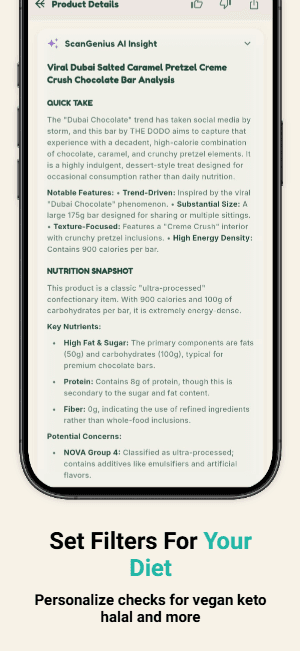
🧠 ScanGenius AI Insight
Nuanced ingredient descriptions and NOVA processing classifications without simplistic scores.
👨👩👧👦 Household Profiles
Screen for your partner, children, and guests in a single scan with named attribution.
4. Comparison Matrix: How Scanner Apps Detect Seed Oils
| Feature | Food Scan Genius | Bobby Approved | Yuka App | Fig App |
|---|---|---|---|---|
| Automated Seed Oil Flagging | Deterministic Rule Matching | Curated (Small Catalog) | None (Scores Fat Grams) | Paid Tier ($59/yr) |
| Deep Sub-Ingredient Parsing | Recursive AST Analysis | Manual Review | Shallow Match | Store Dependent |
| Database Scale | 5,000,000+ Barcodes | Curated List | Crowdsourced | Store Specific |
| Pricing / Cost | 100% Free Core Features | Paid Subscriptions | Freemium | $59.99/year |
5. How to Screen Out Seed Oils in 3 Simple Steps
- Download Food Scan Genius: Available free for iOS and Android.
- Add Seed Oils to Your Preferences: Set your dietary profile to flag canola, soybean, and industrial vegetable oils, or add custom oil sensitivities.
- Scan in the Aisle: Point your camera at any grocery barcode to receive an instant ingredient audit trail in under 2 seconds.
Instant Seed Oil & Additive Audit Trail
6. Frequently Asked Questions (FAQ)
What are the ‘Hateful Eight’ seed oils to avoid in grocery products?
The primary refined industrial seed oils include Canola (Rapeseed) Oil, Soybean Oil, Corn Oil, Cottonseed Oil, Sunflower Oil, Safflower Oil, Grapeseed Oil, and Rice Bran Oil. These oils undergo high-heat refining, chemical bleaching, and deodorizing using hexane solvents.
Why are seed oils in almost every packaged snack and dressing?
Seed oils are heavily subsidized and cost a fraction of cold-pressed extra virgin olive oil, avocado oil, or grass-fed butter. Food manufacturers use them as cheap emulsifiers and shelf-life extenders.
Can Food Scan Genius flag seed oils hidden inside sub-ingredients?
Yes! Unlike basic apps, Food Scan Genius’s 5M+ NutriGraph database performs deep AST sub-ingredient parsing to detect soybean oil or canola oil hidden inside seasoning blends, baked goods, and dressings.
Can I add custom seed oil rules to my scanning profile?
Yes! Through our ‘Add Your Own Custom Sensitivity’ feature, you can add any specific oil, additive, or personal dislike (e.g. Cottonseed Oil, Palm Oil) to your automated alert profile.
Eliminate Seed Oils From Your Pantry — Scan Free Today
Never second-guess confusing grocery labels again. Download Food Scan Genius to uncover hidden additives, toxic dyes, and allergens for the whole household before you buy.