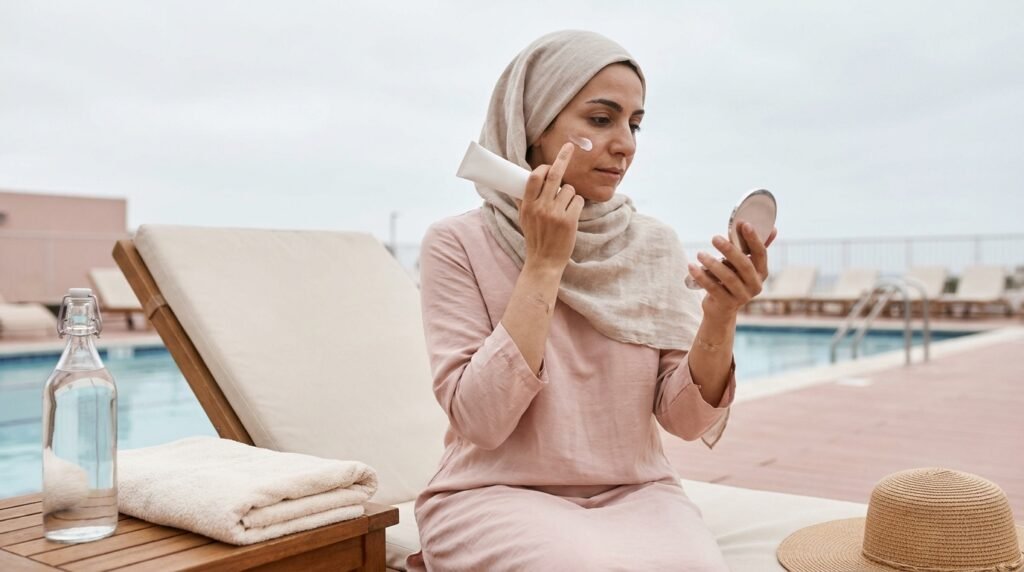
1. The short answer: SPF 30 minimum, with UVA protection that matches
Black skin needs a broad-spectrum sunscreen of SPF 30 or higher every day, with high UVA protection (PA+++ or above, or a UVA seal) and generous application. SPF 50 suits those prone to dark marks.
Melanin does protect. Laboratory estimates often put the natural protection of deeply pigmented skin at roughly SPF 13. That is well short of what you need over a full day, and it does not stop UV from triggering uneven pigment. Black patients also tend to be diagnosed with skin cancers, including melanoma, at later stages, largely because suspicion is lower. Sunscreen does not replace skin checks. See a dermatologist about any new or changing spot, especially on the palms, soles or under a nail. Acral melanoma occurs at these sites, and its link to UV exposure is less clear.
The SPF number measures protection against UVB, the main cause of sunburn, as tested at 2 mg of product per square centimetre of skin. SPF 30 filters about 97% of UVB and SPF 50 about 98%. The difference looks small, but most people apply a quarter to a half of the tested amount, so the higher number gives a useful safety margin.
UVA matters at least as much for this audience. It penetrates deeper, passes through window glass, and is a key driver of tanning, photoageing and persistent pigmentation. SPF says nothing about it, so check for one of these markers:
- US: the words "broad spectrum", which means a critical wavelength of at least 370 nm.
- UK and EU: the UVA logo in a circle, meaning UVA protection of at least one third of the labelled SPF. Some brands also use a star rating, where 4 or 5 stars is best.
- Japan, Korea and many other markets: the PA system, where PA+++ is high and PA++++ is the highest.
2. Mineral, chemical or hybrid: choosing filters without a cast
The most common reason people with deep skin tones abandon sunscreen is a grey or lilac cast. The cause is usually the filter type, and you can work around it once you know what to look for.
Mineral filters are zinc oxide (typically 10-25% in finished products) and titanium dioxide (up to 25% in the US). Zinc oxide covers a broader part of the UVA range, which is why it is the more useful of the two. Both sit on the skin and scatter light, so they can look chalky. Micronised or nano-sized particles reduce the cast but do not remove it. Tinted formulas that use iron oxides blend far better on medium to deep skin. Look for shade ranges beyond a single "universal" tint, and swatch along the jawline in daylight rather than relying on the pack.
Chemical (organic) filters absorb UV and are usually invisible on skin. Common examples are avobenzone (up to 3% in the US), bemotrizinol or Tinosorb S, and diethylamino hydroxybenzoyl hexyl benzoate (Uvinul A Plus), both of which are permitted in the UK and EU. Ecamsule (Mexoryl SX) is also used. Octocrylene often appears alongside avobenzone to keep it photostable. The practical trade-offs are possible stinging near the eyes and, in a few people, irritation. Because the US has approved fewer modern UVA filters than the UK, EU or Asia, imported products may offer better UVA coverage than US-made ones.
Hybrid formulas combine both types. They can lower the mineral load, and therefore the cast, while keeping a strong UVA profile.
Read the Active Ingredients panel (US) or the INCI list (elsewhere) rather than the front label. Terms such as "sheer", "invisible" and "for all skin tones" are not regulated. If you are comparing several formulas against your current routine, scanning the barcode in Skin Scan Genius shows the filters used and how they sit alongside your existing actives.
3. Dark marks, visible light and why tint helps
Post-inflammatory hyperpigmentation (PIH) is among the most common concerns in deeper skin tones. It follows acne, eczema flares, insect bites, irritation from strong actives and even minor friction. UV exposure can darken these marks and prolong how long they last, so daily sunscreen is a basic part of managing them. It will not lighten existing marks by itself.
Visible light (roughly 400-700 nm) is the extra variable. Standard mineral and chemical filters offer little protection in this range. In studies of people with Fitzpatrick skin types IV-VI, tinted formulas containing iron oxides produced less visible-light-induced pigmentation than untinted ones, including untinted mineral sunscreens. To check for them, look for iron oxides on the label, often listed as CI 77491, CI 77492 and CI 77499.
If you are dealing with persistent patches, particularly melasma, which is hormonally influenced and often relapses, see a dermatologist for diagnosis. Treatments such as prescription hydroquinone, azelaic acid at 15-20% or tranexamic acid are used under supervision, and each has its own risks. Sunscreen is what keeps those treatments from being undone.
4. Layering order and interactions with your other actives
Sunscreen goes last in your skincare, before makeup. Layering errors usually dilute the sunscreen film or compromise the other actives.
- Cleanse with a gentle, non-stripping cleanser.
- Water-based serums go on next: vitamin C, niacinamide, hyaluronic acid.
- Moisturiser follows, if you use one. Gel-creams work well under sunscreen.
- Sunscreen goes on after that, with about a quarter teaspoon (roughly 1.25 ml) for the face and neck.
- Makeup goes on over the sunscreen once it has set for a minute or two.
Vitamin C. L-ascorbic acid works best at 10-20% in a formula with a pH below about 3.5. Used in the morning under sunscreen it adds antioxidant protection, but it is a supplement to sunscreen and not a replacement. Derivatives such as magnesium ascorbyl phosphate tolerate higher pH and can be gentler on sensitive skin.
Niacinamide. At 2-5% it is compatible with every common sunscreen filter. Higher concentrations can irritate some people, and irritation is something to avoid when you are prone to PIH.
Exfoliating acids. Glycolic acid (commonly 5-10%) and salicylic acid (0.5-2%), usually formulated at pH 3-4, increase sun sensitivity. If you use them at night, applying sunscreen the next morning is essential.
Retinoids. Adapalene 0.1%, tretinoin and retinol belong in the evening routine. Irritation from over-use can itself trigger dark marks, so build up frequency slowly and let your sunscreen protect the skin during the day.
Benzoyl peroxide. At 2.5-5% it is fine in the same routine, but it can be drying. Use a moisturiser between it and sunscreen if your skin feels tight.
Wait a minute or two between layers so each product can settle. Do not mix sunscreen into moisturiser or foundation, because that dilutes the protection. SPF makeup and powders are not enough on their own, since nobody applies them at the tested amount. Reapply roughly every two hours when outdoors and after sweating or swimming. Water-resistance claims on the label state 40 or 80 minutes. Skin Scan Genius can check a new sunscreen's formula against your current serums and exfoliants if you are unsure how they combine.
Check it against your own routine. Skin Scan Genius reads a product’s full INCI list and flags conflicts with the actives you already use, by skin type and concern.
Frequently asked questions
Do Black people really need sunscreen every day?
Yes. Melanin gives partial protection, but UV still contributes to uneven pigment, photoageing and DNA damage. Daily broad-spectrum SPF 30 or higher is sensible, including on cloudy days, because UVA passes through cloud and window glass.
Is SPF 50 better than SPF 30 for dark skin?
SPF 50 filters about 98% of UVB against about 97% for SPF 30, so the gain is modest. Its real benefit is a margin of error when you apply less than the tested amount. Strong UVA protection and consistent application matter more than the number.
Which sunscreen will not leave a white cast on dark skin?
Chemical and hybrid formulas are usually invisible. If you prefer mineral, choose a tinted product with iron oxides in a shade close to your skin tone. Micronised zinc oxide also helps, but swatch the product in daylight before buying.
Can vitamin C or a moisturiser with SPF replace sunscreen?
No. Vitamin C adds antioxidant support but does not filter UV. A moisturiser with SPF only works if you apply it at the tested amount, which is thicker than most people use. It is safest to use a dedicated sunscreen and apply it generously.