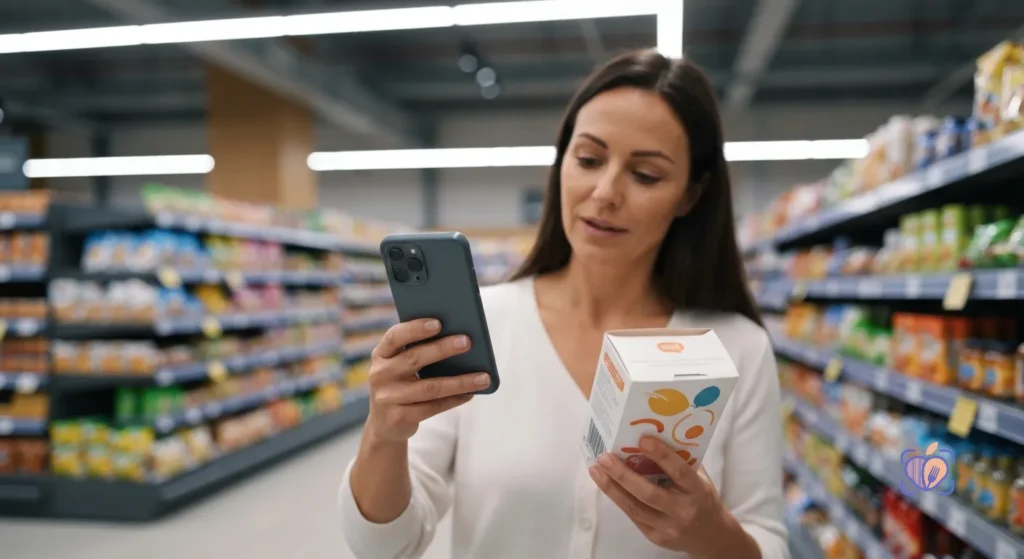
Let’s be honest. You’re standing in the grocery aisle, phone in hand, feeling a familiar sense of dread. The packaging is screaming promises—’All Natural,’ ‘Gluten-Free,’ ‘Heart Healthy’—but you’ve been burned before. You need the truth, not the marketing.
So you open a food scanner app. And the frustration begins all over again.
You’re tired of apps that give you a simple, childish score out of 100, as if your family’s complex medical needs could be reduced to a pass/fail grade. You’re exhausted by apps that let you scan five items—just enough to get your hopes up—before hitting you with a $40 paywall right when you need them most. You’re overwhelmed by juggling three different apps because one handles your son’s nut allergy, another handles your partner’s Keto diet, and neither one tells you a thing about sustainability.
The era of the single-diet, pay-to-play barcode scanner is over. It was a nice idea, but it failed. It failed because it doesn’t understand how real people shop for real families in 2026. It failed because it treats your health like a game and your wallet like an ATM.
We’re here to tell you there’s a better way. But first, let’s pull back the curtain on the apps you’ve been told to trust. Let’s talk about why they’re failing you.
The illusion of the “100/100” health score (Why Yuka’s European additive scoring fails severe allergy sufferers)
Yuka is beautiful. It’s clean, simple, and popular. It gives you a satisfyingly simple score: 100 is good, 0 is bad. It feels definitive. It feels like you’ve cracked the code.
But it’s an illusion. A dangerous one.
Yuka’s scoring system is heavily based on European standards for food additives (E-numbers) and a general aversion to sugar, salt, and fat. On the surface, this seems reasonable. But it conflates two completely different concepts: ‘clean eating’ and ‘medical safety.’
Let’s take a real-world example. You’re at a birthday party and you want to check the Otter Pops nutrition facts for your child. You scan the box with Yuka. It will likely give it a terrible score—maybe a 10/100. Why? Because it’s high in sugar and contains artificial colors like Red 40. The app flags the additive as ‘hazardous’ and you, the concerned parent, put the box back.
But what did Yuka miss? It missed everything that actually matters.
What if your child’s specific, life-threatening allergy isn’t to Red 40, but to corn? The primary ingredient in those Otter Pops is high-fructose corn syrup. Yuka’s simple score, focused on its narrow definition of ‘clean,’ completely overlooks the ingredient that could send your child to the emergency room. It gave you a piece of information, but it wasn’t the information you needed. It sold you a feeling of safety, not actual safety.
This isn’t a tool for people with serious allergies or dietary restrictions. It’s a tool for people who want a gold star for avoiding polysorbate 80. For a family managing a severe dairy, soy, or nut allergy, a simple ‘good’ or ‘bad’ score isn’t just useless—it’s a liability. It creates a false sense of security, encouraging you to look at their number instead of the actual ingredients that matter to your body.
Fig (Food is Good): Great data, but a massive paywall (Why 5 free scans a month isn’t enough for a real grocery trip)
Then there’s Fig. We’ll give them credit: their data is more granular than Yuka’s. They understand that people have specific dietary needs and they do a decent job of flagging individual ingredients for those diets. They’re the smart, sophisticated competitor.
And they know it. Which is why they treat their product like a luxury good.
Fig’s model is built on a simple, cynical premise: get you hooked, then make you pay. They give you five free scans a month. Five. Let’s put that in perspective. A standard weekly grocery trip for a family of four involves evaluating dozens of items. You’re checking the new brand of pasta sauce, the ‘healthy’ kids’ snacks, the bread, the yogurt, the cereal. You could burn through your five scans before you even leave the produce section.
Imagine this: You’re in aisle 9. Your child has a Celiac diagnosis, and you’ve just found a new brand of ‘gluten-free’ cookies. But you also need to avoid dairy. You scan the box… and a pop-up appears: “You’ve reached your scan limit for the month. Upgrade to Premium for $39.99/year to continue.”
It’s not just an inconvenience; it’s a manufactured crisis. They are holding your family’s safety hostage. They give you a taste of clarity and then, at the moment of decision, they lock the medicine cabinet and slide a credit card reader under the door. It’s a business model that preys on the anxiety of parents and allergy sufferers.
Real life doesn’t fit into five neat scans. Real grocery shopping is a chaotic, 45-minute sprint of discovery and decision-making. A tool that quits on you after five uses isn’t a tool at all. It’s a demo. And you and your family deserve more than a demo.
Spoonful: Excellent for Low-FODMAP, useless for the rest of your family
Spoonful deserves respect for what it does. It has carved out a niche by serving specific communities, particularly those navigating the incredibly complex Low-FODMAP diet for IBS, as well as gluten-free lifestyles. For those users, it’s a godsend.
But the modern family is not a niche.
Spoonful is a specialist in a world that demands a general practitioner. What happens when you, the Low-FODMAP user, are also shopping for your partner, who is trying Keto to manage their blood sugar? And your teenage son, who has a severe peanut allergy? Are you supposed to pull out three different apps to scan the same jar of almond butter?
- Spoonful: Says it’s not Low-FODMAP.
- A Keto App: Says it’s great for Keto.
- An Allergy App: Screams about the almonds for your son’s friend who’s coming over.
This is the reality Spoonful and other niche apps ignore. The modern grocery cart is a reflection of a multi-diet household. Relying on a specialist app is like hiring a plumber to fix your electricity. They’re great at their one job, but they can’t help you with the rest of the house. You’re left paying for multiple subscriptions, juggling multiple interfaces, and still not getting a single, clear answer for your whole family from one scan.
The 39-Label Intersection Problem (Why modern shoppers need Keto + Vegan + Peanut-Free simultaneously)
Here is the fundamental truth that other apps have failed to grasp: you are not just one thing. Your family is not just one thing.
You are not just a ‘Gluten-Free Shopper.’ You are a person managing a gluten sensitivity, whose partner is a vegetarian, whose child has a dairy allergy, and who is trying to adhere to a low-sugar lifestyle for the whole family. This is the 39-Label Intersection Problem.
We call it that because at Food Scan Genius, we support 39 distinct dietary labels, from major allergens like peanuts and soy to lifestyle choices like Vegan and Paleo, to medical diets like Low-FODMAP and Keto. The challenge isn’t just identifying one of these things; it’s identifying the intersection of all of them at once.
When you scan a product, you’re not asking a single question. You’re asking a dozen, simultaneously:
* “Is this safe for my son’s peanut allergy?”
* “Does this fit my low-carb diet?”
* “Is it vegan for my daughter?”
* “Is it free of the Red 40 dye that my other child is sensitive to?”
* “Is this considered an ultra-processed food?”
Checking the Otter Pops nutrition label is a perfect example. One scan needs to deliver a complex answer: No for Keto (sugar), No for clean eating (additives), but Yes for Peanut-Free, Yes for Gluten-Free, and Yes for Dairy-Free. No other app is built to handle this complex, layered reality. They give you one answer, for one person, for one diet. It’s a black-and-white photograph of a world that exists in vibrant, complicated color.
Food Scan Genius: The Ultimate 2026 Barcode Scanner (Unlimited free scans, 39 labels, Triple-Score metrics: Eco/Nova/Nutri)
We saw this broken landscape and decided to build something better. Not an iteration, but a revolution. Food Scan Genius is built on a foundation of respect for your intelligence, your budget, and the complex reality of your life.
First, we believe safety shouldn’t have a limit. That’s why our core scanning feature is, and always will be, free. And unlimited. Scan your whole cart. Scan your entire pantry. Go to a friend’s house and scan their snacks before your kids touch them. We will never charge you to access basic safety information. We will never hold your health hostage. We trust that when you see the power of our full feature set, you’ll find it’s worth the price of a cup of coffee.
Second, we solve the 39-Label Intersection Problem. We don’t just have 39 diet and allergen labels; we let you combine them. Create a profile for every single person in your family. Create one for ‘Dad’ (Keto, Low-Sodium). Create one for ‘Sarah’ (Vegan, Gluten-Free). Create one for ‘Michael’ (Peanut, Dairy, Soy-Free). When you scan a single barcode, you get a clear, color-coded answer for every profile. One scan, one screen, complete clarity for the entire family. No more cross-referencing, no more guessing.
Third, we replaced the single, arbitrary health score with intelligent, transparent data. We don’t believe in a ‘100/100’ score because we know ‘healthy’ means different things to different people. Instead, we give you three globally recognized, science-backed metrics so you can decide for yourself:
- Nutri-Score: An A-to-E letter grade based on a government-backed scientific model that balances nutrients to encourage (protein, fiber) and those to limit (sugar, saturated fat). It’s the objective nutritional truth.
- NOVA Score: A 1-to-4 rating that classifies food by its level of processing. It’s the definitive way to distinguish between an unprocessed apple, a processed jar of applesauce, and an ultra-processed, apple-flavored candy.
- Eco-Score: An A-to-E grade that assesses the environmental impact of a product, from its ingredients to its packaging. Because we know that for the modern consumer, health isn’t just about personal well-being; it’s about the planet’s well-being, too.
Food Scan Genius isn’t another nanny app telling you what to do. It’s a co-pilot, giving you all the data you need—nutritional, allergen, processing, and environmental—to make the best decision for you and the people you love.
The Feature Comparison Table
Words are one thing. Let’s look at the facts.
| Feature | Food Scan Genius | Yuka | Fig (Food is Good) | Spoonful |
|---|---|---|---|---|
| Pricing | Free Unlimited Scans; $4.99/mo for Premium | Free; $20/yr for offline & search | 5 Free Scans/mo; $39.99/yr | Limited Free; $24.99/yr |
| Allergen Depth | Excellent (39 labels, incl. all major) | Poor (Not designed for allergies) | Good (Focus on specific diets) | Good (Niche: FODMAP/GF) |
| Unlimited Scans | Yes (Free Forever) | Yes | No (Paywalled at 5/mo) | No (Paywalled) |
| Multi-Profile Capability | Yes (Unlimited Family Profiles) | No | No | No |
Stop Paying More for Less. It’s Time to Upgrade.
The choice is clear. You can continue to pay $40 a year to be told ‘no’ after five scans. You can continue to rely on a simplistic score that might miss a life-threatening allergen. You can continue juggling three different apps and still not have the full picture.
Or you can make a change.
Stop guessing. Stop rationing your scans. Stop paying for half-solutions that create more anxiety than they solve. Your family’s health is not a place for compromise.
Download Food Scan Genius right now. Use the unlimited free scanner for as long as you want. See the difference for yourself. When you’re ready for the power of unlimited family profiles, custom alerts, and our full suite of tools, our premium plan is here for you.
Get the clarity you deserve. Get Food Scan Genius.
Download on the App Store (iOS)
Download on Google Play (Android)
Frequently Asked Questions
1. How is Food Scan Genius different from Yuka’s 100-point score?
Instead of one arbitrary ‘health’ score, Food Scan Genius provides three transparent, science-backed metrics: the Nutri-Score (A-E nutritional grade), the NOVA score (1-4 food processing level), and the Eco-Score (A-E environmental impact). This allows you to define what ‘healthy’ means for you, rather than relying on a single opinion that may dangerously overlook your specific allergies or dietary needs.
2. Can I really scan unlimited items for free?
Yes. Absolutely. The core feature of scanning a product to see its ingredients, allergen warnings for a single profile, and our triple-score data is completely free and unlimited. We believe everyone deserves access to basic food safety information without a paywall. Our premium subscription unlocks advanced features like unlimited multi-person profiles for your entire family.
3. I manage multiple allergies and diets in my family. Can this app handle that?
Yes, this is our core strength. With a premium subscription, you can create an unlimited number of unique profiles (e.g., ‘Dad – Keto’, ‘Son – Peanut & Dairy Allergy’). When you scan one item, our app instantly shows you a ‘Yes/No/Maybe’ for every single profile, solving the complex ‘intersection problem’ for multi-diet households in a single screen.
4. What is the “Otter Pops nutrition” information based on?
Our data, including for products like Otter Pops, is sourced from the world’s largest open-source food database, Open Food Facts, which is continuously updated by a global community and cross-referenced with manufacturer data. For our triple-score, we use the official, publicly documented algorithms for Nutri-Score, NOVA classification, and Eco-Score, ensuring our information is objective, transparent, and based on established scientific standards.