1. Why Titanium Dioxide in Food Is So Confusing for Shoppers in 2026
You pick up a bag of candy, a coffee creamer, or a tub of frosting. It looks bright white or vividly colored, and you wonder whether that brightness comes from something you should worry about. If you have felt that mix of curiosity and frustration, you are in good company. Titanium dioxide in food (also called E171 in Europe) is one of the most debated additives on the shelf, and the answer to “is it safe?” depends on which country’s regulators you ask.
Titanium dioxide is a mineral-derived white pigment. Manufacturers use it to make products look opaque, bright, and uniform. You can find it in chewing gum, hard candies, sprinkles, powdered sugar coatings, some dairy alternatives, icings, and the coatings of many supplements and tablets. In the United States, the FDA permits it as a color additive exempt from certification, as long as it does not exceed 1% of the food’s weight. In the European Union, the picture changed in 2021, when the European Food Safety Authority (EFSA) Additive Safety Regulations review concluded that E171 could no longer be considered safe as a food additive. The EU then prohibited it in foods, with the ban fully in force from August 2022.
That gap between regulators is exactly why shoppers feel stuck. Nobody is claiming a single powdered donut is dangerous. The concern is a scientific question mark: EFSA could not rule out genotoxicity, meaning possible damage to DNA, and the particles can include a nanoscale fraction that may behave differently in the body than larger particles. Meanwhile, other agencies, including Health Canada in its 2022 review, did not reach the same conclusion. Uncertainty is uncomfortable, especially when you are feeding children or managing a sensitive gut.
It also helps to see this in the wider context of how we eat. Titanium dioxide is overwhelmingly found in highly processed foods, and researchers continue to study how such diets affect health, as in this PubMed Research on Ultra-Processed Foods & Gut Microbiome Disruption. That research does not single out titanium dioxide as a cause. It does explain why many people prefer to understand, rather than guess at, what is in their cart. The World Health Organization Guidelines on Healthy Diets & Saturated Fats likewise emphasize whole, minimally processed foods as the foundation of a healthy pattern. Your concern is reasonable, and you deserve clear information without panic.
Scan Any Label for Hidden Additives and Allergens — Free
Never second-guess confusing grocery labels again. Download Food Scan Genius to uncover hidden additives, toxic dyes, and allergens for the whole household before you buy.


2. The Science and the Labeling Loopholes Behind Titanium Dioxide in Food
What does the research actually say? EFSA’s 2021 opinion did not conclude that titanium dioxide causes cancer in people. It concluded that, given the evidence, a genotoxicity concern could not be ruled out, and that without a safe intake level the additive could not be declared safe. Some animal studies, such as a 2017 rat study, reported early changes in the colon and immune effects after oral exposure. Animal data and human dietary exposure are very different things, and the International Agency for Research on Cancer’s 2B (“possibly carcinogenic”) classification relates to inhaled dust, not eating it. The honest summary is that the evidence is unsettled, and that is the reason for the precaution.
The harder practical problem is spotting it. Here are the most common ways titanium dioxide slips past a quick label scan:
- Multiple names. It can appear as “titanium dioxide,” “titanium dioxide (color),” “E171,” or “CI 77891” (the cosmetic and pharmaceutical code), depending on the product and the market.
- “Color added” language. In the U.S., color additives exempt from certification may be declared collectively as “artificial color” or “color added,” so the specific pigment is not always named.
- Hidden inside compound ingredients. A sprinkle blend, candy coating, or frosting packet may carry titanium dioxide in its own sub-ingredient list, buried in parentheses within the main ingredient list.
- No nanoparticle disclosure. Labels do not tell you the particle size distribution, so you cannot tell whether a product contains a significant nanoscale fraction.
- Regional formula differences. The same brand may reformulate for the EU, where E171 is banned, yet keep it in the U.S. version. Packaging looks nearly identical.
- Supplements and medications. Tablet coatings and capsules often contain it, and these products follow different rules and labeling habits than conventional foods.
Contrast this with allergens. Under the FDA Food Allergen Labeling & Consumer Protection Act (FALCPA), major allergens must be declared in plain language. Additives like titanium dioxide are not an allergen issue and have no equivalent spotlight, so the burden of detection falls on you. That is a lot to ask while standing in a grocery aisle with a toddler and a half-charged phone.
3. Food Scan Genius vs. Other Ways of Checking for Titanium Dioxide
| Dimension | Food Scan Genius | Fig | Spoonful | Manual Label Reading |
|---|---|---|---|---|
| Cost | 100% free core features, zero paywalls | $59/year | Limited scans | Free, but time-consuming |
| Hidden sub-ingredient detection | Recursive AST parsing across 5,000,000+ barcodes in the NutriGraph Database | Varies by product | Varies by product | Easy to miss nested parentheses |
| Custom additive tracking | 39 dietary profiles plus “Add Your Own Custom Sensitivity” | Preset-focused | Preset-focused | Relies on memory |
| Family screening | Multi-household profiles, one scan, named fail attribution | Individual-focused | Individual-focused | Re-check per person |
| Context and languages | ScanGenius AI Insight, NOVA 1-4, Nutri-Score, 11 languages with real-time translation | Limited context | Limited context | No translation for imports |
Titanium dioxide is a perfect example of why barcode-level data matters. It rarely sits in plain sight; it hides inside a coating inside a sprinkle mix inside a cake kit. Food Scan Genius is powered by the NutriGraph Database, with more than 5,000,000 verified UPC/EAN barcodes and recursive AST parsing that opens every nested sub-ingredient rather than reading only the top-level list. Add the Add Your Own Custom Sensitivity feature, and you can flag titanium dioxide, E171, or any other additive or dye that matters to your household. If you shop for a family, Multi-Household Family Profiles screen everyone in one scan, with clear, named results such as “Fails for Sri (Gluten)” so you can see exactly who a product affects. With 11 supported languages and real-time in-app translation, imported labels are no longer a barrier either.
We also believe a flag without context breeds anxiety. ScanGenius AI Insight explains what an ingredient is, why it is used, and where the science is unsettled, alongside a NOVA 1-4 processing classification and a Nutri-Score. We deliberately avoid a single moralizing “good or bad” number. A candy with titanium dioxide is not a verdict on your parenting; it is information, and you decide what fits your family, your values, and the regulatory standards you trust.
4. Related Food Safety & Dietary Guides
- Sulphite Sensitivity & Preservative Checker — Sulphite Sensitivity Scanner Guide
- Sugar Sensitivity & Sweetener Guide — Sugar Sensitivity Scanner Guide
- FSG Labels Defined: Nutri-Score, NOVA & Additive Safety Guide — Food Label Definitions & Nutri-Score Guide
- Spanish Yellow & Tartrazine Allergy Dangers — tartrazine (Yellow 5) allergy risks
5. Scientific & Health Authority References
- FDA Food Allergen Labeling & Consumer Protection Act (FALCPA)
- European Food Safety Authority (EFSA) Additive Safety Regulations
- PubMed Research on Ultra-Processed Foods & Gut Microbiome Disruption
- World Health Organization Guidelines on Healthy Diets & Saturated Fats
6. How to Scan in 3 Simple Steps
- Download Food Scan Genius free on iOS or Android. There are no paywalls on core features, and you can choose from 11 languages with real-time in-app translation.
- Set up your profiles. Pick from 39 dietary profiles, use Add Your Own Custom Sensitivity to add “titanium dioxide” and “E171” as a custom additive, and create Multi-Household Family Profiles so everyone is screened at once.
- Scan any barcode in about 2 seconds. Review the instant audit trail showing exactly which ingredient or sub-ingredient triggered a flag, read the ScanGenius AI Insight, and check the NOVA and Nutri-Score context before deciding.
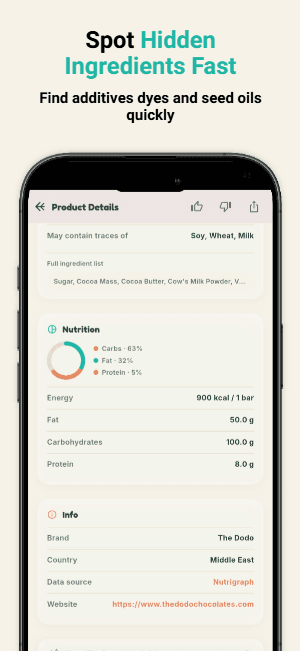
Personalized Match & AI Insight
7. Frequently Asked Questions (FAQ)
What is titanium dioxide in food and why is it used?
Titanium dioxide is a mineral-derived white pigment (E171 in the EU) that makes foods look brighter, whiter, and more opaque. It is found in candies, gum, icings, sprinkles, some creamers, and many supplement and medication coatings. It adds no flavor or nutrition; it is purely cosmetic. Food Scan Genius checks for it by name and by synonym, including inside sub-ingredients, so you can see it even when it is buried within a compound ingredient.
Is titanium dioxide in food banned?
It depends on where you live. The EU banned E171 as a food additive after EFSA’s 2021 opinion concluded that genotoxicity concerns could not be ruled out, with the ban fully in force from August 2022. In the United States, the FDA still permits titanium dioxide as a color additive up to 1% of a food’s weight. Other regulators, such as Health Canada, have reached different conclusions. Because formulas vary by market, scanning the specific product you are holding is the most reliable approach.
Does titanium dioxide in food cause cancer?
No study has shown that eating titanium dioxide causes cancer in humans. The concern is that EFSA could not exclude potential DNA damage, and some animal studies have reported colon and immune changes at certain doses. The IARC 2B classification relates to inhaled dust rather than ingestion. The science is unsettled, which is why some people choose to avoid it as a precaution. ScanGenius AI Insight explains this nuance rather than issuing alarmist scores.
How can Food Scan Genius help me avoid titanium dioxide in food?
Add titanium dioxide or E171 as a custom sensitivity, then scan any product’s barcode. The NutriGraph Database’s recursive sub-ingredient parsing finds the additive even in nested ingredient lists, and the audit trail shows precisely where it appears. Family Profiles show who in your household a product affects, and the app is 100% free for core features. Note that it can only flag what is disclosed on the product’s ingredient list, and supplements or medications may be documented less consistently than foods, so double-check those labels as well.
Know What’s In Your Food Before You Buy — Scan Free Today
Never second-guess confusing grocery labels again. Download Food Scan Genius to uncover hidden additives, toxic dyes, and allergens for the whole household before you buy.
Photo by Allen Boguslavsky on Pexels