A standard 1-cup (240g) serving of classic egg drop soup contains 65 calories, 3.8 grams of protein, 1.7 grams of total fat, 8.2 grams of carbohydrates, and 892 milligrams of sodium.
Macronutrient Profile and Biochemical Composition of Egg Drop Soup
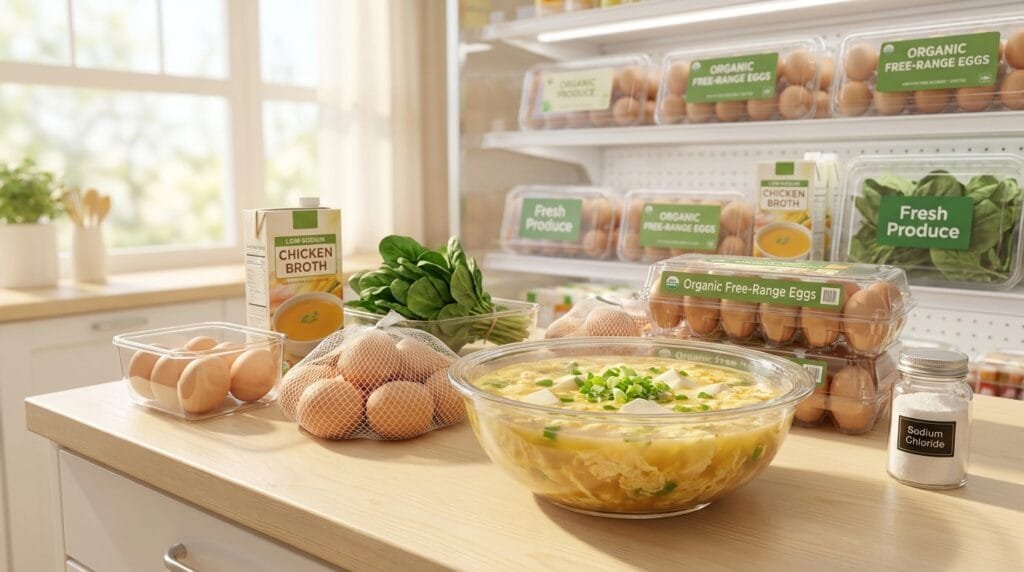
Traditional Chinese egg drop soup (dànhuātāng, or ‘egg flower soup’) relies on a minimalist formulation: seasoned poultry or vegetable broth thickened with starch, into which raw, beaten eggs are drizzled in a gentle whirlpool at the final stage of simmering. From a nutritional standpoint, the simplicity of its ingredient manifest translates to a profile characterized by low caloric density, moderate protein concentration, minimal lipids, and exceptionally high mineral salinity. According to data compiled in the USDA FoodData Central database (FDC ID 172978), a standardized 240-gram metric cup yields approximately 65 kilocalories. The caloric breakdown is derived primarily from two macronutrient sources: the dispersed lipid-protein emulsion of the cooked egg ribbons and the complex carbohydrates from the gelatinized thickening agent.
The protein fraction of egg drop soup—typically registering between 3.5 and 4.2 grams per 1-cup volume—is driven by the quantity of whole egg incorporated per batch. Commercial kitchen ratios historically allot one medium-to-large hen’s egg (which inherently provides roughly 6 grams of complete protein containing all nine essential amino acids) across 1.5 to 2 serving bowls. Because the white and yolk are fully emulsified during preparation, the soup retains the bioavailable ovalbumin, ovotransferrin, and lipovitellin proteins of the egg. For individuals managing dietary restrictions or hyper-reactivity, these proteins are critical allergen markers. Adherence to the Food Allergy Research & Education (FARE) Clinical Standards dictates noting that egg proteins do not denature sufficiently through rapid simmering to eliminate their allergenic binding capacity, making cross-contact verification essential in commercial broth preparation.
Carbohydrate values in egg drop soup range consistently between 7 and 9 grams per serving. Unlike clear broths or consommé, egg drop soup requires an altered viscosity to suspend the gossamer egg strands evenly throughout the liquid. This suspension is achieved via cornstarch (maize starch) slurry, a pure polysaccharide composed of amylose and amylopectin. Under high heat, these starch granules absorb water and swell, undergoing gelatinization at temperatures between 62°C and 72°C. This culinary necessity adds approximately 6 to 8 grams of rapidly digestible carbohydrates per cup. Dietary fiber remains near zero (under 0.4 grams), while simple sugars remain low (under 0.8 grams), originating almost entirely from trace additions of sugar used to balance broth acidity or natural sugars present in scallion garnishes.
Lipids remain minimal unless significant quantities of toasted sesame oil, rendered chicken fat (schmaltz), or pork-based stock are introduced. A standard restaurant formulation contains roughly 1.5 to 2.2 grams of total fat per cup, of which only 0.4 to 0.6 grams are saturated fatty acids. This modest fat load reflects standard culinary practices that balance aromatic oils against clear broth bases, remaining well within the thresholds outlined by the World Health Organization Guidelines on Healthy Diets & Saturated Fats, which recommend that saturated fats constitute less than 10 percent of daily total energy intake. The primary nutritional variable of clinical interest in egg drop soup is its sodium content, which routinely ranges from 800 to over 1,000 milligrams per single cup serving, reflecting the heavy reliance on sodium chloride, concentrated bouillon cubes, and monosodium L-glutamate (MSG).
Reading Real Labels: Commercial Dehydrated Mixes vs. Restaurant Takeout
When examining egg drop soup across retail packaging and restaurant menus, significant compositional variances emerge between ready-to-eat restaurant items and shelf-stable instant mixes. A primary example in retail grocery is the Kikkoman Restaurant Style Egg Flower Soup Mix (Clear Soup base). On the US Nutrition Facts panel, the serving size is listed as 1/4 pouch (6.2 grams dry mix), yielding approximately 20 calories, 1 gram of protein, 3 grams of carbohydrate, and 610 milligrams of sodium prior to adding the consumer-supplied egg. Once prepared according to package directions—by whisking in one fresh large whole egg—the actual consumed profile changes: the serving gains roughly 72 calories, 6.3 grams of protein, and 4.8 grams of fat. Consumers reading only the unfortified panel baseline systematically miscalculate their actual intake.
A critical divergence appears when comparing North American labeling against European Union and United Kingdom formats for equivalent items, such as Asian pantry imports. In the EU, Regulation (EU) No 1169/2011 mandates that nutrition information must be presented per 100 grams or per 100 milliliters of the product as sold, with optional ‘as prepared’ secondary declarations. On an EU label for a dehydrated soup mix, the raw powder will exhibit astronomical sodium levels—often exceeding 8,000 to 12,000 milligrams of sodium (or 20 to 30 grams of salt) per 100 grams of powder. Shoppers unfamiliar with European formatting frequently mistake this high concentration for a single portion. Conversely, US labels prioritize the ‘per serving’ column based on Reference Amounts Customarily Consumed (RACC), set by the FDA at 245 grams for prepared soups, masking the dry concentration behind reconstitution directions.
Commercial shelf-stable variants also differ chemically from freshly prepared restaurant stock through their inclusion of texturizers, flavor enhancers, and preservatives. Products like Sun Luck Instant Egg Drop Soup utilize maltodextrin, hydrolyzed soy protein, disodium inosinate, disodium guanylate, and yellow food colorings (such as Yellow 5 and Yellow 6) to replicate the golden hue and umami profile that home cooks achieve with high-grade stock and egg yolks. The additive safety of these stabilizing agents falls under strict oversight, including the European Food Safety Authority (EFSA) Additive Safety Regulations, which have established precise acceptable daily intakes (ADIs) for glutamates (30 mg/kg body weight per day) to ensure consumer tolerance.
When navigating instant powdered pouches where reconstitution ratios obscure the actual sodium intake, scanning the barcode with Food Scan Genius quickly recalculates the true nutrient density per prepared fluid ounce and flags hidden fillers. These fillers are notable because shelf-stable bases rely on industrial ultra-processing to prevent staling and lipid rancidity. Scientific evaluations, including PubMed Research on Ultra-Processed Foods & Gut Microbiome Disruption, demonstrate that recurring exposure to complex emulsifier blends and refined starches typical of dehydrated convenience foods can alter bacterial diversity and intestinal epithelial signaling compared to whole-food broths prepared directly from poultry carcasses and fresh eggs.
| Metric / Nutritional Component | Restaurant Standard (1 Cup / 240g) | Takeout Container (1 Pint / 473g) | Dehydrated Commercial Mix (Prepared, 1 Cup) | Homemade Low-Sodium (1 Cup / 240g) |
|---|---|---|---|---|
| Total Calories (kcal) | 65 | 128 | 75 | 58 |
| Protein (g) | 3.8 | 7.5 | 4.5 | 4.2 |
| Total Fat (g) | 1.7 | 3.3 | 2.4 | 1.6 |
| Saturated Fat (g) | 0.5 | 1.0 | 0.7 | 0.4 |
| Cholesterol (mg) | 55 | 108 | 62 | 52 |
| Total Carbohydrates (g) | 8.2 | 16.1 | 8.9 | 6.1 |
| Dietary Fiber (g) | 0.3 | 0.6 | 0.2 | 0.3 |
| Total Sugars (g) | 0.8 | 1.5 | 1.1 | 0.4 |
| Sodium (mg) | 892 | 1,757 | 780 | 320 |
| Potassium (mg) | 115 | 226 | 95 | 145 |
| Calcium (mg) | 18 | 35 | 22 | 20 |
| Iron (mg) | 0.6 | 1.2 | 0.5 | 0.7 |
Common Misconceptions and Label Interpretation Errors
A widespread assumption among individuals following strict low-carbohydrate or ketogenic regimens is that egg drop soup is fundamentally carbohydrate-free because its visible ingredients appear to be simply eggs and broth. In practice, traditional culinary techniques require 1 to 1.5 tablespoons of cornstarch per quart of liquid to achieve the characteristic glossy sheen and hydrodynamic drag needed to form delicate egg petals. Omitting this step causes the whisked eggs to sink immediately to the bottom as dense curds rather than feathering into suspended ribbons. Consequently, a single restaurant bowl routinely delivers 8 to 10 grams of net carbohydrates, which can unintentionally exhaust daily carbohydrate allocations for individuals managing strict metabolic protocols.
Another common mistake involves misjudging portion volumes when ordering takeout. Chinese restaurant containers labeled as ‘small’ or ‘pints’ contain 16 fluid ounces (approximately 473 milliliters or two standardized measuring cups). Diners routinely consume the entire container under the impression that it constitutes a single serving corresponding to the generic 65-calorie profile found on consumer nutrition apps. In reality, finishing a standard takeout pint doubles the intake: 130 calories, 16 grams of carbohydrates, and roughly 1,780 milligrams of sodium—a figure that accounts for over 77 percent of the FDA’s Recommended Daily Intake (RDI) for sodium in a single dish.
Finally, consumers often conflate the deep yellow color of commercial egg drop soup with a high concentration of nutrient-rich egg yolks. While pasture-raised hen yolks contain lutein and zeaxanthin that impart natural yellow hues, the commercial restaurant trade and packaged soup manufacturers frequently rely on ground turmeric powder or artificial color additives (FD&C Yellow No. 5/Tartrazine) to achieve uniform visual intensity while minimizing egg volume. Diners cannot determine the actual egg content or protein mass solely by the color depth of the broth; true nutritional verification requires assessing the grams of protein listed on the certified label or calculating the number of whole eggs deployed per recipe volume.
Frequently asked questions
Is egg drop soup keto-friendly?
Standard restaurant egg drop soup is generally not strict keto-friendly because it uses cornstarch as a thickening agent, yielding 7 to 9 grams of net carbohydrates per cup. To make it keto-compliant, homemade versions replace cornstarch with zero-carb thickeners such as xanthan gum or glucomannan.
Why is the sodium content so high in egg drop soup?
The high sodium concentration (typically 800 to 950 mg per cup) stems from concentrated chicken base, table salt, soy sauce, and monosodium glutamate (MSG). These sodium compounds are added in high concentrations to provide robust savory umami against the diluting effect of starch-thickened water.
Does egg drop soup contain gluten?
While the primary thickener is cornstarch (which is naturally gluten-free), many commercial preparations and restaurants incorporate chicken bouillons or soy sauces that contain wheat derivatives. Celiac patients must confirm that the specific broth base and soy seasonings are certified gluten-free.
How many calories are in a full takeout pint of egg drop soup?
A standard 16-fluid-ounce takeout pint holds two cups of soup, translating to approximately 130 calories, 7.6 grams of protein, 3.4 grams of fat, 16.4 grams of carbohydrates, and 1,750 to 1,900 milligrams of sodium.
Can egg drop soup provide significant dietary protein?
A single 1-cup serving provides only 3.5 to 4 grams of protein, which is relatively modest. Because the egg is distributed across several portions of broth, egg drop soup functions primarily as a light appetizer rather than a substantial protein source unless additional whole eggs or tofu cubes are introduced.
References
- Food Allergy Research & Education (FARE) Clinical Standards
- European Food Safety Authority (EFSA) Additive Safety Regulations
- PubMed Research on Ultra-Processed Foods & Gut Microbiome Disruption
- World Health Organization Guidelines on Healthy Diets & Saturated Fats
Related guides
- Best Food Allergy Scanner App – Scan Food Labels Instantly — Food Allergy & Sensitivity Scanner Hub
- The 7 Best Free Food Scanner Apps of 2026 — best free food scanner apps
- Choosing the Best Barcode Scan App for Your Health — guide to choosing a barcode scanner app
- Food Scan Genius: World’s #1 Food Ingredient Scanner App — Food Scan Genius scanner app
Check Any Label Against 5 Million Products — Free
Never second-guess confusing grocery labels again. Download Food Scan Genius to uncover hidden additives, toxic dyes, and allergens for the whole household before you buy.