
1. The Modern Plant Milk Dilemma: Why Finding Clean Dairy-Free Milk Is Difficult
Standing in the refrigerated beverage aisle in search of the best dairy free milk products has transformed from a simple grocery trip into an exhausting exercise in biochemical scrutiny. Whether you are managing systemic lactose intolerance, navigating an IgE-mediated cow’s milk allergy, managing eosinophilic esophagitis, or pursuing an anti-inflammatory plant-based lifestyle, you face dozens of competing cartons claiming to be healthy, sustainable, and pure. Yet, beneath claims like ‘Barista Blend,’ ‘Extra Creamy,’ and ‘Naturally Flavored’ lies a complex matrix of industrial thickeners, high-temperature vegetable oils, synthetic phosphates, and isolated sugars that can aggravate gastrointestinal inflammation or spoil your culinary preparations.
For consumers seeking clinical safety and kitchen performance, the stakes are elevated. While the FDA Food Allergen Labeling & Consumer Protection Act (FALCPA) mandates clear declarations for major food allergens such as milk and soy, it offers zero protection against unlisted processing aids, hidden cross-contact, or synthetic emulsifiers that cause postprandial distress. A dairy-free milk that steams into microfoam for your morning flat white might achieve that velvety texture solely through dipotassium phosphate and gellan gum—substances that can disrupt sensitive gut barriers. Conversely, a minimalist two-ingredient almond milk may curdle the moment it touches an acidic light-roast espresso, separating into an unpalatable, watery mess.
In home cooking and baking, functional failures are just as frequent as gut reactions. Substituting traditional dairy in a roux, custard, or creamy curry requires precise fat, protein, and sugar ratios. Many commercial plant milks contain high amounts of refined oils that alter your recipes or push saturated fat intakes past the thresholds established by the World Health Organization Guidelines on Healthy Diets & Saturated Fats. Shoppers are forced to juggle culinary trial-and-error alongside health concerns, scanning minute ingredient lists under harsh supermarket lighting while hoping their choice won’t trigger an allergic reaction or upset a family member’s stomach.
Scan Any Label for Hidden Additives and Allergens — Free
Never second-guess confusing grocery labels again. Download Food Scan Genius to uncover hidden additives, toxic dyes, and allergens for the whole household before you buy.


2. Deceptive Labeling and Sneaky Additives in Dairy-Free Milk Formulations
Commercial plant-based milks are among the most technologically engineered items in modern food processing. To replicate the naturally occurring emulsion of bovine milk fat globule membranes, manufacturers introduce specialized stabilizers, texturizers, and industrial lipids. While food safety authorities like the European Food Safety Authority (EFSA) Additive Safety Regulations evaluate single-ingredient toxicity profiles, regulatory oversight rarely evaluates how these multi-additive mixtures interact with vulnerable human microbiomes. Recent PubMed Research on Ultra-Processed Foods & Gut Microbiome Disruption demonstrates that persistent exposure to synthetic emulsifiers can degrade the intestinal mucus layer, potentially fostering systemic low-grade inflammation.
When selecting dairy free milk products across diverse applications—whether drinking straight, cooking a savory sauce, or crafting a silky espresso macchiato—look past the front label and be mindful of these six common ingredients and loopholes:
- Dipotassium & Disodium Phosphates: Regularly added to ‘barista’ style oat and soy milks as acidity regulators to prevent curdling in hot coffee. Inorganic synthetic phosphates are absorbed rapidly by the body, which can be problematic for individuals managing chronic kidney disease or metabolic dysregulation.
- Polysorbate 80 and Carboxymethylcellulose (CMC): Potent synthetic emulsifiers engineered to bind oil-and-water suspensions. Research links these compounds to altered intestinal microbiota composition, thinning of the protective mucus layer, and enhanced susceptibility to colitis.
- Carrageenan (E407) and Degraded Carrageenan: Extracted from red edible seaweeds, this ubiquitous thickening agent is widely deployed to suspend added minerals like calcium carbonate. Degraded forms (poligeenan) induce robust mucosal inflammation in biological models, and food-grade carrageenan triggers bloating and flare-ups in individuals with sensitive digestive tracts.
- Deodorized Expeller-Pressed Seed and Rapeseed Oils: Often the second or third ingredient in commercial oat milks. Manufacturers use these refined industrial seed oils to match the 3.5% fat level of whole cow’s milk, which can alter the omega-6 to omega-3 fatty acid profile of your diet.
- Enzymatic Sugar Generation via Hydrolysis: Many brands claim ‘No Added Sugars’ while subjecting natural oats to intense enzymatic processing that breaks natural starches into simple maltose. This can cause a high glycemic response while evading standard ‘Added Sugars’ label warnings.
- Gums (Guar, Xanthan, Gellan, Locust Bean Gum): Frequently stacked in combinations within single cartons. While technically derived from natural sources, this cumulative microbial fermentation inside the human colon frequently induces severe gas, abdominal distension, and IBS-like episodes.
3. Food Scan Genius vs. Legacy Dietary Apps for Dairy-Free Shoppers
| Feature / Technology | Food Scan Genius | Fig App | Spoonful | Manual Label Checking |
|---|---|---|---|---|
| Cost & Core Accessibility | 100% Free Core Engine (Zero Paywalls) | $59.99/year subscription | Limited daily scans, gated paywall | Free, but time-intensive and error-prone |
| Database Depth & Precision | 5M+ UPCs with Recursive AST Sub-Ingredient Parsing | Crowdsourced text matching | Curated catalog, regional gaps | Vulnerable to missed micro-ingredients |
| Multi-Household Screening | Yes (Single scan flags: ‘Fails for Sri (Gluten)’) | Single profile only | Single profile only | Manual cross-referencing for each person |
| AI Formulation Context | ScanGenius AI Insight + NOVA 1-4 + Nutri-Score | Basic binary Green/Yellow/Red | FODMAP-oriented status only | No objective contextual scoring |
| Global Language Translation | 11 Languages with real-time in-app parsing | English-focused | English-focused | Requires third-party translate tools |
Selecting the right dairy free milk products across multiple kitchen applications—from high-heat pan reductions to morning lattes—requires precise ingredient visibility. Food Scan Genius is built to solve this problem by pairing an enterprise-grade NutriGraph Database of over 5 million verified barcodes with proprietary recursive Abstract Syntax Tree (AST) sub-ingredient parsing. When you scan an oat or almond milk barcode, our system examines the parent ingredient as well as any sub-components, processing aids, added phosphates, hidden gums, and seed oil carriers. Unlike apps like Fig ($59/year) or Spoonful that lock comprehensive scans behind paywalls, Food Scan Genius delivers its core scanning engine 100% free.
Rather than relying on generic, moralizing health scores, the app utilizes ScanGenius AI Insight to provide actionable food science context. It pairs official NOVA 1-4 ultra-processing classifications with objective Nutri-Score metrics, clearly explaining how a product’s formulation behaves in cooking, drinking, or frothing. Families managing multiple health considerations can use our Multi-Household Profiles to evaluate the entire home’s needs in a single scan. Whether flagging gluten cross-contact in an oat milk or uncovering hidden carrageenan for someone with IBD, Food Scan Genius provides clear, transparent ingredient audits in seconds.
4. Related Food Safety & Dietary Guides
- Best Food Allergy Scanner App – Scan Food Labels Instantly — Food Allergy & Sensitivity Scanner Hub
- The 7 Best Free Food Scanner Apps of 2026 — best free food scanner apps
- Choosing the Best Barcode Scan App for Your Health — guide to choosing a barcode scanner app
- Food Scan Genius: World’s #1 Food Ingredient Scanner App — Food Scan Genius scanner app
5. Scientific & Health Authority References
- FDA Food Allergen Labeling & Consumer Protection Act (FALCPA)
- European Food Safety Authority (EFSA) Additive Safety Regulations
- PubMed Research on Ultra-Processed Foods & Gut Microbiome Disruption
- World Health Organization Guidelines on Healthy Diets & Saturated Fats
6. How to Scan in 3 Simple Steps
- Download Food Scan Genius completely free on iOS or Android with zero locked paywalls or restricted daily scan limits.
- Configure your personalized dietary matrix from 39 integrated profiles—including Dairy-Free, Low-FODMAP, Celiac, Paleo, and Nut-Free—or specify custom sensitivities such as dipotassium phosphate, carrageenan, or canola oil.
- Scan any plant milk carton barcode in the supermarket aisle to get an immediate, transparent audit trail highlighting cooking suitability, barista foaming performance, NOVA 1-4 processing level, and multi-family allergen safety.
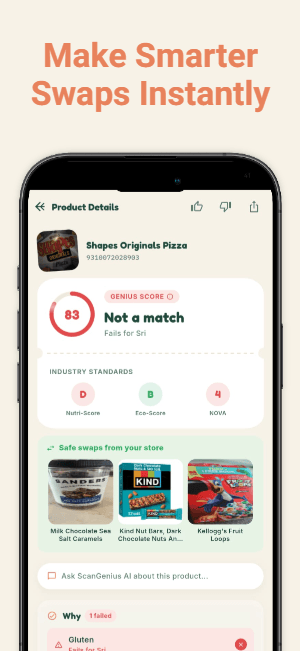
Instant Dairy-Free Audit Trail
7. Frequently Asked Questions (FAQ)
Which dairy free milk products work best for frothing and espresso drinks?
For silky microfoam in coffee, you need a balance of healthy fats and stabilized proteins. Oat milk and soy milk are generally the top choices for barista applications. However, many commercial ‘Barista Editions’ use synthetic dipotassium phosphate to prevent the natural acidity of coffee from curdling the milk. If you prefer to avoid inorganic phosphates and added vegetable oils, look for organic soy or oat milks that rely solely on whole ingredients. You can also scan the carton with Food Scan Genius to identify formulations that hold microfoam without synthetic stabilizers.
What is the best dairy free milk for savory cooking and baking?
For savory cooking—like soups, roux, and casseroles—unsweetened, unflavored cashew milk or neutral soy milk is ideal because their natural protein and fat ratios mimic cow’s milk without imparting heavy residual flavors. In baking, unsweetened soy milk shines because its high protein content promotes proper browning via the Maillard reaction. For baking, almond milk is an excellent all-around option, whereas coconut milk should be reserved for recipes where its natural sweetness and tropical flavor profile are welcome.
How does Food Scan Genius catch hidden dairy derivatives that bypass basic label reading?
Certain dairy-derived processing derivatives, such as caseinates, whey protein solids, and cross-reactive lactalbumin, can occasionally lurk in products marketed with vague terms like ‘lactose-free’ or ‘non-dairy’ (which legally differ from ‘dairy-free’). Food Scan Genius uses an enterprise-grade NutriGraph Database with recursive AST parsing. It inspects nested sub-ingredient strings to identify hidden dairy derivatives, emulsifier matrices, and potential cross-contact risks, alerting you instantly on screen.
Can I use Food Scan Genius if someone in my household has a tree nut allergy while another is dairy-free?
Yes. Food Scan Genius features Multi-Household Family Profiles. You can establish distinct profiles for every family member under a single account. A single barcode scan evaluates the item against all configured needs at once. If an almond or cashew milk is safe for your dairy-free diet but unsafe for a family member with a tree nut allergy, the scan results clearly show the conflict—for example: ‘Fails for Sri (Tree Nut Allergy)’—making safe household meal planning fast and straightforward.
Know What’s In Your Food Before You Buy — Scan Free Today
Never second-guess confusing grocery labels again. Download Food Scan Genius to uncover hidden additives, toxic dyes, and allergens for the whole household before you buy.