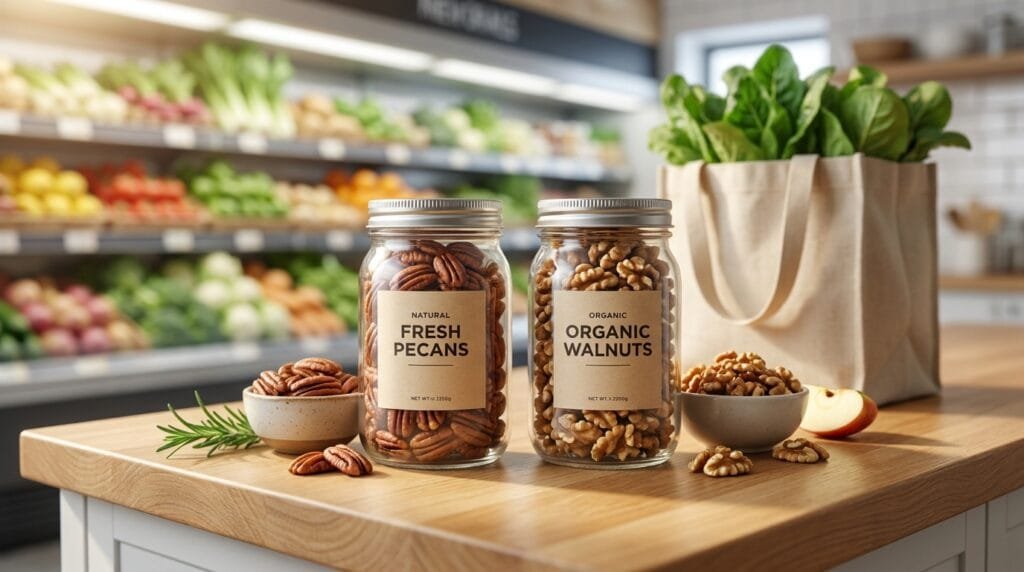
Walnuts provide 2.5 grams of plant-based omega-3 ALA and 4.3 grams of protein per ounce (28g), whereas pecans contain higher monounsaturated fat (11.6g), more dietary fiber (2.7g), and less omega-3 (0.3g), yielding 196 calories versus walnuts’ 185 calories.
Nutritional Architecture: Polyunsaturated Omega-3s Versus Monounsaturated Oleic Acid
Although pecans (Carya illinoinensis) and English walnuts (Juglans regia) both belong to the botanical family Juglandaceae, their macronutrient profiles diverge significantly at the molecular level. A standard 1-ounce (28.35-gram) serving of raw walnuts yields approximately 185 kilocalories, 4.3 grams of protein, and 18.5 grams of total lipids. Crucially, the lipid matrix in walnuts is dominated by polyunsaturated fatty acids (PUFAs), accounting for roughly 13.4 grams per ounce. Within this PUFA fraction lies alpha-linolenic acid (ALA), an essential omega-3 fatty acid. Walnuts deliver approximately 2.57 grams of ALA per ounce, making them the richest plant-based nut source of omega-3s. Aligning with the World Health Organization Guidelines on Healthy Diets & Saturated Fats, substituting saturated fatty acids with the polyunsaturated and monounsaturated lipids found in these tree nuts substantially mitigates markers of systemic cardiovascular risk and reduces low-density lipoprotein (LDL) cholesterol.
Conversely, pecans contain roughly 196 kilocalories, 2.6 grams of protein, and 20.4 grams of total fat per ounce. Rather than polyunsaturates, pecans are primarily composed of monounsaturated fatty acids (MUFAs), delivering 11.6 grams of oleic acid per serving compared to just 2.5 grams in walnuts. Pecans also provide superior dietary fiber—approximately 2.7 grams per ounce compared to walnuts’ 1.9 grams—resulting in a lower net carbohydrate impact (1.2 grams versus 2.0 grams per ounce). For individuals managing glycemic variability or adhering to strict ketogenic regimens, pecans provide a marginally superior fat-to-net-carbohydrate ratio, alongside an impressive manganese density that satisfies up to 55% of the Daily Value (DV) in a single serving, contrasted with walnuts supplying roughly 40% DV.
From an immunological perspective, consumers frequently assume tree nuts share identical allergenic proteins, but the diagnostic reality is nuanced. The primary storage proteins implicated in walnut sensitization are Jug r 1 (a 2S albumin) and Jug r 2 (a vicilin-like globulin), whereas pecan allergens center around Car i 1 and Car i 2. According to the Food Allergy Research & Education (FARE) Clinical Standards, clinical cross-reactivity between walnut and pecan approaches 90% due to the structural homology between these seed storage proteins, meaning patients reactive to one species almost universally require strict avoidance of the other, even though they may tolerate phylogenetically distant nuts like almonds or pistachios.
Deciphering Labels: US Nutrition Facts vs. EU/UK Packaging on Retail Shelves
When purchasing commercial packaged nuts—such as Kirkland Signature Raw Walnut Halves or Diamond of California Pecan Halves—interpreting the package requires understanding geographical labeling frameworks. Under United States Food and Drug Administration (FDA) regulations (21 CFR § 101.9), the Reference Amount Customarily Consumed (RACC) for nuts is 30 grams, yet brands almost universally standardize serving sizes to 1 ounce (28 grams, roughly 14 walnut halves or 19 pecan halves). The US label lists “Total Carbohydrate” inclusive of dietary fiber, meaning an American shopper must manually calculate net carbohydrates by subtracting dietary fiber from total carbohydrates (e.g., 3.9g total carbs minus 2.7g fiber yields 1.2g net carbs for raw pecans).
In the European Union and the United Kingdom, Regulation (EU) No 1169/2011 mandates that nutrition information appear per 100 grams, with per-portion declarations remaining optional. Furthermore, European packaging already separates non-digestible fiber from available carbohydrates. On a 100g bag of Whitworths Shelled Walnuts in the UK, the carbohydrate value displayed (typically 3.3g to 7.0g depending on botanical variety testing) is already net carbs, while fiber is listed separately below. Consumers who cross-reference transatlantic recipes or import nutritional data frequently make the mistake of double-subtracting European fiber values, falsely believing the nut contains negative or zero carbohydrate content. On a 100-gram scale, walnuts log 654 kcal, 15.2g protein, 65.2g fat, and 9.1g ALA, whereas pecans record 691 kcal, 9.2g protein, 72.0g fat, and a mere 1.0g ALA.
Another common point of label confusion arises with roasted, salted, or flavored product lines. Commercial dry roasting does not alter lipid structures substantially, but oil-roasted varieties often introduce extraneous industrial seed oils like soybean or cottonseed oil. Scanning an unfamiliar ingredient deck with the Food Scan Genius app instantly surfaces these added oils, sodium loads, and covert processing aids. Furthermore, in products treated with synthetic preservatives to protect sensitive PUFAs against oxidative rancidity, the European Food Safety Authority (EFSA) Additive Safety Regulations strictly regulate additives such as butylated hydroxyanisole (BHA, E320) or tert-butylhydroquinone (TBHQ, E319). In contrast, ultra-processed candied pecan or maple-walnut snacks frequently introduce high concentrations of sucrose and emulsifiers; consumers seeking microbiome support should note that PubMed Research on Ultra-Processed Foods & Gut Microbiome Disruption demonstrates how added synthetic additives and high-glycemic coatings can compromise beneficial commensal bacteria, countering the intrinsic prebiotic benefits of the raw nut’s native polyphenols.
| Nutrient / Parameter | Raw English Walnuts (Per 100g) | Raw English Walnuts (Per 28.35g / 1 oz) | Raw Pecans (Per 100g) | Raw Pecans (Per 28.35g / 1 oz) |
|---|---|---|---|---|
| Energy (Kilocalories) | 654 kcal | 185 kcal | 691 kcal | 196 kcal |
| Total Protein | 15.2 g | 4.3 g | 9.2 g | 2.6 g |
| Total Lipid (Fat) | 65.2 g | 18.5 g | 72.0 g | 20.4 g |
| Saturated Fatty Acids | 6.1 g | 1.7 g | 6.2 g | 1.8 g |
| Monounsaturated Fat (MUFA) | 8.9 g | 2.5 g | 40.8 g | 11.6 g |
| Polyunsaturated Fat (PUFA) | 47.2 g | 13.4 g | 21.6 g | 6.1 g |
| Alpha-Linolenic Acid (ALA Omega-3) | 9.08 g | 2.57 g | 0.99 g | 0.28 g |
| Total Carbohydrates | 13.7 g | 3.9 g | 13.9 g | 3.9 g |
| Dietary Fiber | 6.7 g | 1.9 g | 9.6 g | 2.7 g |
| Net Carbohydrates | 7.0 g | 2.0 g | 4.3 g | 1.2 g |
| Total Sugars | 2.6 g | 0.7 g | 4.0 g | 1.1 g |
| Manganese (% Daily Value) | 148% DV (3.4 mg) | 42% DV (0.97 mg) | 196% DV (4.5 mg) | 55% DV (1.28 mg) |
| Copper (% Daily Value) | 178% DV (1.6 mg) | 50% DV (0.45 mg) | 133% DV (1.2 mg) | 38% DV (0.34 mg) |
| Zinc (% Daily Value) | 28% DV (3.1 mg) | 8% DV (0.88 mg) | 41% DV (4.5 mg) | 12% DV (1.28 mg) |
| Magnesium (% Daily Value) | 38% DV (158 mg) | 11% DV (45 mg) | 29% DV (121 mg) | 8% DV (34 mg) |
Culinary and Storage Pitfalls: Rancidity, Baking Substitutions, and Tannin Profiles
A critical culinary error is treating walnuts and pecans as direct, interchangeable 1:1 substitutes in pastry recipes without adjusting sugar and acid levels. The pellicle (papery outer skin) of the English walnut is concentrated with ellagitannins, giving it a distinctive astringency, slight bitterness, and dry mouthfeel. Pecans, by contrast, feature a higher endogenous sucrose content (4.0g/100g versus 2.6g/100g) paired with dense monounsaturated fats, delivering a buttery, naturally sweet flavor profile. In delicate baking applications like shortbreads or chiffon cakes, substituting walnuts where pecans are specified can introduce an unwelcome astringency and may cause doughs to appear gray or discolored due to polyphenols reacting with alkaline leaveners like sodium bicarbonate.
An equally rampant misstep involves domestic storage management. Consumers regularly store both nuts in open pantry containers at room temperature, unaware that their shelf life is governed by their differing lipid vulnerabilities. Because walnuts contain 47.2 grams of polyunsaturated fats per 100 grams—primarily linoleic and alpha-linolenic acids featuring double bonds prone to rapid auto-oxidation—they develop a harsh, paint-like rancid odor within two to three months when exposed to light and ambient oxygen. Pecans, protected by their stable monounsaturated oleic acid matrix, maintain room-temperature integrity somewhat longer, but both nuts require refrigeration below 40°F (4°C) for up to six months, or freezing at 0°F (-18°C) in airtight vapor-barrier packaging for up to two years to arrest lipid peroxidation.
Frequently asked questions
Which nut is better for heart health: pecans or walnuts?
Both support cardiovascular wellness, but they do so through different lipid pathways. Walnuts are the definitive choice for boosting anti-inflammatory alpha-linolenic acid (ALA omega-3), delivering 2.57g per ounce. Pecans excel in lowering LDL oxidation through high concentrations of monounsaturated oleic acid (11.6g per ounce) and plant sterols.
Are pecans lower in net carbs than walnuts for a keto diet?
Yes, pecans contain fewer net carbs. A standard 1-ounce serving of pecans provides 3.9g of total carbohydrate and 2.7g of dietary fiber, leaving approximately 1.2g of net carbs. The same serving of walnuts contains 3.9g of carbohydrate and 1.9g of fiber, yielding 2.0g of net carbs.
Why do walnuts taste more bitter than pecans?
The bitterness in walnuts originates from ellagitannins and other phenolic compounds concentrated inside the outer papery skin (the pellicle). Pecans contain lower concentrations of these astringent tannins and roughly 50% more natural sugars, producing a noticeably sweeter, buttery flavor profile.
Can you substitute walnuts for pecans in a traditional pecan pie?
You can substitute walnuts, but the pie will be distinctly less sweet and noticeably more astringent due to walnut tannins. Culinary professionals recommend lightly toasting the walnuts and rubbing off the papery skins before baking, while occasionally increasing the brown sugar or maple syrup slightly to balance the walnut’s natural bitterness.
Do walnuts and pecans cross-react for individuals with tree nut allergies?
Yes, cross-reactivity is extremely high between pecans and walnuts. Both species belong to the family Juglandaceae, and their primary 2S albumin storage proteins (Car i 1 in pecans and Jug r 1 in walnuts) share significant molecular homology, meaning clinical reactivity to one almost always warrants clinical avoidance of both.
References
- Food Allergy Research & Education (FARE) Clinical Standards
- European Food Safety Authority (EFSA) Additive Safety Regulations
- PubMed Research on Ultra-Processed Foods & Gut Microbiome Disruption
- World Health Organization Guidelines on Healthy Diets & Saturated Fats
Related guides
- Best Food Allergy Scanner App – Scan Food Labels Instantly — Food Allergy & Sensitivity Scanner Hub
- The 7 Best Free Food Scanner Apps of 2026 — best free food scanner apps
- Choosing the Best Barcode Scan App for Your Health — guide to choosing a barcode scanner app
- Food Scan Genius: World’s #1 Food Ingredient Scanner App — Food Scan Genius scanner app
Check Any Label Against 5 Million Products — Free
Never second-guess confusing grocery labels again. Download Food Scan Genius to uncover hidden additives, toxic dyes, and allergens for the whole household before you buy.