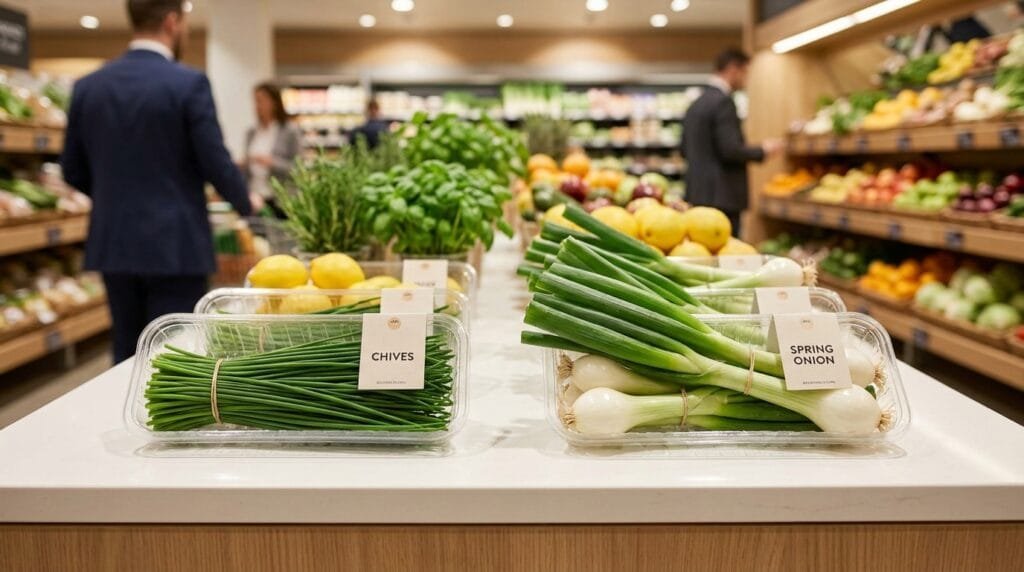
Chives (Allium schoenoprasum) are thin, delicate herbs eaten raw as a garnish. Spring onions (Allium fistulosum or Allium cepa) are immature alliums with a white bulb and thick green stalks, usable raw or cooked across high-heat applications.
Botanical Identity, Culinary Function, and Heat Tolerance
Although both species belong to the genus Allium, their culinary and structural profiles differ fundamentally. Chives (Allium schoenoprasum) are classified botanically as perennial herbs. Their leaves are slender, hollow, and cylindrical, terminating without a swollen basal bulb. Chemically, chives contain lower concentrations of sulfur-bearing thiosulfinates and volatile allyl sulfides than common onions, yielding an understated, herbaceous aroma. Heat rapidly degrades their volatile flavor compounds and breaks down their cell walls into an unpalatable gray-green mush. Consequently, chives function almost exclusively as a finishing herb, added off the heat to emulsions, egg dishes, or cold dairy bases to preserve their delicate profile and align with general nutritional recommendations such as the World Health Organization Guidelines on Healthy Diets & Saturated Fats.
Spring onions, by contrast, are juvenile vegetables primarily harvested from Allium fistulosum (bunching onions) or young Allium cepa (bulb onions). They consist of three distinct functional segments: the rooted base, a pronounced white bulb, and rigid, hollow green stalks. The white and pale green portions contain dense, tightly packed layers rich in fructans and organosulfur compounds, delivering a pungent bite similar to a mature shallot. The upper green stalks are sturdier and more fibrous than chive blades. Because of this layered, dense cellular architecture, spring onions can endure prolonged cooking. Sautéing, stir-frying, grilling, and braising caramelize their complex sugars without compromising their structural integrity.
A recurring regulatory and botanical nuance involves regional nomenclature. In the United Kingdom, Australia, and New Zealand, the term “spring onion” is commonly used interchangeably with “scallion.” In the United States, however, produce distributors sometimes differentiate the two: “scallions” refer to bunching varieties harvested with perfectly straight, non-bulbous white bases, while “spring onions” refer to young true onions showing an incipient, rounded bulb. Regardless of minor regional terminology, both scallions and spring onions possess the robust density required for high-heat cooking, contrasting sharply with the heat-sensitive, purely herbaceous chive. Neither species is categorized as a major allergen under the FDA Food Allergen Labeling & Consumer Protection Act (FALCPA), although adverse reactions to allium sulfites and fructans remain clinically recognized.
Label Verification: Navigating Ingredients and Nutritional Panels
When examining pre-packaged and processed foods, the distinction between chives and spring onions is frequently obscured by ambiguous ingredient declarations. In the United States, Title 21 of the Code of Federal Regulations allows certain dehydrated alliums to be listed under general terms like “spices” or “dehydrated onion,” though high-end formulations explicitly state “freeze-dried chives” or “dehydrated green onion.” For instance, in a commercial product like Philadelphia Chive & Onion Cream Cheese Spread, the ingredient statement lists “dried chives” alongside “dried onions.” A 30g serving reflects standard lipid and moisture metrics, but the aromatic compounds are preserved via freeze-drying. Conversely, in shelf-stable noodle bowls such as Nongshim Shin Ramyun, the dehydrated vegetable garnish pack includes “green onion flakes” (spring onion) rather than chives. Green onion withstands rapid boiling in water for four minutes while rehydrating to a firm, fibrous bite, whereas freeze-dried chives would disintegrate into the broth.
In the European Union and the United Kingdom, Regulation (EU) No 1169/2011 mandates that ingredients be identified by their specific legal or customary name, disallowing vague aggregations when an ingredient characterizes the food. On a prepared salad dressing or dip, such as Marks & Spencer Sour Cream & Chive Dip, the label must state the exact percentage of chives (e.g., “Chives (2%)”) in accordance with Quantitative Ingredient Declaration (QUID) rules. Nutritional values in these territories are presented per 100g rather than by standard reference servings. Fresh chives contain approximately 30 kcal, 3.27g of protein, and 4.35g of carbohydrates per 100g, while spring onions provide approximately 32 kcal, 1.83g of protein, and 7.34g of total carbohydrates per 100g, driven by their higher concentration of natural sugars in the bulb.
Consumers scanning processed snacks—such as sour cream and onion potato chips—often mistakenly assume the green flecks are chives. In high-volume commercial manufacturing, green flecks are almost exclusively dehydrated spring onion flakes or parsley, used because chives lose their color and flavor during baking or frying. Scanning ingredient lists with the Food Scan Genius mobile app allows shoppers to verify whether a product uses authentic herbs or relies on concentrated powders and flavor additives evaluated under the European Food Safety Authority (EFSA) Additive Safety Regulations. In modern processed foods, analyzing these additive structures is increasingly relevant given PubMed Research on Ultra-Processed Foods & Gut Microbiome Disruption, which links heavily emulsified, artificially seasoned formulations with altered gut flora compared to whole-allium culinary alternatives.
| Metric / Characteristic | Chives (Allium schoenoprasum) | Spring Onion (Allium fistulosum / cepa) |
|---|---|---|
| Botanical Classification | Perennial Herb | Immature Biennial/Perennial Allium Vegetable |
| Edible Parts | Hollow scapes (leaves) and edible blossoms | White bulb, pale transition zone, green stalks |
| Stem Diameter (Typical) | 1.5 mm to 3 mm | 8 mm to 20 mm |
| Heat Tolerance | Extremely low; bitter/mushy if boiled or sautéed | High; withstands stir-frying, grilling, and stewing |
| Primary Culinary Role | Cold garnish, finishing herb, dairy fold-in | Aromatic base, stir-fry component, robust garnish |
| Carbohydrates (per 100g, raw) | 4.35 g | 7.34 g |
| Dietary Fiber (per 100g, raw) | 2.5 g | 2.6 g |
| Sugars (per 100g, raw) | 1.85 g | 2.33 g |
| FODMAP Level (Monash Univ. metrics) | Low (up to 19g serving) | Bulb: High (fructans); Green Tops: Low |
| Common Processing Method | Freeze-drying, fresh snipping | Air-drying, dehydration, fresh chopping |
Common Culinary Confusions and Ingredient Substitutions
A common error in home kitchens is substituting chives and spring onions at a strict 1:1 volume ratio. Because spring onions possess significantly thicker cell walls and a higher concentration of pungent allicin precursors, replacing chives with an equivalent volume of raw spring onion bulb overwhelms delicate preparations such as compound butters, deviled eggs, or French omelets. If an emergency substitution is necessary, use only the top dark-green leafy sections of the spring onion, sliced into fine ribbons, and reduce the overall volume by approximately 40 percent.
Conversely, attempting to substitute chives into cooked bases—such as Asian stir-fries, Latin sofritos, or long-simmered mirepoix—is structurally ineffective. Chives lack the fibrous structural density and concentrated sugars of the spring onion bulb; when subjected to direct pan heat or boiling liquids, their volatile essential oils vaporize instantly, leaving limp, stringy matter without aromatic lift. In recipes calling for sautéed spring onions, substitute small shallots or the white portions of leeks rather than chives.
Another point of confusion involves garlic chives (Allium tuberosum), which are frequently conflated with both standard European chives and spring onions. Garlic chives feature flat, solid, strap-like blades—unlike the round, hollow scapes of common chives—and exhibit a pronounced allicin punch that mimics crushed raw garlic. While garlic chives can withstand slightly more cooking than common chives, they cannot substitute for the crunchy, structural bulk of a spring onion bulb.
Frequently asked questions
Can I substitute chives for spring onions in a stir-fry?
No. Chives have fragile cell walls and delicate essential oils that burn or turn into mush under high heat. In a stir-fry, substitute with leeks, shallots, or the white parts of scallions instead.
Are scallions and spring onions the exact same vegetable?
In everyday cooking and British/Commonwealth English, yes. In commercial US agriculture, true spring onions are harvested later than scallions, displaying a distinct round bulb at the base, whereas scallions feature a straight, non-swollen white shank.
Which is better for someone following a low-FODMAP diet?
Chives are low-FODMAP at standard serving sizes (up to 19g). For spring onions, the white bulb is high in fructans and should be avoided, but the dark green tips are low-FODMAP and safe for sensitive individuals.
How do you store fresh chives versus fresh spring onions?
Wrap chives loosely in a damp paper towel and place them in an airtight container or sealable plastic bag in the vegetable crisper for up to one week. Spring onions can be stood upright in a glass jar with an inch of water covering the roots, covered loosely with a plastic bag, and refrigerated for up to two weeks.
Do chives taste like green onions?
Chives have a much milder, purely herbaceous onion flavor without the sharp, sulfurous bite found in the white bulb of a green onion. Green onions provide a sharper crunch and a far more pronounced allium pungency.
References
- FDA Food Allergen Labeling & Consumer Protection Act (FALCPA)
- European Food Safety Authority (EFSA) Additive Safety Regulations
- PubMed Research on Ultra-Processed Foods & Gut Microbiome Disruption
- World Health Organization Guidelines on Healthy Diets & Saturated Fats
Related guides
- Best Food Allergy Scanner App – Scan Food Labels Instantly — Food Allergy & Sensitivity Scanner Hub
- The 7 Best Free Food Scanner Apps of 2026 — best free food scanner apps
- Choosing the Best Barcode Scan App for Your Health — guide to choosing a barcode scanner app
- Food Scan Genius: World’s #1 Food Ingredient Scanner App — Food Scan Genius scanner app
Check Any Label Against 5 Million Products — Free
Never second-guess confusing grocery labels again. Download Food Scan Genius to uncover hidden additives, toxic dyes, and allergens for the whole household before you buy.