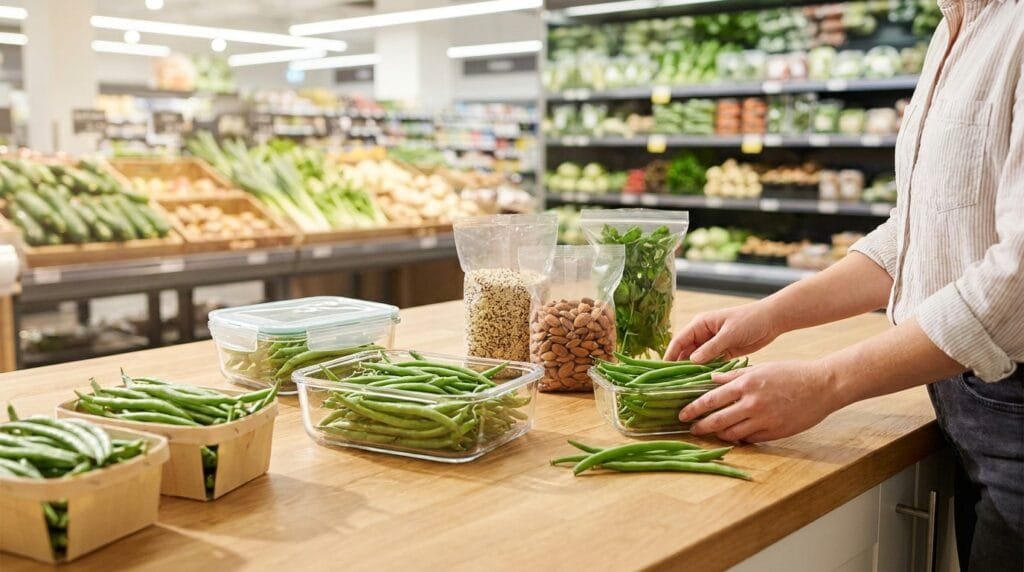
One 100-gram serving of raw French beans provides 31 calories, 1.83 grams of protein, 0.22 grams of fat, 6.97 grams of carbohydrates, and 2.7 grams of dietary fiber, alongside 43 micrograms of vitamin K (36% DV) and 12.2 milligrams of vitamin C.
Nutritional Composition and Physiological Mechanisms of French Beans
French beans (Phaseolus vulgaris), often designated commercially as haricots verts, fine beans, or snap beans, represent an immature edible pod cultivar characterized by high moisture content (approximately 90.3% by mass) and an exceptionally low energy density of 31 kilocalories (130 kJ) per 100 grams. From a macronutrient standpoint, the carbohydrate fraction (6.97g per 100g) is predominantly composed of non-starch polysaccharides and complex structural carbohydrates rather than free sugars. Of this total carbohydrate content, dietary fiber constitutes 2.7 grams per 100 grams, divided roughly between insoluble lignocellulosic structural components (cellulose and hemicellulose) and soluble fractions including pectin. This low-glycemic, fiber-rich architecture supports stable blood glucose regulation, closely aligning with physiological benchmarks established by the World Health Organization Guidelines on Healthy Diets & Saturated Fats, which emphasize the metabolic necessity of non-starch dietary fiber for cardiovascular disease prevention and lipid profile management.
The micronutrient density of French beans is defined by clinically relevant concentrations of phylloquinone (vitamin K1), L-ascorbic acid (vitamin C), and pteroylmonoglutamic acid derivatives (folate or vitamin B9). A standard 100-gram raw portion yields approximately 43 micrograms of phylloquinone—equating to roughly 36% of the Recommended Dietary Intake (RDI) for adults. Phylloquinone acts as an indispensable co-factor for the gamma-glutamyl carboxylase enzyme, which catalyzes the post-translational carboxylation of glutamic acid residues in osteocalcin and matrix Gla-protein (MGP), directly modulating bone mineralization and inhibiting ectopic vascular calcification. Concurrently, French beans provide 12.2 milligrams of ascorbic acid per 100 grams (14% Daily Value), functioning as an endogenous electron donor to combat reactive oxygen species and facilitate the reduction of plant-based non-heme ferric iron (Fe3+) into absorbable ferrous iron (Fe2+) within the duodenal brush border.
At the colonic level, the dietary fiber matrix and resistant starch fractions present in Phaseolus vulgaris undergo anaerobic fermentation by commensal microbiota, yielding beneficial short-chain fatty acids (SCFAs)—predominantly acetate, propionate, and butyrate. Butyrate functions as the primary metabolic substrate for colonocytes, sustaining mucosal epithelial integrity, enhancing claudin-mediated tight junctions, and suppressing local pro-inflammatory cascades. This cellular preservation presents a sharp physiological contrast to the degradative mucosal alterations observed in diets dominated by processed, emulsified convenience items, a dynamic extensively documented in PubMed Research on Ultra-Processed Foods & Gut Microbiome Disruption. French beans also introduce biologically active polyphenol complexes, specifically flavonols such as quercetin-3-glucoside, kaempferol derivatives, and xanthophyll carotenoids (lutein and zeaxanthin), which deposit selectively in the macular tissue of the retina to filter high-energy blue wavelength light.
As a legume crop, French beans naturally synthesize anti-nutritional defense compounds, specifically phytohemagglutinin (lectins) and myo-inositol hexakisphosphate (phytic acid). However, unlike mature dry kidney beans, which harbor hazardous concentrations of toxic lectins that mandate rigorous boiling, French beans are harvested at an immature pod stage and exhibit significantly lower baseline lectin activity. Phytic acid naturally chelates divalent cations such as zinc (Zn2+), calcium (Ca2+), and iron (Fe2+), marginally reducing their luminal bioavailability. Brief culinary thermal processing—specifically convective steaming for 4 to 6 minutes or blanching in water at 100°C for 3 minutes—denatures heat-sensitive lectin structures and hydrolyzes upwards of 30% to 50% of bound phytic acid without inducing excessive thermal degradation of heat-labile folate and vitamin C.
Reading French Bean Labels: US Nutrition Facts vs. EU/UK Declarations and Real Products
When evaluating French bean packaging, consumers encounter distinct differences between the mandatory regulatory labeling frameworks enforced in the United States by the Food and Drug Administration (FDA) versus those enforced in the European Union and United Kingdom under Regulation (EU) No 1169/2011. Under the US Nutrition Labeling and Education Act (NLEA), French beans are governed by a Reference Amount Customarily Consumed (RACC) of 85 grams for frozen or raw presentations, or 120 to 130 grams (typically defined as 1/2 cup) for canned variants. Consequently, a US panel displays macro- and micronutrients calibrated specifically to that irregular serving weight. In direct contrast, EU and UK food law mandates standardized reporting per 100 grams of product across all retail SKUs, with voluntary secondary disclosures allowed for manufacturer-determined serving portions.
Real-world shelf products demonstrate how processing choices alter nutritional declarations. Consider raw or individually quick-frozen (IQF) presentations, such as Birds Eye Steamfresh Cut Green Beans (US) or Picard Haricots Verts Très Fins (France/EU). The Birds Eye product designates a serving size of 2/3 cup (85g), reporting 25 calories, 0g fat, 5g total carbohydrate, 2g dietary fiber (7% DV), 1g total sugars, 1g protein, and 0mg sodium. Meanwhile, the Picard EU package reports standardized values per 100g: 32 kcal (134 kJ), 0.2g fat (of which saturates are <0.1g), 3.8g carbohydrates (with 1.6g sugars), 3.0g dietary fiber, 2.0g protein, and 0.01g salt. Note the labeling variance: EU regulations calculate carbohydrates as 'glycemic carbohydrates' (excluding dietary fiber entirely), whereas US labels list 'Total Carbohydrate' as an aggregate sum that includes the fiber fraction, causing apparent discrepancies between trans-Atlantic products possessing identical raw composition.
Canned French beans introduce severe sodium distortions that alter the cardiovascular profile of the food. In products like Del Monte Fresh Cut Blue Lake French Style Green Beans, a single 1/2-cup serving (121g) contains 380 milligrams of sodium—amounting to 17% of the US Daily Value (2,300mg)—derived strictly from added canning brine. If an individual consumes the entire 14.5-ounce can (approximately 3.5 servings), sodium intake reaches 1,330 milligrams. By contrast, a ‘No Salt Added’ variant lists only 10 milligrams of naturally occurring sodium per 121g. Canned formulations often introduce firming agents such as calcium chloride (E509) to preserve pod turgor and structural rigidity against thermal retort processing. In European imports, these additives fall under the rigorous oversight of European Food Safety Authority (EFSA) Additive Safety Regulations, which confirm their technological safety but highlight the importance of scanning ingredient statements for functional processing aids.
To navigate these inconsistencies across commercial iterations—ranging from pristine IQF single-ingredient packages to shelf-stable jars immersed in seasoned brines—systematic verification is essential. When checking packaged vegetable blends or jarred haricots verts in the grocery aisle, using the Food Scan Genius mobile app allows shoppers to instantly audit barcode data, differentiating whole-food legume fiber from hidden sodium additives, calcium firming salts, or added industrial starches. Furthermore, although Phaseolus vulgaris is not classified as a priority allergen under the US Food Allergen Labeling and Consumer Protection Act (FALCPA) or EU Annex II, individuals managing severe legume cross-reactivities (such as systemic arachin or glycine max sensitivities) must monitor cross-contact warnings, utilizing diagnostic criteria verified by Food Allergy Research & Education (FARE) Clinical Standards to avoid industrial processing lines shared with soy or peanuts.
| Nutrient / Metric | Raw French Beans (per 100g) | Boiled & Drained (per 100g) | Canned, Drained (per 100g) | US Daily Value (% DV per 100g Raw) |
|---|---|---|---|---|
| Energy | 31 kcal (130 kJ) | 35 kcal (146 kJ) | 24 kcal (100 kJ) | 1.5% |
| Water Content | 90.32 g | 89.22 g | 93.10 g | N/A |
| Protein | 1.83 g | 1.89 g | 1.22 g | 3.7% |
| Total Lipid (Fat) | 0.22 g | 0.28 g | 0.14 g | 0.3% |
| Carbohydrates | 6.97 g | 7.88 g | 4.58 g | 2.5% |
| Dietary Fiber | 2.70 g | 3.20 g | 1.90 g | 9.6% |
| Free Sugars | 3.26 g | 1.40 g | 1.25 g | N/A |
| Calcium (Ca) | 37 mg | 44 mg | 38 mg | 2.8% |
| Iron (Fe) | 1.03 mg | 0.65 mg | 0.81 mg | 5.7% |
| Potassium (K) | 211 mg | 146 mg | 90 mg | 4.5% |
| Sodium (Na) | 6 mg | 1 mg (unsalted) | 230–350 mg (salted brine) | 0.3% (raw) |
| Vitamin C | 12.2 mg | 9.7 mg | 4.1 mg | 13.6% |
| Vitamin K1 | 43.0 mcg | 40.0 mcg | 28.5 mcg | 35.8% |
| Folate (B9) | 33.0 mcg | 32.0 mcg | 24.0 mcg | 8.3% |
Common Misconceptions and Nutritional Pitfalls
A prevalent nutritional mistake is conflating the macronutrient profile of French beans with that of mature, dry pulses such as black beans, navy beans, or pinto beans. While both belong to Phaseolus vulgaris, French beans are harvested while the seeds inside are fully immature and the succulent pericarp (pod) forms the primary edible tissue. As a consequence, French beans contain only 1.83 grams of protein per 100 grams, compared to 21 to 25 grams of protein per 100 grams of dry mature pulses. Relying on French beans as a primary protein substitute in vegan or plant-forward dietary planning results in an unintended macronutrient deficit unless paired with concentrated protein substrates such as legumes, grains, or isolates.
A second persistent misconception is that consuming raw French beans provides optimal nutrition by avoiding culinary heat degradation. While excessive boiling does leach water-soluble micronutrients—depleting vitamin C by up to 25% and potassium by up to 30% into discarded cooking water—consuming French beans completely raw is counterproductive. Moderate cooking, specifically short-interval steaming or microwaving, is necessary to disrupt cellular plant matrices, significantly enhancing the bioavailability of lipid-soluble carotenoids (lutein and beta-carotene) while thermalizing and inactivating phaseolin lectins and naturally occurring hemagglutinins that irritate the gastric mucosa.
Finally, consumers frequently misjudge frozen French beans as nutritionally inferior to fresh supermarket produce. Fresh French beans undergo progressive post-harvest physiological deterioration, including enzymatic respiration and ascorbic acid oxidation, often losing over 50% of their native vitamin C within 7 days of commercial storage at ambient or refrigerated temperatures. Conversely, commercial Individually Quick Frozen (IQF) French beans are typically blanched and blast-frozen within hours of harvest, effectively arresting enzymatic pathways and preserving vitamin K, folate, and carotenoid concentrations at levels equivalent or superior to retail fresh beans that have spent several days in supply chain transit.
Frequently asked questions
How many calories and carbs are in a 100g serving of French beans?
A 100-gram serving of raw French beans provides 31 calories (130 kJ), 6.97 grams of total carbohydrates, 2.7 grams of dietary fiber, and 1.83 grams of protein.
Are French beans high in vitamin K?
Yes. French beans provide approximately 43 micrograms of phylloquinone (vitamin K1) per 100 grams raw, which supplies roughly 36% of the adult Daily Value (120 mcg), essential for normal blood clotting and bone osteocalcin carboxylation.
Do frozen French beans lose their nutrients compared to fresh?
No. Industrial flash-freezing (IQF) stabilizes French beans immediately post-harvest. Fresh beans stored in transit and retail bins often lose up to 50% of their vitamin C within one week, whereas frozen beans preserve virtually all of their fiber, mineral, and vitamin K content.
Can you eat French beans raw safely?
While French beans possess far fewer toxic lectins (phytohemagglutinin) than mature dry red kidney beans, consuming large quantities completely raw can cause mild gastrointestinal irritation. Light steaming or blanching completely deactivates these proteins while optimizing carotenoid bioavailability.
Why do canned French beans have higher sodium levels on the label?
Commercial canning facilities pack French beans in an aqueous sodium chloride brine to assist preservation, flavor, and texture. Unless explicitly labeled ‘No Salt Added,’ canned French beans can contain 300 to 400 milligrams of added sodium per 100 grams.
References
- Food Allergy Research & Education (FARE) Clinical Standards
- European Food Safety Authority (EFSA) Additive Safety Regulations
- PubMed Research on Ultra-Processed Foods & Gut Microbiome Disruption
- World Health Organization Guidelines on Healthy Diets & Saturated Fats
Related guides
- Best Food Allergy Scanner App – Scan Food Labels Instantly — Food Allergy & Sensitivity Scanner Hub
- The 7 Best Free Food Scanner Apps of 2026 — best free food scanner apps
- Choosing the Best Barcode Scan App for Your Health — guide to choosing a barcode scanner app
- Food Scan Genius: World’s #1 Food Ingredient Scanner App — Food Scan Genius scanner app
Check Any Label Against 5 Million Products — Free
Never second-guess confusing grocery labels again. Download Food Scan Genius to uncover hidden additives, toxic dyes, and allergens for the whole household before you buy.