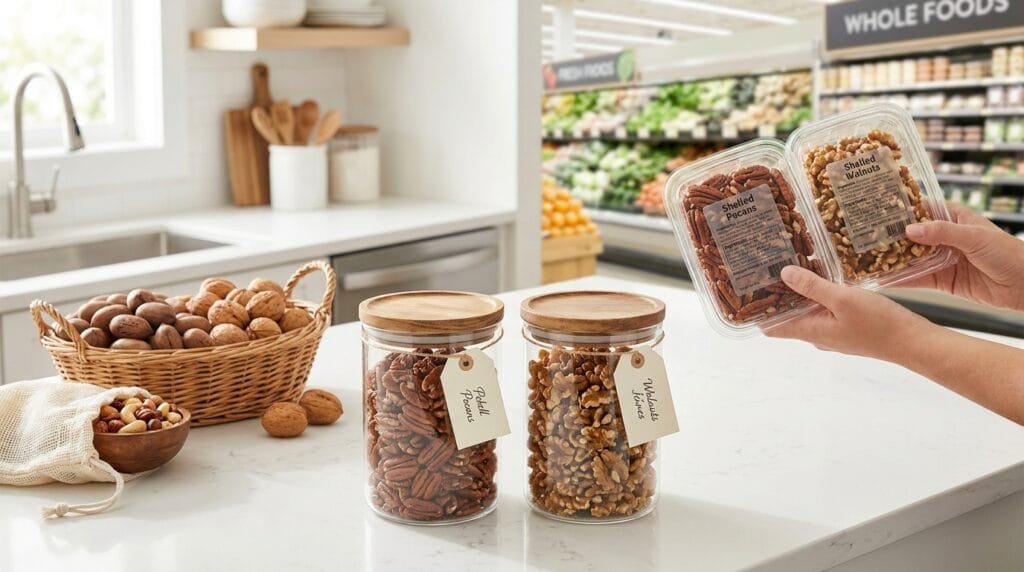
Pecans taste sweeter and contain 72% fat—mostly monounsaturated oleic acid. Walnuts taste earthy, slightly bitter, and lead significantly in heart-healthy polyunsaturated fats, packing 9.1 grams of plant-based omega-3 alpha-linolenic acid (ALA) per 100 grams versus 1.0 gram in pecans.
Botanical Heritage, Nutritional Profiles, and Functional Chemistry
While both pecans (Carya illinoinensis) and English or Persian walnuts (Juglans regia) belong to the botanical family Juglandaceae, their biochemical and culinary profiles diverge significantly. Pecans are native to North America, traditionally thriving in the river valleys of the southern United States and northern Mexico. Walnuts trace their lineage across Central Asia and the Mediterranean basin. Both botanically qualify as “drupaceous nuts” or drupes rather than true botanical nuts, as their edible meat constitutes the seed enclosed inside a hard endocarp shell surrounded by a fleshy green husk. Despite sharing taxonomic traits, their lipid compositions dictate fundamentally different health benefits, shelf lives, and thermal stability in cooking.
The defining nutritional contrast centers on their fatty acid distributions. Pecans contain the highest total lipid content of any commercial tree nut aside from macadamias, averaging 72 grams of fat per 100-gram serving. Of this total, approximately 41 grams are heart-healthy monounsaturated oleic acid (18:1), mirroring the lipid makeup of extra virgin olive oil. In contrast, walnuts deliver 65 grams of total fat per 100 grams, but their matrix is dominated by polyunsaturated fatty acids (PUFAs), accounting for roughly 47 grams. Most notably, walnuts are one of the richest plant-based sources of alpha-linolenic acid (ALA), an essential omega-3 fatty acid. According to the World Health Organization Guidelines on Healthy Diets & Saturated Fats, substituting saturated fats with polyunsaturated fats like ALA directly supports cardiovascular wellness and aids systemic inflammation control.
These distinct chemical structures translate into completely different sensory attributes and cooking properties. Pecans possess a naturally buttery, sweet profile derived from a slightly higher concentration of simple sugars (around 4 grams per 100 grams) combined with neutral-tasting monounsaturated fats. This sweetness makes them ideal for desserts, caramelizations, and pralines. Walnuts feature a distinct tannic astringency and slight bitterness housed within their papery outer pellicle. When exposed to dry heat in baking or roasting, the volatile compounds in walnuts transition to a deep, savory, and woody note. However, because walnuts possess high concentrations of polyunsaturated double bonds, they oxidize and turn rancid far faster than pecans when exposed to room temperature oxygen and ultraviolet light.
From an immunogenic standpoint, both nuts represent potent allergen vectors. Clinical management guidelines from Food Allergy Research & Education (FARE) Clinical Standards highlight that tree nut allergies often display cross-reactivity within botanical families. Because pecans and walnuts share major 2S albumin storage proteins (such as Car i 1 in pecans and Jug r 1 in walnuts), cross-sensitization between the two approaches 80% to 90%. Consumers allergic to walnuts are overwhelmingly reactive to pecans as well, necessitating strict cross-contact avoidance regardless of which nut is printed on an allergen warning label.
Reading Real Labels: Deciphering Pecans and Walnuts on Packaged Goods
When examining raw or roasted nuts in retail grocery aisles, the differences between US Nutrition Facts panels and UK/EU food declarations can complicate nutrient comparisons. Consider an American retail brand such as Fisher Chef’s Naturals Pecan Halves versus Fisher Chef’s Naturals Walnut Halves. In the United States, FDA regulations standardize tree nut servings at 1 ounce (28.35 grams, typically rounded to 28 grams on panels). For pecans, this 28-gram serving yields 196 calories, 20 grams of total fat, 4 grams of total carbohydrates (including 3 grams of dietary fiber and 1 gram of total sugars), and 2.6 grams of protein. A 28-gram serving of Fisher Walnut Halves declares 185 calories, 18.5 grams of total fat, 3.9 grams of total carbohydrates (2 grams of dietary fiber), and 4.3 grams of protein—nearly 65% more protein per standard serving than pecans.
In contrast, European and British packaging (governed by EU Regulation No 1169/2011) mandates declarations per 100 grams alongside any voluntary per-portion metrics. Under brands like Kirkland Signature or Whitworths in the UK, a 100-gram declaration immediately clarifies the macro differential: 100 grams of raw pecans deliver roughly 691 kcal, 72g fat, 9.2g protein, and 9.6g fiber. The 100-gram walnut declaration reveals roughly 654 kcal, 65g fat, 15.2g protein, and 6.7g fiber. Crucially, EU labels do not require a breakdown of polyunsaturated vs. monounsaturated fats unless a formal nutritional claim is made. Shoppers seeking heart-healthy omega-3s who scan a generic mixed bag with Food Scan Genius can instantly extract the underlying lipid breakdown and identify whether the primary nut constituent provides short-chain omega-3 ALA or monounsaturated oleic acid.
Misinterpretations frequently happen when evaluating processed or seasoned nut products, such as candied pecans or seasoned walnut snack pouches. In these multi-ingredient goods, the addition of sugars, maltodextrin, seed oils, and chemical glazing agents alters the health profile substantially. Many industrial glazes rely on emulsifiers and artificial preservatives vetted under European Food Safety Authority (EFSA) Additive Safety Regulations, yet high intake of synthetic food coatings has raised questions within broader PubMed Research on Ultra-Processed Foods & Gut Microbiome Disruption. Reading past the front-of-pack claims (“Rich in Omega-3” or “Keto-Friendly”) to inspect the exact ingredient list ensures consumers distinguish between unprocessed raw kernels and ultra-processed confectionery snacks.
| Nutrient / Metric (per 100g raw) | Pecan Nut (Carya illinoinensis) | Walnut (Juglans regia) | Primary Biological Impact |
|---|---|---|---|
| Total Energy | 691 kcal (2,889 kJ) | 654 kcal (2,738 kJ) | Dense caloric fuel from dietary lipids |
| Total Fat | 72.0 g | 65.2 g | Pecans are higher in total lipids |
| Monounsaturated Fat (MUFA) | 40.8 g | 8.9 g | Pecans favor oleic acid (oxidatively stable) |
| Polyunsaturated Fat (PUFA) | 21.6 g | 47.2 g | Walnuts dominate in polyunsaturates |
| Omega-3 Fatty Acid (ALA 18:3) | 1.0 g | 9.1 g | Walnuts supply over 9x more plant omega-3 |
| Omega-6 Fatty Acid (LA 18:2) | 20.6 g | 38.1 g | Essential linoleic acid |
| Protein | 9.2 g | 15.2 g | Walnuts provide 65% more essential amino acids |
| Dietary Fiber | 9.6 g | 6.7 g | Pecans offer higher insoluble and soluble fiber |
| Total Sugars | 3.97 g | 2.61 g | Pecans impart naturally sweeter flavor |
| Magnesium | 121 mg (29% DV) | 158 mg (38% DV) | Walnuts lead in neuromuscular support |
| Manganese | 4.5 mg (196% DV) | 3.4 mg (148% DV) | Both deliver potent antioxidant enzyme cofactors |
| Primary Tannic Compound | Ellagitannins (low) | Ellagitannins (high / astringent) | Walnuts have stronger astringency on palate |
Common Confusions: Shelf Life, Culinary Swaps, and Visual Identification
A widespread mistake is assuming pecans and walnuts can be swapped 1:1 across all culinary applications without adjusting flavor or moisture. In savory recipes—such as an authentic Genovese-style walnut sauce, pesto, or grain bowls—substituting pecans can introduce excess sweetness and lack the assertive, bitter-tannic backbone provided by walnuts. Conversely, substituting walnuts into delicate baked goods like shortbreads, pecan pies, or pralines can impart a dry, chalky astringency unless the walnuts are blanched or toasted thoroughly to soften the outer skin’s tannins.
Another critical misconception involves shelf stability and storage. Consumers often store both nuts in ambient pantry jars, unaware that their lipid vulnerabilities are fundamentally asymmetric. Because walnuts consist of more than 47% polyunsaturated fatty acids containing multiple delicate double bonds, they oxidize rapidly when exposed to air, light, and ambient heat (above 20°C/68°F), turning rancid within two to three months. Pecans, protected by their stable monounsaturated oleic acid matrix, maintain freshness significantly longer. Nevertheless, both nuts should ideally be stored in airtight containers inside the refrigerator (up to six months) or freezer (up to two years) to halt oxidative degradation.
Finally, consumers often confuse in-shell and shelled forms visually. In their raw, shelled state, pecans are elongated, smooth-lobed, and feature a deep amber-red hue with darker longitudinal grooves. Walnuts are rounded, pale tan, and deeply convoluted with undulating, brain-like folds. In the shell, the distinction is even more pronounced: pecans possess smooth, oblong, thin shells that crack easily under moderate hand pressure, while English walnuts exhibit rough, corrugated, spherical shells that require a mechanical hinge cracker.
Frequently asked questions
Can you substitute walnuts for pecans in baking recipes?
Yes, walnuts can replace pecans at a 1:1 weight ratio in most baked goods such as brownies, quick breads, and cookies. However, walnuts impart a more astringent, slightly bitter profile and less natural sweetness, so toasting them prior to baking is recommended to mellow their flavor.
Which nut has more omega-3 fatty acids, pecans or walnuts?
Walnuts have significantly more omega-3 fatty acids. Walnuts provide approximately 9.1 grams of alpha-linolenic acid (ALA) per 100 grams, whereas pecans contain only about 1.0 gram per 100 grams, making walnuts the superior choice for plant-based omega-3s.
Why do walnuts taste more bitter than pecans?
Walnuts have a higher concentration of ellagitannins and polyphenolic compounds concentrated in their thin, papery outer skin (the pellicle). Pecans contain lower levels of these astringent tannins and possess slightly higher natural sugar content, giving them a buttery, sweet taste.
How should pecans and walnuts be stored to prevent rancidity?
Both nuts should be stored in airtight, moisture-proof containers in a refrigerator or freezer. Because walnuts contain high levels of delicate polyunsaturated fats, they turn rancid at room temperature within 2 to 3 months, whereas refrigerated kernels remain fresh for up to a year.
Are pecan allergies and walnut allergies the same?
While caused by different specific proteins, pecans and walnuts belong to the same botanical family (Juglandaceae) and share highly homologous 2S albumin storage proteins. Clinical studies show cross-reactivity between pecan and walnut allergies occurs in up to 80% to 90% of tree-nut-allergic patients.
References
- Food Allergy Research & Education (FARE) Clinical Standards
- European Food Safety Authority (EFSA) Additive Safety Regulations
- PubMed Research on Ultra-Processed Foods & Gut Microbiome Disruption
- World Health Organization Guidelines on Healthy Diets & Saturated Fats
Related guides
- Best Food Allergy Scanner App – Scan Food Labels Instantly — Food Allergy & Sensitivity Scanner Hub
- The 7 Best Free Food Scanner Apps of 2026 — best free food scanner apps
- Choosing the Best Barcode Scan App for Your Health — guide to choosing a barcode scanner app
- Food Scan Genius: World’s #1 Food Ingredient Scanner App — Food Scan Genius scanner app
Check Any Label Against 5 Million Products — Free
Never second-guess confusing grocery labels again. Download Food Scan Genius to uncover hidden additives, toxic dyes, and allergens for the whole household before you buy.