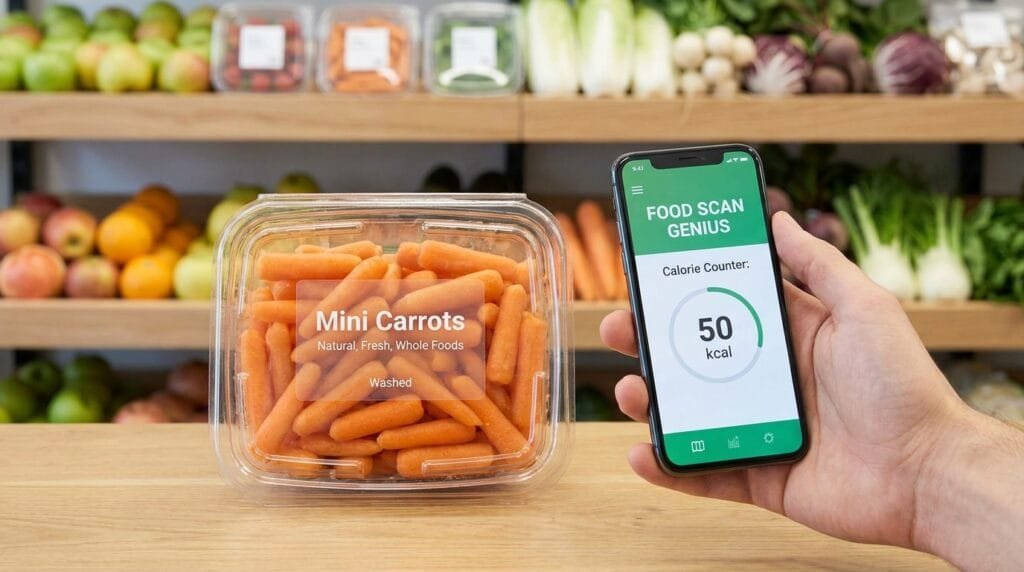
A standard 85-gram serving of mini carrots (approximately 8 to 9 pieces) contains 35 calories. Individual baby-cut carrots average 4 calories each, delivering 41 calories per 100 grams, primarily derived from 8.2 grams of total carbohydrates and 2.9 grams of dietary fiber.
Nutritional Mechanics and Regulatory Classifications of Mini Carrots
Mini carrots—commercially recognized as “baby-cut carrots”—are manufactured from full-sized, slender cultivars of the species Daucus carota sativus (predominantly Imperator varieties). Rather than being immature root vegetables harvested early, they are mechanically cut into 2-inch segments, abraded to remove the fibrous outer skin, washed, and bagged. According to data maintained in the USDA FoodData Central database (Foundation Food FDC ID: 170393), raw baby carrots average 41.4 kilocalories per 100 grams of edible weight. Water constitutes approximately 88.3% of the total vegetable mass, creating an energy density of just 0.41 calories per gram. This low caloric yield makes mini carrots an exceptionally high-volume food, aligning directly with nutritional strategies outlined in the World Health Organization Guidelines on Healthy Diets & Saturated Fats, which emphasize displacing calorie-dense simple fats with fresh produce.
The macronutrient architecture of mini carrots explains their modest caloric footprint. In a standard 100-gram sample, protein contributes 0.98 grams (approximately 3.9 calories) and total lipids contribute a negligible 0.24 grams (roughly 2.2 calories). The remaining energy is supplied by 8.24 grams of total carbohydrates, of which 4.8 grams present as naturally occurring free sugars (chiefly sucrose, followed by glucose and fructose) and 2.9 grams exist as dietary fiber. Unlike industrial snack foods that undergo chemical refining, the natural cellular structure of these roots keeps their cellular matrix intact. This intact cellular structure is clinically relevant, as highlighted in PubMed Research on Ultra-Processed Foods & Gut Microbiome Disruption, which demonstrates that natural plant fibers resist rapid enzymatic breakdown in the small intestine, slightly reducing the net metabolizable energy compared to processed sugars.
Variation in caloric content across individual pieces arises primarily from natural moisture content and root diameter. A petite piece weighing 7 grams contains approximately 2.9 calories, whereas a thicker cut piece weighing 14 grams can contain up to 5.8 calories. Additionally, post-harvest storage conditions influence carbohydrate concentration: as harvested carrots respire, they consume their own stored monosaccharides, which can marginally lower caloric value over extended cold-storage periods, though rarely by more than 1 to 2 calories per typical retail serving.
Reading Real-World Commercial Labels: US vs. International Standards
When examining market-leading brands in the United States, such as Grimmway Farms or Bolthouse Farms Baby Cut Carrots, the Nutrition Facts panel is governed by the Food and Drug Administration (FDA) Reference Amounts Customarily Consumed (RACC) under 21 CFR 101.9. The established RACC for raw carrots is 85 grams, described on the package as “about 3 oz” or roughly “8 to 9 baby carrots.” At this reference weight, the label states 35 calories. Under federal rounding regulations, caloric values below 50 calories must be expressed in 5-calorie increments. Consequently, an 85-gram serving with an analytical baseline of 35.19 calories is rounded directly to 35 calories, while smaller single-portion bags (such as 57-gram school-lunch snack pouches) list 20 or 25 calories depending on precise pack weight.
By contrast, consumer packaging in the European Union and the United Kingdom follows Regulation (EU) No 1169/2011 on Food Information to Consumers (FIC). On products like Tesco Baby Carrots or Sainsbury’s British Cut Carrots, energy must be declared per 100 grams alongside the required kilojoule metric. On these packages, the consumer sees 173 kJ / 41 kcal prominently displayed. Because EU regulations mandate the per-100g standard, cross-referencing European nutrition labels with American 85g labels often causes confusion: a shopper comparing a UK 100g declaration (41 kcal) to a US 85g declaration (35 kcal) might mistakenly assume different agricultural varieties or sweeter processing, when the discrepancy is entirely mathematical.
Misreading also occurs frequently with pre-portioned multi-packs containing dips. When plain baby carrots are bundled with ranch dressing or hummus, the panel displays nutritional data for the aggregate product unless split into dual-column formats. For those managing strict caloric thresholds, using Food Scan Genius to check the barcode of pre-packaged produce kits ensures that the calories from the raw root are analyzed separately from added oils, dairy fats, or emulsifiers. Furthermore, while carrots themselves are naturally free of priority allergens, facilities that pack mixed vegetable trays often process celery or nuts, requiring adherence to the FDA Food Allergen Labeling & Consumer Protection Act (FALCPA) for facility cross-contact disclosures.
A persistent myth regarding the white film that sometimes forms on refrigerated mini carrots is that it represents added sugar or preservation chemicals. In reality, this “carrot blush” is harmless surface dehydration and microscopic lifting of outer cells caused by the industrial cutting process. The washing protocols used across both the US and Europe utilize chlorine or acidified wash water to remove field soil, which fully complies with European Food Safety Authority (EFSA) Additive Safety Regulations and FDA sanitation guidelines. These processing washes leave zero caloric residue and do not alter the inherent nutritional content of the raw root vegetable.
| Portion / Measurement | Weight (Grams) | Energy (Calories) | Total Carbohydrates | Dietary Fiber | Free Sugars |
|---|---|---|---|---|---|
| 1 Small Mini Carrot | 7 g | 3 kcal | 0.6 g | 0.2 g | 0.3 g |
| 1 Medium Mini Carrot | 10 g | 4 kcal | 0.8 g | 0.3 g | 0.5 g |
| 1 Large Mini Carrot | 14 g | 6 kcal | 1.2 g | 0.4 g | 0.7 g |
| 1 Ounce (Avoirdupois) | 28.35 g | 12 kcal | 2.3 g | 0.8 g | 1.4 g |
| US RACC Serving (8–9 pieces) | 85 g | 35 kcal | 7.0 g | 2.5 g | 4.1 g |
| Metric Reference Standard | 100 g | 41 kcal | 8.2 g | 2.9 g | 4.8 g |
| 1 Metric Cup (Whole mini carrots) | 120 g | 50 kcal | 9.9 g | 3.5 g | 5.8 g |
| 1 Standard Retail Bag | 454 g (16 oz / 1 lb) | 188 kcal | 37.4 g | 13.2 g | 21.8 g |
Common Measurement Errors and Dietary Tracking Pitfalls
The most widespread mistake in logging mini carrots comes from relying on unit counting rather than scale weight. A user logging “10 baby carrots” as 35 calories based on generic mobile app entries assumes each carrot weighs approximately 8.5 grams. However, commercial sorting tolerances allow individual pieces in a single bag to range anywhere from 6 grams to over 15 grams. If a consumer consumes 10 large baby-cut carrots weighing 14 grams each, the actual portion size is 140 grams—representing 58 calories rather than the intended 35 calories. For precision in caloric deficit tracking, weighing portions in grams is necessary.
Another common point of failure is conflating raw and cooked nutritional profiles without adjusting for moisture migration. When mini carrots are boiled or steamed, they absorb slight amounts of water, causing an 85-gram portion of cooked carrots to contain marginally fewer calories (approximately 30 kcal) due to increased water dilution. Conversely, roasting mini carrots drives off internal water through evaporation. If 150 grams of raw mini carrots are roasted down to an 85-gram finished weight without added oil, that 85-gram cooked portion now carries the concentrated energy of the original 150-gram mass—roughly 62 calories. If roasting oils such as olive or canola oil are applied, a single tablespoon adds 120 calories, transforming a low-calorie root dish into a calorie-dense side.
Frequently asked questions
How many calories are in 10 baby carrots?
Ten average-sized mini carrots weigh approximately 100 grams combined and contain roughly 41 calories. If the pieces are small (around 70 grams total), they yield roughly 29 calories, whereas ten large cuts (140 grams) can reach 58 calories.
Do baby carrots have more sugar or calories than regular carrots?
No. Baby-cut carrots are simply regular field-grown carrots cut into smaller shapes. Their caloric density (41 kcal/100g) and natural sugar content (4.8g/100g) are virtually identical to standard peeled whole carrots.
How many calories are in an entire 1-pound bag of mini carrots?
A standard 1-pound (16-ounce / 454-gram) bag of mini carrots contains approximately 188 calories. It also provides roughly 37.4 grams of total carbohydrates and 13.2 grams of dietary fiber.
Why do some labels report 30 calories per serving while others report 35 calories?
This discrepancy is due to federal FDA rounding guidelines. An 85-gram serving has roughly 35.2 calculated calories; brands with slightly lower measured moisture contents or smaller serving definitions (such as 80 grams) round down to 30 calories, while 85-gram portions round to 35 calories.
How many net carbs are in an 85-gram serving of mini carrots?
An 85-gram serving contains approximately 4.5 grams of net carbohydrates. This is calculated by taking the 7.0 grams of total carbohydrates and subtracting the 2.5 grams of non-digestible dietary fiber.
References
- FDA Food Allergen Labeling & Consumer Protection Act (FALCPA)
- European Food Safety Authority (EFSA) Additive Safety Regulations
- PubMed Research on Ultra-Processed Foods & Gut Microbiome Disruption
- World Health Organization Guidelines on Healthy Diets & Saturated Fats
Related guides
- Best Food Allergy Scanner App – Scan Food Labels Instantly — Food Allergy & Sensitivity Scanner Hub
- The 7 Best Free Food Scanner Apps of 2026 — best free food scanner apps
- Choosing the Best Barcode Scan App for Your Health — guide to choosing a barcode scanner app
- Food Scan Genius: World’s #1 Food Ingredient Scanner App — Food Scan Genius scanner app
Check Any Label Against 5 Million Products — Free
Never second-guess confusing grocery labels again. Download Food Scan Genius to uncover hidden additives, toxic dyes, and allergens for the whole household before you buy.