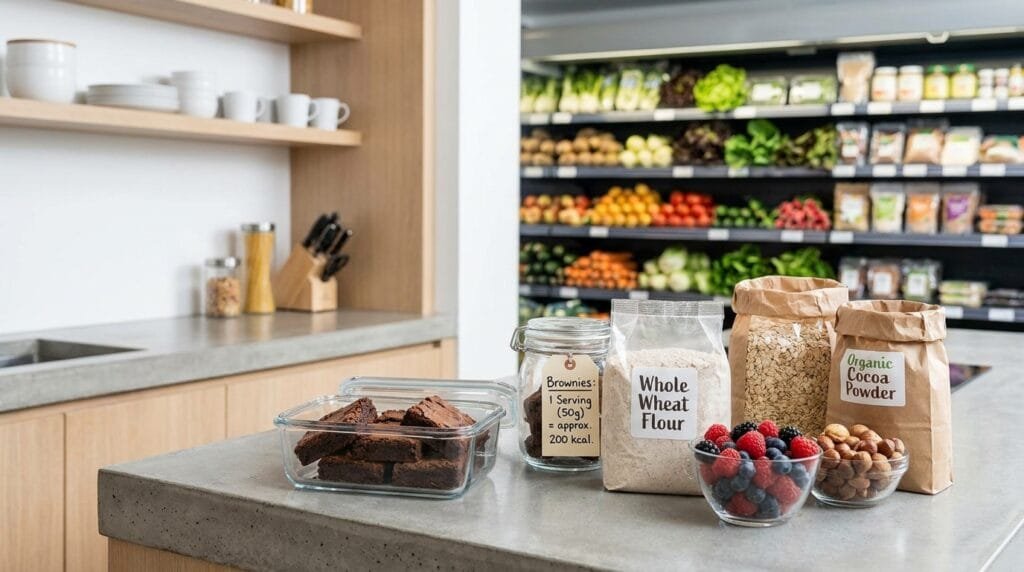
A standard homemade brownie (60 grams) contains approximately 240 to 280 calories. Commercial packaged single-serve brownies typically range from 200 to 450 calories, while oversized bakery portions can reach 500 to 600 calories, primarily determined by butter and sugar content.
The Anatomy of Brownie Caloric Density: Formulations, Fats, and Regulatory Servings
Caloric density in baked goods is determined by moisture elimination, starch gelatinization, and lipid-to-sugar ratios. A brownie is distinct from traditional chocolate cake due to its low water activity, minimal leavening, and heavy fat-to-flour proportion. According to baseline food composition metrics from USDA FoodData Central, an uniced, cake-style commercial brownie yields approximately 405 kcal per 100 grams, whereas a dense, fudge-style brownie exceeds 466 kcal per 100 grams. The caloric calculation is fundamentally driven by macronutrient physics: lipids provide 9 kcal per gram, while carbohydrates (primarily sucrose and wheat flour starches) and proteins contribute 4 kcal per gram. Because a standard fudge recipe demands high volumes of unsalted butter or shortening alongside melted chocolate, fat commonly accounts for 45% to 55% of the total energy yield.
Portion standards set by regulatory agencies contrast sharply with commercial retail realities. Under the United States Food and Drug Administration (FDA) Code of Federal Regulations (21 CFR 101.12), the Reference Amount Customarily Consumed (RACC) for brownies and cake-type bars without icing is officially established at 40 grams. At 40 grams, a standard prepared brownie yields between 160 and 190 calories. However, commercial bakeries and packaged food processors rarely sell brownies at the 40-gram threshold; standard commercial baked items typically range from 60 grams to upwards of 120 grams. The elevated lipid profile of these larger portions regularly conflicts with broad public health benchmarks, such as the World Health Organization Guidelines on Healthy Diets & Saturated Fats, which recommend limiting saturated fatty acids to less than 10% of total daily energy intake—a ceiling rapidly approached by a single bakery-scale brownie providing 8 to 14 grams of saturated fat.
Recipe variations and structural inclusions exert significant upward pressure on the total energy count. Incorporating 50 grams of chopped English walnuts or pecans introduces an additional 325 to 350 calories to a batch, driven by the polyunsaturated and monounsaturated fatty acid matrix of tree nuts. Similarly, semisweet chocolate chips, peanut butter swirls, or salted caramel ribbons increase the dry solids and lipid load while reducing relative hydration. In mass-market production, shelf life and structural integrity require specialized emulsifiers, humectants (such as vegetable glycerin or sorbitol), and modified starches, regulated internationally under frameworks like the European Food Safety Authority (EFSA) Additive Safety Regulations. These additives preserve chewiness without staling, but they maintain high caloric density by replacing water content with metabolizable carbohydrate solids.
Industrial versus artisanal processing further dictates the biochemical impact of these calories. Modern packaged confections frequently rely on interesterified vegetable oils, high-fructose corn syrup, and refined starches. Recent clinical investigations, such as PubMed Research on Ultra-Processed Foods & Gut Microbiome Disruption, demonstrate that ultra-processed macronutrient combinations alter physiological satiety signals differently than traditional matrixes made exclusively of butter, sugar, eggs, and cocoa. Concurrently, processors are mandated under the FDA Food Allergen Labeling & Consumer Protection Act (FALCPA) to disclose core allergens common to brownie manufacturing, including eggs, dairy, soy lecithin, and tree nuts, all of which constitute the foundational caloric matrix of conventional formulations.
Label Deconstruction: US Nutrition Facts vs. EU Standards on Real Packaged Products
Discrepancies in international labeling laws create widespread consumer confusion regarding brownie energy calculations. In the United States, the FDA mandates that nutrition panels display values based on a single serving size, rounded to practical household measures. Conversely, European Union regulations (EU FIC No 1169/2011) and UK food standards require mandatory reporting per 100 grams of product, with per-portion disclosures remaining optional. Because moisture content in brownies is low, the per-100-gram baseline consistently reveals figures between 400 and 490 kcal, whereas a US label might highlight a figure of 130 to 180 kcal simply by calibrating the serving size to a fraction of the physical pastry.
A precise analysis of commercial products illustrates these regulatory differences. For instance, a box of Betty Crocker Delights Supreme Fudge Brownie Mix displays two distinct columns on its US label: “Mix as Packaged” and “Mix as Prepared.” The dry mix states 100 calories per 23-gram serving (1/20th of the box). However, executing the package instructions—which mandate the addition of 1/3 cup of water, 1/3 cup of vegetable oil, and one large egg—raises the caloric yield to 140 calories per 32-gram prepared square. If a consumer slices that same 13×9 inch pan into 12 standard portions instead of the manufacturer-prescribed 20 portions, each resulting square weighs approximately 53 grams and delivers 233 calories. In retail environments, checking these calculations on complex multi-column packaging can be streamlined by scanning the product with Food Scan Genius, which parses the underlying serving size data against the net package weight.
Single-serve retail products showcase even wider variance. A standard Little Debbie Cosmic Brownie weighs 62 grams and is labeled as a single serving containing 280 calories, 11 grams of fat, and 24 grams of added sugars (providing 451 kcal per 100g). In contrast, coffeehouse selections like the Starbucks Double Chocolate Brownie serve an 82-gram portion yielding 410 calories, 24 grams of total fat, and 46 grams of total carbohydrates (equating to 500 kcal per 100g). At the opposite extreme, engineered diet confections such as the Fiber One 70 Calorie Chocolate Fudge Brownie weigh only 25 grams; by substituting high-density fats and sugars with soluble corn fiber, allulose, and fractionated palm oil, the manufacturer compresses the unit yield to 70 calories (280 kcal per 100g), demonstrating how portion manipulation and non-nutritive bulking agents alter standard bakery metrics.
| Brownie Product / Type | Serving Size (g) | Energy (kcal) | Energy per 100g (kcal) | Total Fat (g) | Total Carbs (g) | Protein (g) |
|---|---|---|---|---|---|---|
| USDA SR Legacy Fudge Brownie (Homemade) | 60 g | 279 | 466 | 15.2 | 34.8 | 3.4 |
| USDA SR Legacy Cake-Type Brownie | 50 g | 202 | 405 | 8.9 | 29.5 | 2.6 |
| Betty Crocker Supreme Fudge (Prepared as Directed) | 32 g | 140 | 438 | 5.0 | 22.0 | 1.0 |
| Little Debbie Cosmic Brownie | 62 g | 280 | 451 | 11.0 | 44.0 | 2.0 |
| Starbucks Double Chocolate Brownie | 82 g | 410 | 500 | 24.0 | 46.0 | 5.0 |
| Commercial Bakery Fudge Brownie (Large) | 120 g | 540 | 450 | 28.0 | 68.0 | 6.0 |
| Fiber One Chocolate Fudge Brownie | 25 g | 70 | 280 | 2.0 | 17.0 | 1.0 |
| Almond Flour Keto Brownie (Standard Recipe) | 45 g | 195 | 433 | 18.0 | 6.0 | 4.5 |
Common Calorie Miscalculations and Formulation Pitfalls
A primary source of tracking error involves confusing the dry mix baseline with the prepared item. Boxed brownie mixes list dry powder values on the primary panel, excluding the added vegetable oil, butter, and whole eggs required during preparation. A home baker who mismeasures oil—such as pouring three tablespoons over the stated 1/2 cup—adds up to 360 calories of unmetered lipid energy across the pan, or an extra 30 to 40 calories per slice. Similarly, replacing vegetable oil with dairy butter shifts the fat composition: while butter contains roughly 102 kcal per tablespoon compared to oil’s 120 kcal per tablespoon (due to water and milk solids in butter), its higher saturated fat profile fundamentally alters the solid-fat index and texture without dramatically decreasing overall caloric density.
A secondary misconception is the assumption that “grain-free,” “keto,” or “refined sugar-free” brownies inherently carry fewer calories. Formulations substituting blanched almond flour for all-purpose wheat flour inadvertently increase energy density. Standard white flour contains approximately 364 kcal per 100 grams with 1 gram of fat, whereas almond flour contains approximately 590 kcal per 100 grams with 50 grams of fat. Even when sugar is replaced with erythritol or monk fruit, the disproportionate lipid load from nut meals, coconut oil, and unsweetened baker’s chocolate often results in a final slice that matches or exceeds the 250-to-300-calorie profile of a traditional sucrose-and-wheat brownie.
Finally, consumers consistently underestimate the cumulative intake generated by “brownie bites” and thin crisps. Because edge pieces and crisps possess a lower moisture-to-surface-area ratio, they concentrate fat and sugar solids through dehydration during baking. A 30-gram handful of brownie crisps delivers 130 to 140 calories—identical per unit weight to a dense fudge bar. Consuming miniature portions without a calibrated scale frequently leads individuals to consume 80 to 100 grams of baked goods under the assumption that smaller physical dimensions correlate with reduced energetic density.
Frequently asked questions
How many calories are in an average 2-inch square homemade brownie?
A standard 2-inch square homemade brownie weighing roughly 50 to 60 grams contains between 220 and 280 calories. The precise value depends on whether the recipe uses a cake-style base (lower fat, higher flour) or a fudge-style base (higher butter, melted chocolate, and sugar).
Why do commercial bakery brownies have more calories than boxed mix brownies?
Commercial bakery brownies are significantly larger and contain higher butterfat and solid inclusions. While a boxed mix portion is regulated to a 30-to-40-gram serving yielding 140 to 180 calories, a commercial bakery brownie routinely weighs 80 to 120 grams and contains added chocolate chunks, resulting in 400 to 550 calories.
How many calories do walnuts add to a brownie?
Adding 1/2 cup (approx. 60 grams) of chopped walnuts to a standard brownie batch adds approximately 390 calories to the entire pan. On an individual portion basis, this increases each brownie’s energy content by 25 to 40 calories, depending on the total slice yield.
Do brownie corner and edge pieces have more calories than center pieces?
Edge and corner pieces have slightly higher caloric density per gram because they lose more moisture through evaporation during baking. While a corner slice may weigh the same as a center slice on a scale, its reduced water content means it holds a slightly higher concentration of fats and sugars.
Can you lower brownie calories by replacing oil with applesauce?
Yes, replacing vegetable oil with unsweetened applesauce reduces calories significantly because oil provides roughly 1,920 calories per cup, whereas unsweetened applesauce provides approximately 100 calories per cup. This substitution eliminates most lipid content, resulting in a spongy, cake-like texture with roughly 30% to 40% fewer total calories per serving.
References
- FDA Food Allergen Labeling & Consumer Protection Act (FALCPA)
- European Food Safety Authority (EFSA) Additive Safety Regulations
- PubMed Research on Ultra-Processed Foods & Gut Microbiome Disruption
- World Health Organization Guidelines on Healthy Diets & Saturated Fats
Related guides
- Best Food Allergy Scanner App – Scan Food Labels Instantly — Food Allergy & Sensitivity Scanner Hub
- The 7 Best Free Food Scanner Apps of 2026 — best free food scanner apps
- Choosing the Best Barcode Scan App for Your Health — guide to choosing a barcode scanner app
- Food Scan Genius: World’s #1 Food Ingredient Scanner App — Food Scan Genius scanner app
Check Any Label Against 5 Million Products — Free
Never second-guess confusing grocery labels again. Download Food Scan Genius to uncover hidden additives, toxic dyes, and allergens for the whole household before you buy.