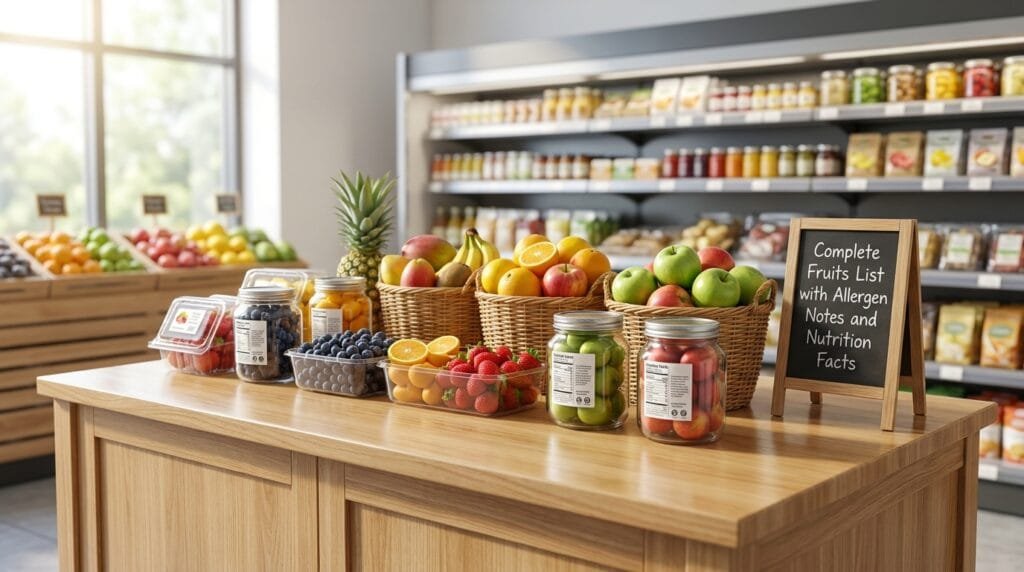
1. Navigating the Modern Fruits List: When Nature’s Sweetness Collides with Hidden Allergens and Processing
For decades, shoppers were taught that navigating a wholesome fruits list was the simplest part of grocery shopping. Whole, vibrant fruits are universally celebrated in clinical literature, aligning directly with the World Health Organization Guidelines on Healthy Diets & Saturated Fats which champion daily consumption of fresh plant foods to mitigate cardiovascular disease and support systemic wellness. Yet for individuals managing food sensitivities, Oral Allergy Syndrome (OAS), fructose malabsorption, or life-threatening anaphylactic profiles, shopping the fruit aisle—and especially packaged fruit derivatives—has become an unexpected minefield.
The modern grocery ecosystem rarely presents fruit in isolation. Whether dealing with post-harvest surface coatings, industrial dehydration agents, flash-frozen medleys packed on shared lines with dairy and tree nuts, or fruit-based snack bars hiding ultra-processed stabilizing gums, consumer vulnerability is at an all-time high. Clinical data highlighted by the Food Allergy Research & Education (FARE) Clinical Standards reveals that cross-reactive plant pan-allergens, such as profilins and lipid transfer proteins (LTPs), trigger adverse reactions across seemingly unrelated botanical families. A patient allergic to birch pollen may suddenly experience acute oral pruritus from a crisp Granny Smith apple, while someone with a latex allergy faces sudden swelling from an avocado, banana, or kiwi.
Compounding this diagnostic complexity is the modern convenience trap. What seems like a single-ingredient pouch of dried mango or a grab-and-go berry smoothie often conceals artificial humectants, added sugars disguised as concentrated fruit purees, and sulfur compounds capable of provoking immediate bronchospasm in asthmatic individuals. For families balancing multi-member dietary restrictions—where one child reacts to stone fruits, a parent manages severe gluten intolerance, and a toddler cannot tolerate synthetic food dyes—relying on naive assumption turns an innocent fruit shopping trip into a stressful clinical hazard.
Scan Any Label for Hidden Additives and Allergens — Free
Never second-guess confusing grocery labels again. Download Food Scan Genius to uncover hidden additives, toxic dyes, and allergens for the whole household before you buy.


2. The Science of Fruit Allergens, Cross-Reactivity, and Deceptive Packaged Formulations
Evaluating a clinical fruits list requires distinguishing between primary IgE-mediated fruit allergies, Pollen Food Allergy Syndrome (PFAS), and non-immunological chemical intolerances. Concurrently, when whole fruits are processed into shelf-stable snacks, fruit preparations, and frozen purees, manufacturing protocols introduce additives that compromise digestive homeostasis. Mounting PubMed Research on Ultra-Processed Foods & Gut Microbiome Disruption demonstrates how industrial emulsifiers and hyper-concentrated fruit pastes destabilize mucosal barriers, leading to increased intestinal permeability and exacerbating immune-mediated sensitivities.
Furthermore, international regulatory frameworks diverge on how post-harvest treatments and fruit additives must be disclosed. As codified under the European Food Safety Authority (EFSA) Additive Safety Regulations, strict limits and mandatory alerts govern compounds like sulfur dioxide, yet loophole naming conventions in packaged fruit products often mask potential irritants. Below are the most insidious culprits, deceptive labeling practices, and immunological cross-reactions embedded within everyday fruit products:
- Sulfur Dioxide and Sulfites (E220–E228): Widely sprayed onto dried apricots, golden raisins, and packaged grapes to inhibit enzymatic browning and extend shelf life. Ingestion triggers severe airway constriction and respiratory distress in sulfite-sensitive and asthmatic shoppers, frequently escaping prominent top-of-pack warnings.
- Post-Harvest Glazes (Shellac & Carnauba Wax): Standard supermarket citrus, apples, and stone fruits are systematically coated with industrial food-grade waxes. These formulations often contain carrier substances or plasticizers derived from casein, soy, or wood resins that are never declared on loose produce display placards.
- Latex-Fruit Syndrome Cross-Reactivity: Hevein-like protein domains cause clinically confirmed immune cross-reactivity between natural rubber latex and common fruits—notably bananas, kiwis, avocados, chestnuts, and figs. Shoppers unaware of this botanical homology face systemic anaphylaxis from whole fruits that carry zero standard allergen advisory badges.
- Pollen Food Allergy Syndrome (PFAS/OAS): Cross-reactions mediated by thermolabile proteins (such as Bet v 1 homologues in birch-allergic patients reacting to apples, pears, peaches, and cherries; or profilins in grass-allergic individuals reacting to melons, oranges, and tomatoes). While cooking denatures some of these proteins, raw consumption can provoke immediate pharyngeal edema.
- Concealed Citrus Bioflavonoids and Citric Acid (Submerged Fermentation): Commercially packaged fruit cocktail cups and fruit purees frequently list "citric acid" or "natural fruit flavoring." In industrial settings, citric acid is predominantly synthesized via microbial fermentation using Aspergillus niger grown on corn or molasses slurry, leaving trace antigens that induce systemic reactions in corn-allergic or mold-sensitive consumers.
- High-FODMAP Fruit Concentrates: Industrial fruit leathers, fruit-flavored yogurts, and juices regularly leverage concentrated pear, apple, or white grape juice syrups as sweetening agents. These concentrates deliver extreme, disproportional doses of free fructose and sorbitol, precipitating intense gastrointestinal distress, bloating, and osmotic diarrhea in individuals with IBS or fructose malabsorption.
3. Democratizing Food Safety: How Food Scan Genius Outperforms Legacy Barcode Scanners
| Feature / Capability | Food Scan Genius | Fig App | Spoonful | Manual Label Checking |
|---|---|---|---|---|
| Core Price & Access Model | 100% Free Core Access (Zero Paywalls) | $59.99/year subscription | Freemium (Strict daily scan limits) | Free, but time-intensive & error-prone |
| Database Depth & Parsing Logic | NutriGraph (5M+ barcodes, recursive AST parsing) | Proprietary list-matching | Curated FODMAP/diet list | Human eyes reading micro-font labels |
| Multi-Household Family Profiles | Yes (1 scan screens entire family with named alerts) | Single user primary profile | Single profile only | Mentally juggling multiple allergy combinations |
| Holistic Nutritional & Processing Analysis | ScanGenius AI Insight + NOVA 1-4 + Nutri-Score | Binary Red/Yellow/Green flag | FODMAP focus only | Requires advanced nutrition expertise |
| Global Translation Support | 11 Global Languages (Real-time in-app translation) | English only | English only | Manual dictionary lookups while traveling |
While traditional diet-tracking apps lock essential consumer safety checks behind predatory paywalls—such as Fig’s $59/year subscription or Spoonful’s harsh daily scan cutoffs—Food Scan Genius democratizes grocery transparency with an uncompromising zero-paywall mission. Powered by the enterprise-grade NutriGraph Database containing over 5,000,000 verified UPC/EAN barcodes, Food Scan Genius does not simply match flat keyword strings. Its underlying architecture executes deep sub-ingredient recursive Abstract Syntax Tree (AST) parsing, systematically deconstructing complex parenthetical ingredient declarations to uncover hidden sulfites, synthetic fruit glazes, and processing derivatives buried deep within packaged fruit foods.
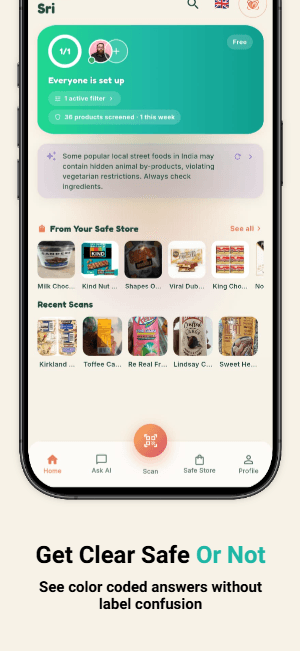
Rather than relying on simplistic, moralizing food scores that label foods arbitrarily as "bad" or "toxic," the platform provides ScanGenius AI Insight. This engine translates complex biochemistry into clear, actionable clinical context, pairing globally recognized NOVA 1-4 ultra-processing classifications and objective Nutri-Score evaluations with personalized allergen alerts. With support for 39 distinct dietary profiles alongside bespoke custom sensitivity triggers, multi-household scanning enables a parent to screen a single barcode in two seconds and immediately receive named fail attribution—such as "Fails for Sri (Gluten), Safe for Maya (Latex/Kiwi Allergy)". Combined with seamless real-time translation across 11 global languages, Food Scan Genius establishes a new gold standard for consumer safety across every grocery aisle.
4. Related Food Safety & Dietary Guides
- Best Food Allergy Scanner App – Scan Food Labels Instantly — Food Allergy & Sensitivity Scanner Hub
- The 7 Best Free Food Scanner Apps of 2026 — best free food scanner apps
- Choosing the Best Barcode Scan App for Your Health — guide to choosing a barcode scanner app
- Food Scan Genius: World’s #1 Food Ingredient Scanner App — Food Scan Genius scanner app
5. Scientific & Health Authority References
- Food Allergy Research & Education (FARE) Clinical Standards
- European Food Safety Authority (EFSA) Additive Safety Regulations
- PubMed Research on Ultra-Processed Foods & Gut Microbiome Disruption
- World Health Organization Guidelines on Healthy Diets & Saturated Fats
6. How to Scan in 3 Simple Steps
- Download Food Scan Genius completely free on iOS or Android with zero subscriptions, paywalls, or scan limits.
- Configure individual household profiles across 39 dietary parameters, or input custom sensitivities for specific fruits, sulfites, or pollen-related cross-reactivities.
- Scan any fruit product, frozen pack, dried fruit, or puree barcode in 2 seconds for an instant AST-parsed safety audit, complete with named family member alerts and objective NOVA processing insights.
Instant Nut Allergen Audit Trail
7. Frequently Asked Questions (FAQ)
How does Food Scan Genius identify hidden fruit allergens in packaged goods?
Food Scan Genius utilizes the NutriGraph Database with recursive Abstract Syntax Tree (AST) parsing. Instead of just searching for the main word ‘fruit,’ it parses complex sub-ingredient parentheticals, identifying hidden derivatives like apple pectin, hydrolyzed fruit proteins, citrus-derived citric acid, and post-harvest glazing agents (such as shellac or carnauba wax) that might trigger immune reactions.
What is the difference between Oral Allergy Syndrome (OAS) and a true fruit allergy?
True fruit allergies are typically driven by stable seed or storage proteins (like lipid transfer proteins) that can survive heat and stomach acid, presenting a risk of severe systemic anaphylaxis. Oral Allergy Syndrome (also known as Pollen Food Allergy Syndrome) occurs when the immune system confuses heat-sensitive pollen proteins (such as birch, ragweed, or grass) with similar proteins in raw fruits like apples, peaches, or melons. Food Scan Genius allows you to add custom sensitivities to account for both types of reactions.
Why are sulfites in dried fruit products dangerous for certain shoppers?
Sulfites (including sulfur dioxide and potassium metabisulfite) are chemical preservatives used to preserve color in dried fruits like apricots, golden raisins, and prunes. In sulfite-sensitive individuals and those with underlying asthma, consuming sulfites can trigger severe respiratory inflammation, wheezing, and acute bronchospasms. Food Scan Genius flags sulfites automatically under its additive screening engine.
Can Food Scan Genius screen for multiple family members with different fruit intolerances simultaneously?
Yes. Food Scan Genius features Multi-Household Family Profiles. In a single two-second barcode scan, the app evaluates the product against every profile in your family, providing clear, named attribution (e.g., ‘Safe for Dad; Fails for Maya – Contains Kiwi Derivative’). This eliminates the need to scan items multiple times or memorize overlapping restrictions.
Know What’s In Your Food Before You Buy — Scan Free Today
Never second-guess confusing grocery labels again. Download Food Scan Genius to uncover hidden additives, toxic dyes, and allergens for the whole household before you buy.