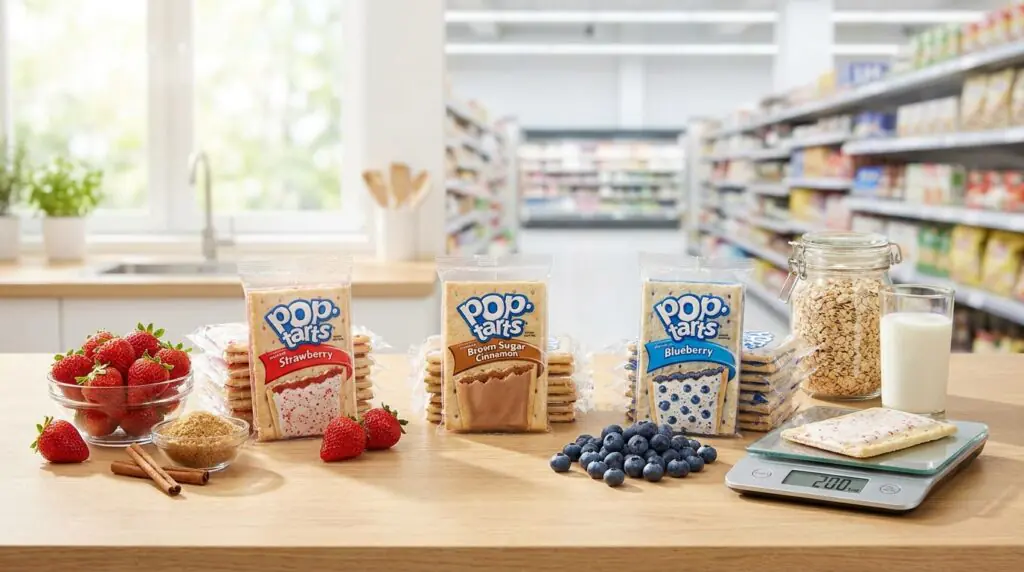
A single standard Pop-Tart pastry contains between 200 and 210 calories. Because standard foil pouches contain two pastries, eating a full pouch delivers 400 to 420 calories. Unfrosted flavors contain 210 calories per pastry due to a denser crust.
Calorie Distribution and Macronutrient Profiles Across Core Flavors
Across the standard lineup manufactured by Kellanova (formerly Kellogg Company), toaster pastry calories cluster into an exceptionally narrow band: between 200 and 210 kilocalories per individual pastry, or 400 to 420 kilocalories per standard two-pastry foil pouch. Fruit-based frosted varieties—including Frosted Strawberry, Frosted Blueberry, Frosted Cherry, and Frosted Raspberry—consistently register at exactly 200 calories per 48-gram pastry. Decadent or dessert-inspired options such as Frosted Chocolate Fudge, Frosted Cookies & Crème, Frosted S’mores, and Frosted Hot Fudge Sundae sit marginally higher at 200 to 210 calories per pastry, primarily driven by modest increases in vegetable oil, cocoa processed with alkali, and dairy-derived solids.
Counterintuitively, unfrosted Pop-Tarts carry higher caloric values than their frosted counterparts. An Unfrosted Strawberry or Unfrosted Brown Sugar Cinnamon pastry contains 210 calories (420 calories per pouch), compared to 200 calories for the frosted versions. Formulators compensate for the absence of the dense sugar-and-gelatin glaze by thickening the flour-based crust to preserve structural integrity inside commercial toasters. Wheat flour and shortening contribute more net energy per gram than the dried sugar glaze, resulting in roughly 0.5 to 1 additional gram of fat and a slightly denser overall pastry matrix.
From a macronutrient perspective, roughly 70 to 74 percent of a Pop-Tart’s caloric load derives from refined carbohydrates. A single frosted pastry delivers 35 to 38 grams of total carbohydrates, of which 14 to 19 grams are added sugars, primarily in the form of high fructose corn syrup, dextrose, and standard granulated sucrose. Lipids account for approximately 20 to 23 percent of the caloric density (typically 4.5 to 5 grams of fat per pastry, with 1.5 grams of saturated fat derived from palm and soybean oils), while protein provides the remaining 4 to 5 percent (2 grams per pastry). Aligning these metrics with dietary frameworks, consumption of a single two-pastry pouch expends nearly 60 to 75 percent of the maximum daily free-sugar threshold recommended by the World Health Organization Guidelines on Healthy Diets & Saturated Fats.
Beyond basic macronutrient accounting, toaster pastries represent class-4 ultra-processed foods under the NOVA classification system. Their caloric density (approximately 4.1 to 4.3 kcal per gram) is engineered through industrial fractionation, pairing refined endosperm flour with isolated fats and emulsifiers like soy lecithin and sodium stearoyl lactylate. Clinical literature, including PubMed Research on Ultra-Processed Foods & Gut Microbiome Disruption, observes that the combination of acellular carbohydrates, low moisture content, and industrial emulsifiers alters caloric transit time, prompting rapid gastric emptying and postprandial glucose spikes relative to minimally processed grain breakfast foods.
Deciphering the Nutrition Facts Panel: US Dual-Column vs. International Labels
When reading a Pop-Tarts carton in the United States, consumer confusion frequently stems from historical changes in mandatory serving sizes. Prior to the FDA’s 2016 Nutrition Facts label overhaul, Kellanova listed the serving size strictly as ‘1 Pastry (48g to 52g)’. However, because standard retail boxes contain individually wrapped, non-resealable foil pouches containing two pastries, the modern FDA rules classify the package as a multi-serving container typically consumed in a single eating occasion. Consequently, US packaging for flagship lines like Frosted Brown Sugar Cinnamon features a dual-column format: one column detailing the nutrient profile ‘Per 1 Pastry’ (200 calories) and the adjacent column detailing the values ‘Per 1 Pouch / 2 Pastries’ (400 calories). Consumers who scan only the left-hand column frequently misjudge their caloric intake by exactly half.
In the United Kingdom and the European Union, labeling mandates diverge sharply from American conventions. Under Regulation (EU) No 1169/2011, manufacturers must declare caloric values standardized ‘per 100g’ alongside any optional per-portion statements. An imported US pastry weighing 50g appears in European distribution with a primary declaration of roughly 405 kcal to 415 kcal per 100g. Furthermore, the European formulation of Pop-Tarts deviates chemically due to European Food Safety Authority (EFSA) Additive Safety Regulations, which restrict or require warning labels on azo-dyes such as Allura Red AC (Red 40) and Sunset Yellow FCF (Yellow 6). European variants substitute natural coloring agents like beetroot red and paprika extract, though these botanical swaps leave the baseline caloric density practically identical to the domestic product.
Ingredient statements also govern how these calories interact with allergen protocols. Every standard Pop-Tart crust relies on enriched wheat flour, meaning gluten and wheat starches form the caloric baseline. Frosted iterations utilize gelatin—derived from beef or pork collagen—as an emulsifying setting agent in the glaze, which also imparts minor protein fractions. Soybean oil, mono- and diglycerides, and soy lecithin function as processing aids and crumb softeners, falling under mandatory reporting dictated by the FDA Food Allergen Labeling & Consumer Protection Act (FALCPA). Unfrosted varieties omit the gelatin layer, slightly modifying the protein-to-lipid ratio without reducing the final caloric tally.
Portioning also changes across secondary brand extensions. Pop-Tarts Bites come in 40-gram grab-and-go pouches, registering 150 calories per pouch, while legacy Pop-Tarts Crisps delivered 100 calories across two lightweight wafers. When validating figures across these product lines, scanning the barcode with the Food Scan Genius mobile utility cross-references the specific manufacturer UPC against updated registry data to verify whether a package calculates energy based on an individual pastry, a multi-pack pouch, or a metric 100-gram serving.
| Flavor / Product Variety | Serving Unit | Serving Weight | Calories (kcal) | Total Fat | Total Sugars |
|---|---|---|---|---|---|
| Frosted Strawberry | 1 Pastry / 2 Pastries (1 Pouch) | 48g / 96g | 200 / 400 | 4.5g / 9.0g | 16g / 32g |
| Frosted Brown Sugar Cinnamon | 1 Pastry / 2 Pastries (1 Pouch) | 50g / 100g | 200 / 400 | 7.0g / 14.0g | 15g / 30g |
| Frosted S’mores | 1 Pastry / 2 Pastries (1 Pouch) | 50g / 100g | 200 / 400 | 5.0g / 10.0g | 19g / 38g |
| Frosted Chocolate Fudge | 1 Pastry / 2 Pastries (1 Pouch) | 50g / 100g | 200 / 400 | 5.0g / 10.0g | 18g / 36g |
| Frosted Cookies & Crème | 1 Pastry / 2 Pastries (1 Pouch) | 50g / 100g | 200 / 400 | 5.0g / 10.0g | 19g / 38g |
| Frosted Blueberry | 1 Pastry / 2 Pastries (1 Pouch) | 48g / 96g | 200 / 400 | 4.5g / 9.0g | 16g / 32g |
| Frosted Cherry | 1 Pastry / 2 Pastries (1 Pouch) | 48g / 96g | 200 / 400 | 4.5g / 9.0g | 16g / 32g |
| Frosted Wild Berry | 1 Pastry / 2 Pastries (1 Pouch) | 48g / 96g | 200 / 400 | 4.5g / 9.0g | 16g / 32g |
| Frosted Hot Fudge Sundae | 1 Pastry / 2 Pastries (1 Pouch) | 50g / 100g | 200 / 400 | 5.0g / 10.0g | 19g / 38g |
| Unfrosted Strawberry | 1 Pastry / 2 Pastries (1 Pouch) | 52g / 104g | 210 / 420 | 5.0g / 10.0g | 14g / 28g |
| Unfrosted Brown Sugar Cinnamon | 1 Pastry / 2 Pastries (1 Pouch) | 52g / 104g | 210 / 420 | 8.0g / 16.0g | 14g / 28g |
| Pop-Tarts Bites (Frosted Strawberry) | 1 Pouch (Bite-sized pieces) | 40g | 150 | 3.5g | 14g |
Common Miscalculations and Caloric Pitfalls with Toaster Pastries
The most pervasive error consumers make involves equating one foil packet with one serving. Because foil wraps enclose two individual pastries and cannot be easily resealed, consumers routinely consume both pastries in one sitting while mentally logging the ‘per pastry’ figure (200 calories) instead of the actual package total (400 calories). Kellanova has addressed this through dual-column reporting, but third-party calorie-tracking applications frequently auto-populate the 200-calorie single-pastry metric when a user scans the package barcode, introducing an unintended 200-calorie deficit error into dietary logs.
A secondary misconception assumes that omitting frosting lowers caloric intake. As noted in label audits, an Unfrosted Strawberry Pop-Tart has 210 calories, whereas a Frosted Strawberry Pop-Tart has 200 calories. The unglazed version substitutes refined sucrose and corn syrup glaze with additional enriched flour and shortening in the crust wall to prevent cracking during transit. The loss of 2 grams of sugar is offset by an extra 0.5 to 1.0 gram of dietary fat and complex starch, increasing the total net caloric yield by 10 calories per pastry (20 calories per pouch).
Finally, preparation habits introduce invisible caloric variances. Standard thermal toasting or microwaving removes moisture via evaporation, slightly concentrating the solids without modifying gross chemical energy. However, culinary additions—most notably spreading salted dairy butter onto the warm pastry crust—significantly alter the nutritional balance. A single tablespoon of butter adds approximately 102 calories and 11.5 grams of fat, converting a standard 400-calorie two-pastry breakfast into a 500-to-600-calorie meal rich in saturated lipids.
Frequently asked questions
How many calories are in a 2-pack of Pop-Tarts?
A standard two-pack pouch of Pop-Tarts contains 400 calories for frosted varieties and 420 calories for unfrosted varieties. Because each individual pastry yields 200 to 210 calories, eating both pastries in the foil wrapper doubles that base amount.
Why do unfrosted Pop-Tarts have more calories than frosted ones?
Unfrosted Pop-Tarts contain 210 calories per pastry, compared to 200 calories for frosted ones, because the bakery formulation uses a thicker pastry crust. Kellanova adds more enriched flour and vegetable shortening to compensate structurally for the absent glaze, yielding more calories per gram than pure sugar icing.
Which Pop-Tart flavor has the highest calorie count?
Unfrosted Brown Sugar Cinnamon and Unfrosted Strawberry are among the highest standard flavors at 210 calories per pastry (420 calories per pouch). Certain dessert-heavy varieties, such as Frosted Chocolate Fudge and Frosted Cookies & Crème, also reach up to 210 calories per pastry due to higher lipid concentrations in their filling and crust.
Which Pop-Tart product has the fewest calories?
Among full-sized toaster pastries, standard fruit varieties like Frosted Strawberry, Blueberry, and Cherry tie for the lowest count at 200 calories per pastry (400 calories per pouch). For smaller portion sizes, Pop-Tarts Bites provide 150 calories per 40-gram pouch.
Does toasting a Pop-Tart change its calorie content?
Toasting does not change the caloric content of a Pop-Tart. The heat drives off water weight through evaporation, which slightly increases caloric density per gram, but the total chemical energy (kilocalories) remains identical unless toppings like butter or spreads are added.
References
- FDA Food Allergen Labeling & Consumer Protection Act (FALCPA)
- European Food Safety Authority (EFSA) Additive Safety Regulations
- PubMed Research on Ultra-Processed Foods & Gut Microbiome Disruption
- World Health Organization Guidelines on Healthy Diets & Saturated Fats
Related guides
- Best Food Allergy Scanner App – Scan Food Labels Instantly — Food Allergy & Sensitivity Scanner Hub
- The 7 Best Free Food Scanner Apps of 2026 — best free food scanner apps
- Choosing the Best Barcode Scan App for Your Health — guide to choosing a barcode scanner app
- Food Scan Genius: World’s #1 Food Ingredient Scanner App — Food Scan Genius scanner app
Check Any Label Against 5 Million Products — Free
Never second-guess confusing grocery labels again. Download Food Scan Genius to uncover hidden additives, toxic dyes, and allergens for the whole household before you buy.