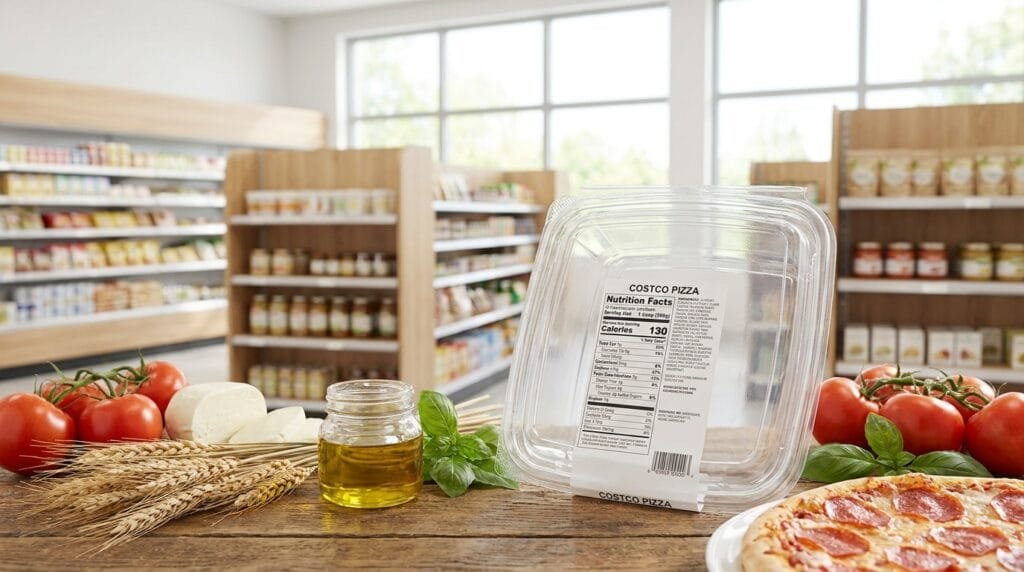
A single slice of Costco food court cheese pizza contains 760 calories, 28 grams of fat, and 44 grams of protein. A slice of pepperoni pizza contains 710 calories, 31 grams of fat, and 34 grams of protein.
Breaking Down the Costco Food Court Slice: Calories, Protein, and Sodium
When you walk past the checkout registers at Costco, the smell of warm dough and bubbling cheese from the food court is almost impossible to ignore. For a couple of dollars, you get a massive slice served on a paper plate that droops under its own weight. To understand the numbers behind that slice, it helps to look at how these pizzas are actually built behind the counter. Costco uses an 18-inch crust that is layered with a hefty amount of sauce and topped using a motorized cheese dispenser to ensure every pie gets a uniform layer of shredded dairy. For a whole cheese pizza, that comes out to nearly one and a half pounds of cheese blend, split across provolone and part-skim mozzarella.
Because of that thick blanket of cheese, many people are surprised to learn that a plain cheese slice actually has more calories than a pepperoni slice. A single slice of Costco food court cheese pizza delivers 760 calories, 28 grams of total fat, 13 grams of saturated fat, 1,410 milligrams of sodium, and an impressive 44 grams of protein. By contrast, a slice of food court pepperoni pizza contains 710 calories, 31 grams of total fat, 12 grams of saturated fat, 1,370 milligrams of sodium, and 34 grams of protein. The reason for the lower calorie count on the pepperoni slice is straightforward: the kitchen staff cuts back the base layer of shredded cheese to make room for approximately sixty slices of cured pepperoni across the pie, reducing the overall dairy mass.
The scale of these numbers comes down to pure physical volume. When you order delivery from a standard national chain, an 18-inch extra-large pizza is typically cut into eight or ten triangular slices. At the Costco food court, that same 18-inch pie is divided into just six enormous slices. A single slice can tip the scales at over 300 grams (about 11 ounces), making it the equivalent of two and a half to three standard delivery slices. When considering everyday meal planning, reviewing the World Health Organization Guidelines on Healthy Diets & Saturated Fats can help place that 12 to 13 grams of saturated fat into a daily perspective, as one slice accounts for more than half the recommended daily intake for an average adult.
Beyond the macronutrients, allergen safety is another primary consideration for families eating at the warehouse. Food court pizzas contain major food allergens, specifically milk and wheat, and are prepped on open counter lines where cross-contact with other kitchen items is possible. Anyone managing severe sensitivities should refer to the Food Allergy Research & Education (FARE) Clinical Standards to understand how shared kitchen preparation areas impact allergen risks. Knowing the exact profile of the food helps you enjoy a hot slice without feeling completely in the dark about what you are feeding yourself or your kids.
Real Labels vs. Food Court Boards: Navigating the Deli and Freezer Aisles
Why Shopping for Pizza Shouldn’t Be This Hard: Standing in Costco with a shopping cart, trying to compare the hot slice at the food court to the four-pack of frozen pizzas in the freezer aisle or the take-and-bake pie in the deli case, can make anyone’s head spin. One package measures a portion as one-fourth of a pizza, another uses one-fifth, and the food court uses one-sixth of a giant circle. You are tired, your cart is already full of bulk paper towels and pantry staples, and you just want a straightforward answer about what you are feeding your family tonight without needing a calculator.
This confusion is where real-world labels and food regulations diverge. In the United States, grocery packages must display a standardized Nutrition Facts panel regulated by the Food and Drug Administration. For example, look at a box of Kirkland Signature Frozen Pepperoni Pizza. The label states that a serving size is 1/4 of a pizza (145 grams), providing 390 calories, 19 grams of fat, and 16 grams of protein. If you do not look at the gram weight, you might assume the frozen slice is nearly half the calories of the food court slice. But in reality, the food court slice is simply more than twice as heavy. If you ate half of that frozen pizza—equivalent in weight to one food court slice—you would consume 780 calories and 38 grams of fat. In Europe or the United Kingdom, regulations require all packaged foods to display numbers per 100 grams alongside any serving size, which prevents this kind of visual trickery by showing true nutritional density across brands.
When looking at packaged crusts, cured meats, and premade frozen pies, additives like sodium nitrite, potassium sorbate, and dough conditioners frequently appear on the printed ingredient statement. Shoppers curious about how these food ingredients are evaluated can consult the European Food Safety Authority (EFSA) Additive Safety Regulations, which review safe handling tolerances for commercial preservation methods. Furthermore, understanding the difference between simple scratch dough and industrial processing is explored widely in public health, including PubMed Research on Ultra-Processed Foods & Gut Microbiome Disruption, highlighting why whole-food balance matters across our weekly meals.
To make sense of all these printed numbers while standing in Aisle 4, Food Scan Genius works as a quick, frictionless two-second sanity check. You do not need a restrictive diet app that makes you feel guilty about buying a frozen treat on a Friday evening. Instead, you simply scan the barcode on the box, and the tool immediately reads the manufacturer’s printed panel to give you clarity on portion weights, hidden sodium levels, and declared allergens. It is important to remember that all nutritional figures, ingredient statements, and allergen warnings come directly from the manufacturer’s physical packaging declarations. The food manufacturer holds sole legal responsibility for what is printed on their label, and having that data clearly organized on your phone screen saves you from squinting at tiny font sizes while your cart blocks the aisle.
| Product & Variety | Serving Description | Weight (g) | Calories | Total Fat (g) | Saturated Fat (g) | Sodium (mg) | Total Carbs (g) | Protein (g) |
|---|---|---|---|---|---|---|---|---|
| Costco Food Court Cheese Slice | 1/6 of 18" pie | 320g | 760 | 28 | 13 | 1,410 | 85 | 44 |
| Costco Food Court Pepperoni Slice | 1/6 of 18" pie | 305g | 710 | 31 | 12 | 1,370 | 70 | 34 |
| Costco Food Court Whole Cheese Pizza | Whole 18" pie (6 slices) | 1,920g | 4,560 | 168 | 78 | 8,460 | 510 | 264 |
| Costco Food Court Whole Pepperoni Pizza | Whole 18" pie (6 slices) | 1,830g | 4,260 | 186 | 72 | 8,220 | 420 | 204 |
| Kirkland Signature Take & Bake (Deli) Pepperoni | 1/5 of 16" pie | 240g | 590 | 27 | 11 | 1,280 | 58 | 28 |
| Kirkland Signature Frozen Pepperoni Pizza | 1/4 of pizza | 145g | 390 | 19 | 8 | 890 | 37 | 16 |
| Kirkland Signature Frozen Cheese Pizza | 1/4 of pizza | 140g | 360 | 15 | 7 | 740 | 40 | 16 |
| Standard Delivery Chain Pepperoni (Comparison) | 1/8 of 14" pie | 110g | 290 | 12 | 5 | 680 | 32 | 12 |
Common Myths and Math Traps Behind Costco Pizza Nutrition
The biggest trap people fall into when looking at Costco pizza is assuming that the meat option must automatically carry more calories than the cheese option. On nearly every other restaurant menu, adding pepperoni or sausage bumps up the overall calorie count. At Costco, the opposite happens. Because their signature cheese slice is piled with an immense volume of shredded dairy to give it that gooey cheese pull, it actually contains 50 more calories and 15 more grams of carbohydrates than the pepperoni slice. If you are choosing cheese solely because you believe it is the lighter or leaner choice, the nutrition facts show that pepperoni is actually lower in total energy and carbohydrates.
Another common mistake is treating a Costco food court slice as interchangeable with a standard pizza slice from a local pizzeria or national chain. If you log a single slice of pizza into an everyday food tracker without specifying Costco, the generic entry might assign you 250 to 290 calories based on a standard 14-inch delivery pie. Because Costco uses an 18-inch pan and cuts it into sixths rather than eighths, that single slice is nearly three times the size of a standard portion. Misjudging the serving weight by relying on generic search entries can leave you underestimating your sodium and saturated fat intake by hundreds of milligrams.
Lastly, do not confuse the deli’s refrigerated take-and-bake pizzas with the hot pizzas sold at the food court window. The take-and-bake pies found in the meat and deli display cases have a distinct dough formulation, use different cheese blends, and are measured with completely different serving sizes on their physical nutrition panels. Always read the printed facts on the specific box or container you purchase, rather than assuming all pizza sold under the warehouse roof shares the same nutritional profile.
Frequently asked questions
How many calories are in an entire whole Costco pizza?
A whole 18-inch Costco food court cheese pizza contains 4,560 calories across its six slices. A whole pepperoni pizza contains 4,260 calories. If the kitchen cuts the pie into 12 smaller slices, each cheese slice is 380 calories and each pepperoni slice is 355 calories.
Why does Costco cheese pizza have more calories than pepperoni?
Costco puts significantly more shredded cheese on the plain cheese pizza—nearly 1.5 pounds per pie—than on the pepperoni pizza. To make room for the meat and keep cooking times even, the kitchen reduces the cheese portion on the pepperoni pie, which lowers its total calories and carbs.
How much sodium is in one slice of Costco pizza?
A single slice of food court cheese pizza contains 1,410 milligrams of sodium, while a pepperoni slice contains 1,370 milligrams. Both options provide around 60% of the daily recommended sodium intake for a typical adult in just one slice.
How does Kirkland Signature frozen pizza compare to food court pizza?
Kirkland Signature frozen pizzas are much smaller and less calorically dense per serving because of standard portion sizes. A single serving (1/4 of a frozen pizza) has about 390 calories and weighs 145 grams, which is roughly half the weight and half the calories of a hot food court slice.
Where do the nutrition facts for Costco food court pizza come from?
All official nutritional figures originate directly from Costco Wholesale’s published food court menu boards and official food service nutrition guides. Food manufacturers and commercial retailers are solely responsible for calculating and publishing the nutritional specifications of the items they prepare and sell.
References
- Food Allergy Research & Education (FARE) Clinical Standards
- European Food Safety Authority (EFSA) Additive Safety Regulations
- PubMed Research on Ultra-Processed Foods & Gut Microbiome Disruption
- World Health Organization Guidelines on Healthy Diets & Saturated Fats
Related guides
- Best Food Allergy Scanner App – Scan Food Labels Instantly — Food Allergy & Sensitivity Scanner Hub
- The 7 Best Free Food Scanner Apps of 2026 — best free food scanner apps
- Choosing the Best Barcode Scan App for Your Health — guide to choosing a barcode scanner app
- Food Scan Genius: World’s #1 Food Ingredient Scanner App — Food Scan Genius scanner app
Check Any Label Against 5 Million Products — Free
Never second-guess confusing grocery labels again. Download Food Scan Genius to uncover hidden additives, toxic dyes, and allergens for the whole household before you buy.