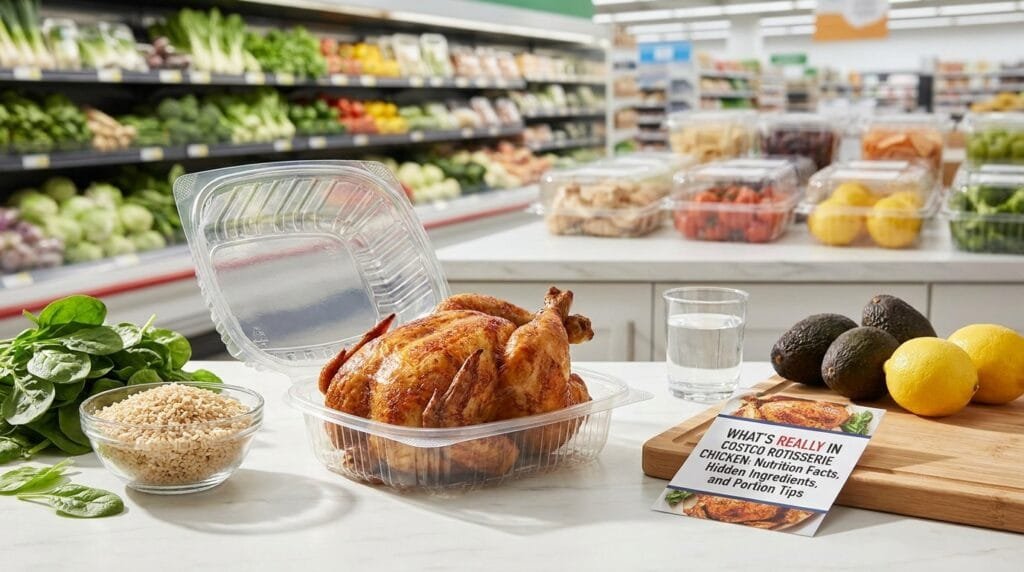
A standard 3-ounce (84g) serving of Costco rotisserie chicken contains 140 calories, 19 grams of protein, 7 grams of total fat, and 460 milligrams of sodium. Eating a breast quarter (about 6 ounces) delivers roughly 280 calories and 920 milligrams of sodium.
The Real Nutrition Breakdown: What Is In a Costco Rotisserie Chicken?
When you walk past the deli counter at Costco, the aroma of golden-roasted chickens in plastic dome containers is nearly impossible to ignore. At just $4.99 for a three-pound bird, it is one of the most famous loss-leaders in American retail. But behind the low price tag lies a food product designed with very specific food science. The official label on a Kirkland Signature Seasoned Rotisserie Chicken lists a 3-ounce (84-gram) serving size of edible meat. In that single serving, you get approximately 140 calories, 19 grams of protein, 7 grams of total fat (including 2.5 grams of saturated fat), and 460 milligrams of sodium. For anyone watching their daily salt intake, that sodium number is usually the biggest eye-opener.
Why does a simple roast bird carry so much salt? Plain, raw chicken breast naturally contains roughly 60 to 70 milligrams of sodium per 3-ounce serving. Costco chickens are pre-marinated using a commercial injection process known as brining or plumping. The declared ingredients on the plastic packaging tell the story: whole chicken, water, and a seasoning blend made of salt, sodium phosphates, hydrolyzed casein, modified corn starch, corn syrup solids, dextrin, carrageenan, and natural flavors. The water and salt solution is injected deep into the breast and thigh muscles before cooking. This ensures the meat stays juicy under hot heat lamps for hours without drying out, but it also increases the sodium content by more than 600 percent compared to fresh chicken.
Understanding where these fats and proteins come from can help you make balanced meal choices. The lean white breast meat provides pure protein with minimal saturated fat, while the skin and darker leg cuts carry more fat. The World Health Organization Guidelines on Healthy Diets & Saturated Fats recommend keeping saturated fats below 10 percent of your total daily energy intake and limiting daily sodium to under 2,000 milligrams. If you eat a generous half-chicken portion in one sitting, you might take in more than 1,800 milligrams of sodium—nearly your entire recommended intake for the day. That does not mean rotisserie chicken is bad for you; it simply means knowing the numbers helps you balance the rest of your meals with low-sodium sides like steamed broccoli, fresh salad greens, or brown rice.
The additives listed on the packaging also draw questions from shoppers. Ingredients like carrageenan (a seaweed-derived thickener) and sodium phosphates are common in prepared deli meats to lock in moisture and stabilize texture. While they help keep the chicken tender, researchers have taken a closer look at how modern commercial thickeners interact with our digestion. Ongoing studies, such as PubMed Research on Ultra-Processed Foods & Gut Microbiome Disruption, suggest that eating heavy amounts of processed food additives over time can change gut bacteria balance in sensitive individuals. Costco is transparent about these ingredients right on the outer container, making it easy to know what you are feeding your household.
How to Read the Label: Portion Sizes, Brine, and Packaging Reality
Shopping for dinner shouldn’t feel like a high-stakes math test. You are tired after a long day, navigating crowded aisles, trying to get wholesome meals on the table without breaking your budget. That is where a quick tool like Food Scan Genius comes in. It is not designed to judge what you buy or enforce strict rules. Instead, it acts as a simple, two-second sanity check right there in Aisle 4. You scan a barcode on your phone, see the real facts clearly laid out, and make an informed choice without having to squint at fine print while your cart rolls away.
When you look at the printed sticker on a Costco rotisserie chicken container, you are looking at manufacturer declarations. It is important to remember that all nutritional panels, allergen notices, and ingredient lists come strictly from the manufacturer’s own physical packaging declarations. If an ingredient or allergen is not declared by the manufacturer on the printed label, it does not exist in food reference databases. Food makers bear full legal responsibility for everything printed on that sticker. Costco clearly marks their net weight—typically around 3 pounds (48 ounces)—and sets the standard serving at 3 ounces of edible portion, yielding roughly 10 to 12 servings per container once bones and cartilage are removed.
Comparing this label to international standards reveals how American packaging can trick our eyes. In the United States, nutrition panels use serving sizes based on what an average person typically eats (Reference Amounts Customarily Consumed, or RACC). A 3-ounce serving represents a piece of meat roughly the size of a deck of cards or a small palm. In Europe and the UK, under European Food Safety Authority (EFSA) Additive Safety Regulations, foods are labeled per 100 grams alongside per-portion numbers. On a 100-gram scale, Costco chicken delivers roughly 165 calories, 22.5 grams of protein, and nearly 550 milligrams of sodium. Because most people easily eat 6 to 8 ounces of chicken during dinner, American shoppers routinely double or triple the numbers shown on the label without realizing it.
Allergen alerts are another detail you must verify on the actual packaging. Some variations of Costco’s rotisserie chicken seasoning have historically included hydrolyzed casein, which is a milk protein, or modified corn starch. According to Food Allergy Research & Education (FARE) Clinical Standards, individuals with severe dairy allergies must check commercial poultry labels carefully, as milk derivatives can appear in unexpected places like marinades and binders. Always take a moment to scan the physical label on your container before heading to the checkout registers, because formulations and supplier blends can shift over time.
| Chicken Cut / Portion | Weight (oz / g) | Calories | Protein (g) | Total Fat (g) | Sat. Fat (g) | Sodium (mg) | Carbs (g) |
|---|---|---|---|---|---|---|---|
| Standard Reference Serving (Mixed) | 3.0 oz (84g) | 140 | 19 | 7.0 | 2.5 | 460 | 0 |
| Breast Meat Only (Skinless) | 3.0 oz (84g) | 115 | 24 | 2.5 | 0.5 | 340 | 0 |
| Thigh Meat with Skin | 3.0 oz (84g) | 170 | 16 | 11.0 | 3.5 | 510 | 0 |
| Full Breast Quarter (with Skin) | 6.0 oz (170g) | 280 | 38 | 14.0 | 5.0 | 920 | 0 |
| Leg Quarter (Thigh + Drumstick, with Skin) | 5.5 oz (156g) | 310 | 29 | 20.0 | 6.0 | 935 | 0 |
| Half Chicken (All Edible Meat, Mixed) | 16.0 oz (454g) | 745 | 101 | 37.0 | 13.0 | 2,450 | 0 |
| Whole Bird (Total Edible Meat, Mixed) | 32.0 oz (907g) | 1,490 | 202 | 74.0 | 26.0 | 4,900 | 0 |
| Raw Unseasoned Chicken Breast (Comparison) | 3.0 oz (84g) | 100 | 22 | 1.5 | 0.4 | 65 | 0 |
Common Mistakes When Tracking Costco Rotisserie Chicken
The most common mistake home cooks and macro trackers make is weighing the entire chicken piece—bones included—and logging that gross weight into their food tracker. If you place a whole roasted chicken breast with rib bones on your digital scale and it reads 8 ounces, about 2 ounces of that weight might just be bone and inedible cartilage. If you log 8 ounces of chicken meat, your app will record around 370 calories and over 50 grams of protein that you never actually ate. To track accurately, strip the meat from the bone first, or weigh the bone plate after you finish eating and subtract that from the starting weight.
Another frequent misstep is treating rotisserie chicken skin the same as the lean meat beneath it. The crispy, seasoned skin holds the vast majority of the injected salt and rendered cooking oils. Eating a breast with the skin intact adds roughly 40 to 60 extra calories and doubles the fat content compared to peeling the skin away. If you are watching your saturated fat or blood pressure, taking the skin off is the simplest way to cut hundreds of milligrams of sodium and several grams of fat from your meal in a single swipe of your fork.
Finally, many people mistake the gelatinous broth that collects at the bottom of the plastic container for pure, lean cooking stock. While it smells wonderful, that liquid is concentrated brine containing rendered chicken fat, melted skin gelatin, salt, and phosphates. Pouring that container juice over your rice or shredded meat can dramatically spike the sodium content of your meal beyond the numbers listed on the nutrition panel. If you want to use the drippings for soup, let the liquid cool in your refrigerator first so you can skim off the solid fat layer, and dilute it with plenty of plain water.
Frequently asked questions
Is Costco rotisserie chicken gluten-free?
Yes, Costco’s Kirkland Signature rotisserie chicken is generally considered gluten-free and is marked as such in most warehouse locations. However, you should always check the label on your specific bird, as supplier seasonings and processing facilities can occasionally vary.
Why does Costco rotisserie chicken have so much sodium?
The chickens are injected with a salt-water brine solution containing sodium phosphates and seasonings prior to roasting. This industrial plumping process keeps the meat tender and moist while sitting under deli display heat lamps, adding about 460mg of sodium per 3-ounce serving.
How many total calories are in an entire Costco rotisserie chicken?
An entire Costco rotisserie chicken yields roughly 32 ounces of edible meat, totaling approximately 1,450 to 1,500 calories. If you eat the entire chicken with all the skin, the total comes closer to 1,800 to 2,000 calories.
Does Costco rotisserie chicken contain dairy or milk allergens?
Costco rotisserie chicken seasonings have historically included hydrolyzed casein, which is a protein derived from milk. Anyone with a diagnosed dairy allergy must read the packaging ingredient statement carefully before purchasing.
How much edible meat do you actually get from one Costco chicken?
A standard 3-pound (48-ounce) Costco chicken yields approximately 2 pounds (32 ounces) of edible meat once the carcass, bones, and cartilage are discarded. This provides roughly 8 to 10 practical 3-ounce servings for meals.
References
- Food Allergy Research & Education (FARE) Clinical Standards
- European Food Safety Authority (EFSA) Additive Safety Regulations
- PubMed Research on Ultra-Processed Foods & Gut Microbiome Disruption
- World Health Organization Guidelines on Healthy Diets & Saturated Fats
Related guides
- Best Food Allergy Scanner App – Scan Food Labels Instantly — Food Allergy & Sensitivity Scanner Hub
- The 7 Best Free Food Scanner Apps of 2026 — best free food scanner apps
- Choosing the Best Barcode Scan App for Your Health — guide to choosing a barcode scanner app
- Food Scan Genius: World’s #1 Food Ingredient Scanner App — Food Scan Genius scanner app
Check Any Label Against 5 Million Products — Free
Never second-guess confusing grocery labels again. Download Food Scan Genius to uncover hidden additives, toxic dyes, and allergens for the whole household before you buy.