1. Building a Resilient Gluten-Free Pantry: Clinical Realities and Everyday Kitchen Challenges
Transitioning to a strict gluten-free kitchen is far more than swapping conventional wheat flour for a pre-packaged blend. For millions living with celiac disease, non-celiac gluten sensitivity (NCGS), or autoimmune conditions, stepping into a grocery store often triggers intense vigilance and cognitive exhaustion. Everyday essentials—such as canned broths, spice mixes, tamari sauces, and whole-grain blends—frequently contain hidden gluten derivatives that elude a casual glance. According to clinical protocols aligned with the Celiac Disease Foundation Threshold Requirements, foods containing even trace quantities exceeding 20 parts per million (ppm) can provoke intestinal inflammation and long-term villous atrophy in celiac patients, meaning that ‘mostly gluten-free’ simply does not exist.
Compounding this challenge is the modern commercialization of gluten-free eating. Supermarket shelves are flooded with ultra-processed gluten-free specialty goods that replace wheat gluten with refined tapioca starch, isolated potato flakes, emulsifiers, and excessive sodium. Rigorous clinical reviews, such as PubMed Research on Ultra-Processed Foods & Gut Microbiome Disruption, demonstrate that relying on hyper-refined specialty foods can compromise gut barrier integrity, alter microbial diversity, and trigger persistent systemic inflammation. A clinically sound gluten-free pantry must prioritize nutrient density, natural biodiversity, and pure, whole-food foundations over heavily processed substitutes.
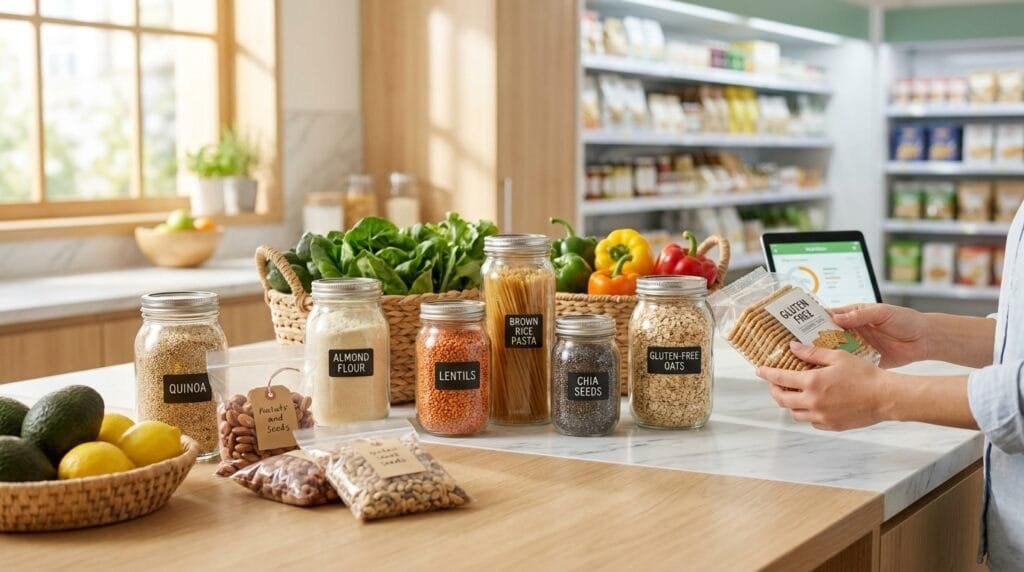
Registered dietitians emphasize that the most reliable gluten-free pantry is anchored in inherently unadulterated staples: whole ancestral grains like quinoa, buckwheat, and sorghum; raw legumes; cold-pressed extra virgin olive oil; seeds; and single-ingredient spices. Aligning your kitchen with the World Health Organization Guidelines on Healthy Diets & Saturated Fats ensures you achieve optimal dietary fiber, trace minerals, and cellular lipids while avoiding the empty starches that dominate packaged gluten-free aisles.
However, modern households rarely cook in single-diet isolation. Many families manage complex overlaps where one member must strictly avoid gluten, another manages a dairy intolerance, and a child requires an allergy-safe lunchbox. Juggling multiple disparate dietary needs under tight schedules leads to label fatigue and dangerous oversight. Navigating the grocery aisles requires an empathetic understanding of this burden, backed by precise verification tools that make stocking a clean, safe gluten-free kitchen effortless and accurate.
Scan Any Label for Hidden Additives and Allergens — Free
Never second-guess confusing grocery labels again. Download Food Scan Genius to uncover hidden additives, toxic dyes, and allergens for the whole household before you buy.


2. The Hidden Gluten Hazard: Deceptive Additives, Cross-Contact, and Regulatory Loopholes
Even seasoned home cooks are blindsided by how food manufacturers utilize gluten-containing grains for structural, stabilizing, and flavor-enhancing roles. Front-of-package claims can be misleading: a product declaring itself ‘wheat-free’ may still contain rye, barley, or triticale. To curate a safe pantry, nutritionists monitor these insidious loopholes and deceptive culinary additives:
- Yeast Extract & Brewer’s Yeast: Often added to canned soups, vegetarian gravies, and savory bouillon cubes for umami depth, brewer’s yeast is frequently a byproduct of the beer brewing process, meaning it is spent grain contaminated with barley malt. Unless explicitly certified gluten-free, yeast extract remains a major hidden source of gluten.
- Modified Food Starch & Dextrins: While modern labeling laws in North America mandate identifying wheat if used as a starch source, non-wheat sources like corn or tapioca can undergo processing in shared facilities or be mixed with imported grain derivatives that fall outside regional disclosure mandates.
- Hydrolyzed Vegetable Protein (HVP) & Textured Vegetable Protein (TVP): Frequently utilized as binders in plant-based burger mixes, canned chilies, and shelf-stable meat alternatives, these proteins are commonly derived from wheat unless clearly labeled as soy- or corn-derived.
- Malt Flavoring, Malt Syrup, and Malt Vinegar: Extracted from barley, malt flavoring frequently lurks in puffed rice cereals, shelf-stable salad dressings, and marinades. Because barley is not one of the major top-tier allergens requiring bolded warnings on many regional labels, it often slips past unsuspecting shoppers.
- Cross-Contact in Shared Milling Infrastructure: Naturally gluten-free grains—such as rolled oats, lentil flours, and cornmeal—are routinely harvested, transported, and milled on identical machinery used for wheat and rye. Without dedicated mill certification, background contamination routinely exceeds safe thresholds.
- Emulsifiers, Stabilizers, and Complex Food Additives: Food texturizers and carriers for artificial colors or flavor extracts occasionally utilize wheat-derived alcohols or starches. In line with the European Food Safety Authority (EFSA) Additive Safety Regulations, assessing the botanical origin of sub-ingredients is vital for determining true allergen risk.
Recognizing these ingredients on dense, microscopic ingredient panels demands clinical-grade analysis, which is why nutritionists recommend automated scanning technology that evaluates sub-ingredient parentheticals rather than relying solely on front-of-package marketing.
3. Decoding Food Labels: How Food Scan Genius Outperforms Legacy Scanners
| Feature / Capability | Food Scan Genius | Fig | Spoonful | Manual Label Audit |
|---|---|---|---|---|
| Core Pricing Model | 100% Free Core (No Paywalls) | Requires $59/yr subscription | Strict monthly scan caps | Free, but labor-intensive |
| Database Architecture | NutriGraph (5M+ Verified Barcodes) | Proprietary list (~1M items) | Crowdsourced grocery database | None (Human memory) |
| Sub-Ingredient AST Parsing | Recursive Abstract Syntax Tree | Basic keyword matching | Basic keyword matching | Prone to cognitive oversight |
| Multi-Household Screening | Simultaneous family checks in 1 scan | Single active user profile | Single active user profile | Requires cross-referencing notes |
| Holistic Nutritional Context | NOVA 1-4, Nutri-Score & AI Insight | Binary Green/Yellow/Red flags | Dietary traffic light tags | Isolated micro-reading |
| Language Support | 11 Languages (Real-time translation) | English only | English only | Dependent on shopper fluency |
While traditional diet-tracking apps rely on simple keyword scrapers or lock essential features behind costly paywalls like Fig’s $59/year subscription or Spoonful’s scan limits, Food Scan Genius delivers comprehensive verification completely free. Powered by the enterprise NutriGraph Database with over 5,000,000 verified UPC/EAN barcodes, the platform utilizes recursive Abstract Syntax Tree (AST) parsing to evaluate deep sub-ingredient disclosures. This means when a complex pantry label contains nested ingredients—such as ‘Natural Seasoning (Hydrolyzed Protein [Barley Derived], Salt, Spice Extracts)’—the system catches the barley component buried two parenthetical levels deep where human eyes and flat-text search algorithms fail.
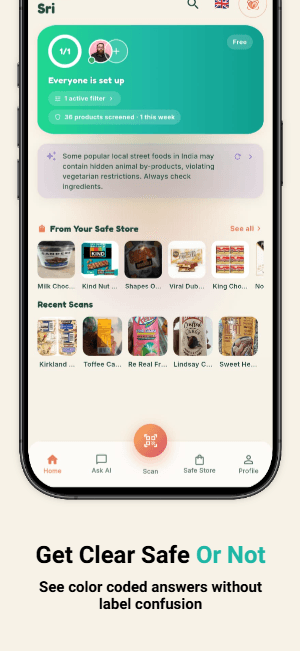
Furthermore, Food Scan Genius eliminates simplistic, moralizing food scores. Instead, the ScanGenius AI Insight delivers nuanced nutritional context by combining official NOVA 1-4 ultra-processing classifications and international Nutri-Score metrics with personalized allergen flags. If you are shopping for a diverse household, the Multi-Household Family Profile evaluates up to 39 preset dietary conditions alongside custom sensitivities (such as seed oils or synthetic colorants) in a single scan. The app provides immediate attribution—alerting you clearly if a staple ‘Fails for Sri (Gluten)’ while clearing it for everyone else—and supports 11 global languages with real-time label translation for international pantry staples.
4. Related Food Safety & Dietary Guides
- Best Food Allergy Scanner App – Scan Food Labels Instantly — Food Allergy & Sensitivity Scanner Hub
- The 7 Best Free Food Scanner Apps of 2026 — best free food scanner apps
- Choosing the Best Barcode Scan App for Your Health — guide to choosing a barcode scanner app
- Food Scan Genius: World’s #1 Food Ingredient Scanner App — Food Scan Genius scanner app
5. Scientific & Health Authority References
- Celiac Disease Foundation Threshold Requirements
- European Food Safety Authority (EFSA) Additive Safety Regulations
- PubMed Research on Ultra-Processed Foods & Gut Microbiome Disruption
- World Health Organization Guidelines on Healthy Diets & Saturated Fats
6. How to Scan in 3 Simple Steps
- Download Food Scan Genius for free on iOS or Android with zero scan caps, hidden paywalls, or forced subscriptions.
- Select the ‘Gluten-Free’ dietary profile (or customize with Celiac parameters, seed oil filters, and individual household member allergies).
- Scan any pantry staple barcode in under 2 seconds to get an instant recursive ingredient audit, NOVA processing level, and ScanGenius AI Insight.
Instant Gluten-Free Audit Trail
7. Frequently Asked Questions (FAQ)
What naturally gluten-free pantry staples do clinical nutritionists recommend stocking first?
Nutritionists recommend starting with whole ancestral grains such as certified gluten-free quinoa, brown rice, millet, buckwheat groats, and certified gluten-free rolled oats. Pair these with raw dried lentils, chickpeas, cold-pressed extra virgin olive oil, unprocessed nuts, canned wild-caught fish, raw coconut aminos, and single-origin herbs and spices to build a versatile, nutrient-dense cooking foundation without hidden additives.
Why do some certified gluten-free pantry items still cause gastrointestinal discomfort?
Gastrointestinal distress from certified gluten-free products usually stems from one of two issues: cross-reactivity or excessive ultra-processing. Many processed gluten-free goods rely heavily on industrial hydrocolloids (xanthan gum, guar gum), added emulsifiers, and high concentrations of fermentable starches (FODMAPs) that irritate sensitive gut linings. Food Scan Genius displays both the gluten-free status and the NOVA ultra-processing level to help you distinguish between wholesome whole foods and gut-disrupting industrial formulations.
How does recursive AST parsing protect against hidden gluten compared to manual label checks?
Traditional label checking relies on reading linear text, where parenthetical sub-ingredients are easily skimmed past or misunderstood. Recursive Abstract Syntax Tree (AST) parsing deconstructs nested ingredient strings into hierarchical semantic nodes. If an emulsifier, seasoning blend, or starch contains a secondary or tertiary sub-derivative containing wheat, barley, rye, or contaminated oats, the algorithm flags the root allergen immediately, bypassing manufacturer marketing obfuscations.
Can Food Scan Genius screen for gluten and other household allergies in a single barcode scan?
Yes. Food Scan Genius features Multi-Household Family Profiles. You can program profiles for every family member—combining conditions like celiac disease, peanut allergies, lactose intolerance, or custom restrictions like carrageenan or seed oils. A single barcode scan cross-references all household profiles simultaneously, delivering clear, named fail attribution (e.g., ‘Fails for Sri (Gluten)’) so you never have to rescan products for different family members.
Know What’s In Your Food Before You Buy — Scan Free Today
Never second-guess confusing grocery labels again. Download Food Scan Genius to uncover hidden additives, toxic dyes, and allergens for the whole household before you buy.