
1. The Modern Breakfast Dilemma: Finding Truly Safe Gluten Free Cereals for the Whole Family
Standing in the cereal aisle on a frantic weekday morning can feel like navigating an ingredient minefield. For households managing celiac disease, non-celiac gluten sensitivity (NCGS), or chronic autoimmune gut inflammation, breakfast isn’t just about convenience—it is a critical safety calculation. You want a bowl of crunchy, delicious comfort that delights your kids before school and provides sustained energy for your workday, but the reality behind bright cereal boxes is often plagued by confusing claims, hidden allergens, and disappointing nutritional profiles.
A major source of consumer frustration stems from the false sense of security created by modern packaging. Under the Celiac Disease Foundation Threshold Requirements, foods labeled ‘gluten-free’ must contain fewer than 20 parts per million (ppm) of gluten. However, micro-exposures accumulate across multiple meals, and vulnerable digestive tracts can react to thresholds far below regulatory baselines. Furthermore, when industrial food manufacturers strip out wheat, rye, and barley, they frequently backfill the texture gap with ultra-refined corn flour, isolated starches, synthetic leavening agents, and staggering amounts of added sucrose.
This nutritional substitution directly undermines metabolic health. When choosing breakfast options, consumers must balance allergen avoidance with the World Health Organization Guidelines on Healthy Diets & Saturated Fats, which emphasize whole dietary matrices, dietary fiber, and minimal added sugars. Parents often find themselves stuck between ultra-processed sugary puffs that guarantee no gluten but offer zero micronutrients, and dense, unpalatable grain clusters that their children refuse to eat. The emotional toll of label fatigue—spending twenty minutes cross-referencing fine-print manufacturing disclaimers under harsh supermarket lights—demands a faster, scientifically rigorous approach to breakfast safety.
Scan Any Label for Hidden Additives and Allergens — Free
Never second-guess confusing grocery labels again. Download Food Scan Genius to uncover hidden additives, toxic dyes, and allergens for the whole household before you buy.


2. Deceptive Labeling, Cross-Contact, and Hidden Culprits in Gluten Free Cereals
Evaluating gluten free cereals requires looking far past the vibrant front-of-pack claims. Industrial cereal manufacturing involves complex supply chains, multi-ingredient extrusions, and shared factory lines where cross-contact is an ever-present risk. To protect your family’s gut barrier, you need to understand the structural loopholes in labeling regulations and the sneaky sub-ingredients that slip through conventional screening.
- Barley Malt Extract and Malt Flavoring: Frequently used as a flavor enhancer in conventional corn flakes and crisped rice, barley malt is derived from a gluten-containing grain. While pure barley is an obvious red flag, processed malt derivatives sometimes hide inside proprietary ‘natural flavoring’ complexes on products that lack explicit third-party certification.
- Uncertified Commodity Oats: While pure oats are inherently gluten-free, commodity oats are grown, harvested, and transported alongside wheat and barley. Unless a cereal specifies certified ‘purity protocol’ or rigorously tested oats, mechanical sorting can fail, allowing hot spots of gluten contamination that easily exceed clinical safety limits.
- Modified Food Starch and Dextrins: Often employed to improve the shelf life and crunch of extruded flakes, modified starches can be derived from wheat, corn, potato, or tapioca. Under US labeling laws, the grain source is typically declared, but imported specialty products or secondary processing aids may obscure the underlying botanical origin.
- Emulsifiers and Hydrocolloids (Carboxymethylcellulose and Polysorbate 80): Used extensively to mimic the elasticity and binding properties of gluten, these synthetic texturizers raise distinct metabolic concerns. Rigorous reviews under the European Food Safety Authority (EFSA) Additive Safety Regulations continually monitor additive safety thresholds, as emerging models indicate certain emulsifiers alter intestinal mucus layers.
- Ultra-Processed Grain Slurries: Highly expanded breakfast puffs rely heavily on extreme heat extrusion of isolated starches. Compelling PubMed Research on Ultra-Processed Foods & Gut Microbiome Disruption demonstrates that heavily stripped, industrially extruded starches can accelerate dysbiosis and trigger systemic inflammatory pathways, even when completely free of gluten proteins.
- Voluntary ‘May Contain’ Advisory Disclaimers: Cross-contact disclosures (e.g., ‘processed in a facility that also handles wheat’) remain completely voluntary under food allergen labeling laws. A cereal may legally display a gluten-free banner on the front panel while harboring high-risk shared-equipment practices in the factory background.
3. Beyond Manual Label Reading: Why Smart Technology Outperforms Guesswork
| Feature / Capability | Food Scan Genius | Fig | Spoonful | Manual Label Reading |
|---|---|---|---|---|
| Cost & Core Access | 100% Free Core (Zero Paywalls) | Freemium / $59/year Subscription | Limited Daily Scans / Paywall | Free (High Time & Error Cost) |
| Ingredient Analysis Depth | NutriGraph (5M+ UPCs, Recursive AST Parsing) | Standard Keyword Matching | Curated Ingredient Database | Human Eyes (Prone to Fine-Print Blindspots) |
| Multi-Family Screening | Single-Scan Multi-Household Attribution | Single Profile Primary | Single Profile Focus | Manual Mental Cross-Referencing |
| Processing & Health Context | ScanGenius AI (NOVA 1-4 + Nutri-Score) | Diet Compatibility Flag Only | Diet Compatibility Flag Only | None (Requires Manual Nutrition Math) |
| Custom Sensitivity Support | 39 Profiles + Custom Triggers (Dyes, Seed Oils) | Preset Diets + Limited Customization | Preset Diets (FODMAP, Celiac) | Full Customization via Memory |
| Global Language Support | 11 Languages (Real-Time In-App Translation) | English Dominant | English Dominant | Language Barrier Dependent |
While traditional diet-tracking apps lock essential features behind steep subscriptions or throttle daily scans, Food Scan Genius is built on the belief that safe food intelligence must be universal. Powered by the enterprise NutriGraph Database of over 5,000,000 verified barcodes, our platform utilizes deep recursive Abstract Syntax Tree (AST) parsing. Instead of basic string-matching that easily misses compound derivatives, NutriGraph deconstructs nested ingredient sub-clauses down to their biological roots. If a manufacturer uses a complex grain slurry containing trace barley malt or unverified oat isolates, the engine instantly traces the allergen lineage back to its source.
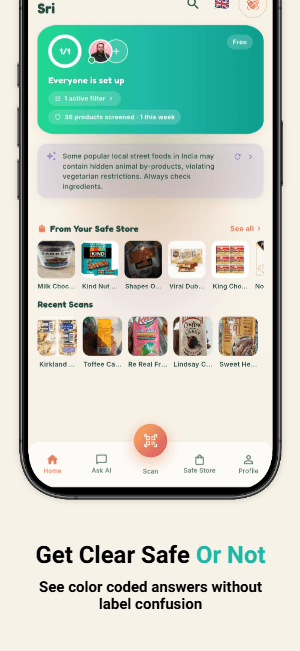
Equally critical is the ScanGenius AI Insight layer, which moves beyond reductive ‘good versus bad’ moralizing scores to provide transparent, multi-dimensional clinical context. In a single two-second barcode scan, parents receive an objective breakdown: an allergen verification check, a NOVA 1-4 classification evaluating ultra-processing, and a validated Nutri-Score reflecting sugar, sodium, and fiber density. Best of all, our Multi-Household Family Profiles allow you to screen for multiple family members simultaneously. One quick scan instantly clarifies safety across the entire breakfast table—flagging specific warnings like ‘Fails for Sri (Gluten)’ while confirming clearance for others.
4. Related Food Safety & Dietary Guides
- Best Food Allergy Scanner App – Scan Food Labels Instantly — Food Allergy & Sensitivity Scanner Hub
- The 7 Best Free Food Scanner Apps of 2026 — best free food scanner apps
- Choosing the Best Barcode Scan App for Your Health — guide to choosing a barcode scanner app
- Food Scan Genius: World’s #1 Food Ingredient Scanner App — Food Scan Genius scanner app
5. Scientific & Health Authority References
- Celiac Disease Foundation Threshold Requirements
- European Food Safety Authority (EFSA) Additive Safety Regulations
- PubMed Research on Ultra-Processed Foods & Gut Microbiome Disruption
- World Health Organization Guidelines on Healthy Diets & Saturated Fats
6. How to Scan in 3 Simple Steps
- Download the Food Scan Genius app completely free on iOS or Android—with 100% free core functionality, no paywalls, and no subscription traps.
- Configure your family’s profile by selecting from 39 clinical dietary presets (including Celiac Disease and NCGS) or typing in custom sensitivities like seed oils or specific food dyes.
- Scan any cereal barcode in the aisle for an instant 2-second audit powered by NutriGraph, receiving named-fail alerts and complete NOVA/Nutri-Score processing context.
Instant Gluten-Free Audit Trail
7. Frequently Asked Questions (FAQ)
Are all cereals labeled ‘gluten-free’ strictly safe for celiac disease?
Not always. Legally, foods labeled gluten-free must stay under 20 parts per million (ppm) of gluten, but highly sensitive individuals can experience intestinal inflammation from recurring low-level exposure. Furthermore, voluntary allergen statements may conceal shared line risks. Food Scan Genius parses sub-ingredients to alert you to questionable grain origins and shared facility risks.
Why are oats such a controversial ingredient in gluten free cereals?
Oats do not naturally contain gluten, but commodity oats are prone to significant agricultural cross-contact from nearby wheat and barley crops. Only certified purity protocol oats maintain stringent safety controls. Scanning a box with Food Scan Genius checks whether the manufacturer utilizes certified oat sourcing or general oat grain that poses contamination risks.
How does Food Scan Genius handle families with multiple food allergies?
Food Scan Genius features Multi-Household Family Profiles. You can program individualized allergy and dietary parameters for every member of your home. When you scan a cereal, the app highlights named-fail attribution in a single view—such as ‘Safe for Liam, Fails for Sri (Gluten)’—saving you from multiple separate scans or manual cross-referencing.
Does a gluten-free label automatically mean a cereal is nutritious?
No. Many gluten-free cereals replace wheat with refined corn starches, white rice flours, and elevated sugar levels to compensate for lost texture. Food Scan Genius utilizes the NOVA 1-4 classification and Nutri-Score algorithms to give you an objective view of processing intensity and nutritional balance, helping you choose cereals that are both safe and genuinely healthy.
Know What’s In Your Food Before You Buy — Scan Free Today
Never second-guess confusing grocery labels again. Download Food Scan Genius to uncover hidden additives, toxic dyes, and allergens for the whole household before you buy.