
1. Why Finding Candies That Are Gluten Free Is Harder Than It Looks in 2026
You stand in the candy aisle holding a bag that looks harmless: fruit chews, a chocolate bar, or a handful of sour gummies. Then you turn it over and start the familiar routine of squinting at tiny print, second-guessing every vague phrase, and wondering whether this treat is worth a week of symptoms. If you live with celiac disease, non-celiac gluten sensitivity, or a wheat allergy, or if you shop for someone who does, that frustration is valid. Finding reliable candies that are gluten free should not require a research project, yet it often does.
Candy looks simple, but modern confectionery is a layered manufacturing process. A single piece can contain a base syrup, a starch, a glaze, a colorant, a flavor system, and a dusting agent, each from a different supplier. Many products are also made on shared lines that handle wafers, cookies, or malted ingredients. For someone with celiac disease, the immune response to gluten can happen even without obvious symptoms, so trace exposure matters. The Celiac Disease Foundation Threshold Requirements reflect the widely recognized standard that foods labeled gluten free should contain fewer than 20 parts per million of gluten. That is a tiny amount, and it is why careful label reading is only the first step.
Candy is also a category where we tend to relax. Holidays, birthday parties, trick-or-treat bags, and stocking stuffers all involve mixed assortments with unwrapped or repackaged pieces. Parents often tell us the hardest part is not the diagnosis but the social cost of saying no, or the guilt when a mistake happens. Please know that being cautious is not being difficult. It is protecting your health, and it deserves better tools than guesswork.
It is also worth separating gluten free from healthy. A gluten-free label tells you about one protein group, not about sugar load, additives, or processing level. The World Health Organization Guidelines on Healthy Diets & Saturated Fats remind us that free sugars and overall dietary patterns matter for everyone. Our goal is to help you make candy choices that are safe first and informed second, without judgment about the occasional treat.
Scan Any Label for Hidden Additives and Allergens — Free
Never second-guess confusing grocery labels again. Download Food Scan Genius to uncover hidden additives, toxic dyes, and allergens for the whole household before you buy.


2. Sneaky Sources of Gluten in Candy: Loopholes Every Label Reader Should Know
Gluten rarely appears in candy under its own name. It hides in ingredients, processing aids, and shared equipment. In the United States, wheat must be declared as a major allergen, but barley and rye are not covered by the same allergen rule, so a product can contain them without a bold "Contains" statement. Regulations also differ across regions. Knowing the common culprits will help you screen any product, whether or not you use an app. For broader context on how additives are assessed, the European Food Safety Authority (EFSA) Additive Safety Regulations are a helpful reference for how ingredients are evaluated, though additive safety and gluten status are separate questions.
- Wheat flour in chewy and twisted candies: Traditional licorice and some soft chews use wheat flour as a structural ingredient. Always check these, even when the flavor suggests only fruit or candy.
- Barley malt and malt extract: Common in malted milk candies, crisped chocolate pieces, and some toffees. Barley contains gluten, and it may appear only as "malt" or "malt syrup" without an allergen callout.
- Wafers, cookie pieces, and crisps: Chocolate bars with crunch, layered wafers, and cookie-dough candies often contain wheat. Crisped rice inclusions may also be made with barley malt.
- Wheat-derived starches and dusting agents: Gummies and jellies are often dusted with starch to prevent sticking. Modified food starch can be wheat-based in some products, and in the US it should be declared as wheat if so.
- "Natural flavors" and colorings of unclear origin: These are usually fine, but they can occasionally carry gluten-containing carriers. When a label is unclear, manufacturer confirmation matters.
- Cross-contact on shared lines: Even a recipe with no gluten ingredients can pick up traces from shared equipment. "May contain wheat" statements are voluntary, while a certified gluten-free label provides stronger assurance.
Another loophole involves wheat-based glucose syrup and dextrose. These are highly refined and often test below the 20 ppm threshold, but labeling conventions differ internationally, which confuses many shoppers. Add the fact that formulas change without notice and the same brand can differ between regular bars and seasonal minis, and it becomes clear why last year’s safe candy may not be this year’s.
Finally, many candies are ultra-processed. Gluten-free status does not change that. If you want to understand why processing level matters for digestive wellness, see this PubMed Research on Ultra-Processed Foods & Gut Microbiome Disruption. It is useful context for anyone with a sensitive gut, but it is not a reason to feel shame about enjoying candy now and then.
3. Food Scan Genius vs. Manual Checking and Other Methods for Candy Shopping
| Dimension | Food Scan Genius | Manual Label Reading | Fig | Spoonful |
|---|---|---|---|---|
| Cost | 100% free core features, zero paywalls | Free, but time-intensive | About $59/yr | Limited scans |
| Ingredient depth | Recursive sub-ingredient parsing across 5,000,000+ verified barcodes | Only what you can read and recognize | Ingredient-based screening | Ingredient-based screening |
| Dietary profiles | 39 profiles plus custom sensitivities | Whatever you remember | Varies by plan | Varies by plan |
| Family screening | Multi-household profiles with named fail attribution | One person at a time, by memory | Limited | Limited |
| Languages | 11 languages with real-time in-app translation | Depends on the package | Varies | Varies |
The core problem with candy labels is that ingredients nest inside other ingredients. A "coating" contains a glaze, which contains a starch, which may come from wheat. Food Scan Genius is powered by the NutriGraph Database, which uses recursive sub-ingredient parsing to look beneath the surface of an ingredient list instead of matching keywords. That means barley malt hidden in a crisp inclusion, or a wheat-based starch inside a dusting blend, is far more likely to be flagged. You can also add a custom sensitivity for anything specific to you, whether that is a particular additive, a dye, or seed oils, and it is applied on top of gluten screening.
Every scan also comes with ScanGenius AI Insight, which explains why a candy passed or failed in plain language. It pairs that with NOVA 1-4 classification and Nutri-Score so you can see processing level and nutritional quality without a simplistic good-or-bad verdict. If you set up Multi-Household Family Profiles, one scan screens everyone at once and tells you exactly who is affected, such as "Fails for Sri (Gluten)." That is especially useful at Halloween or at a party, where one bowl of candy has to work for several people. Please remember that no app replaces certified labeling or a call to the manufacturer when you have doubts. Use the scan as a fast, thorough first filter.
4. Related Food Safety & Dietary Guides
- Best Food Allergy Scanner App – Scan Food Labels Instantly — Food Allergy & Sensitivity Scanner Hub
- The 7 Best Free Food Scanner Apps of 2026 — best free food scanner apps
- Choosing the Best Barcode Scan App for Your Health — guide to choosing a barcode scanner app
- Food Scan Genius: World’s #1 Food Ingredient Scanner App — Food Scan Genius scanner app
5. Scientific & Health Authority References
- Celiac Disease Foundation Threshold Requirements
- European Food Safety Authority (EFSA) Additive Safety Regulations
- PubMed Research on Ultra-Processed Foods & Gut Microbiome Disruption
- World Health Organization Guidelines on Healthy Diets & Saturated Fats
6. How to Scan in 3 Simple Steps
- Download Food Scan Genius free on iOS or Android. There is no paywall on core features, and you can choose from 11 languages with real-time in-app translation.
- Set up your profile for gluten. Choose the gluten-free or celiac-related dietary profile from 39 options, add any custom sensitivities, such as a specific additive, and create Family Profiles so every household member is screened in one scan.
- Scan the candy’s barcode in about 2 seconds. Review the instant audit trail, including named fail attribution, ScanGenius AI Insight, NOVA classification, and Nutri-Score, then decide whether to buy, skip, or contact the manufacturer.
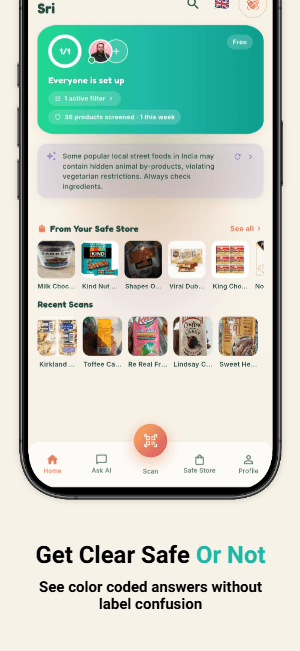
Instant Gluten-Free Audit Trail
7. Frequently Asked Questions (FAQ)
Are most candies that are gluten free safe for people with celiac disease?
Not automatically. Many candies are made without gluten ingredients, such as plain hard candies, many chocolates, and fruit-flavored sweets, but safety depends on the specific formula and on cross-contact in the facility. Products labeled gluten free in the US must meet the under-20 ppm standard, which is the safest signal. Food Scan Genius screens the full ingredient tree against your gluten profile, but if you have celiac disease, favor certified or clearly labeled products and contact the maker when in doubt.
Which ingredients should I watch for when checking whether candy contains hidden gluten?
Look for wheat flour, barley malt, malt extract or syrup, wafers, cookie pieces, crisped inclusions, wheat starch, and unclear modified starches. Traditional licorice and malted candies are frequent offenders. Cross-contact on shared equipment is another hidden risk. Food Scan Genius uses recursive sub-ingredient parsing in the NutriGraph Database to surface these ingredients even when they are nested inside another component, and ScanGenius AI Insight explains the reason for each flag.
Can one scan check candy for my whole family, including someone with a gluten allergy and someone avoiding dyes?
Yes. Multi-Household Family Profiles let you save each person’s dietary needs, then screen all of them in one scan. If a candy contains an issue, the result names who is affected, for example "Fails for Sri (Gluten)." You can combine 39 supported dietary profiles with custom sensitivities, such as specific dyes or additives, so a single bag of candy can be evaluated against every household member at once.
Does a gluten-free candy count as a healthy choice, and does Food Scan Genius rate it that way?
Gluten free only means the product meets a gluten standard. It says nothing about sugar, additives, or processing. Food Scan Genius does not use a simplistic moral score. Instead, ScanGenius AI Insight gives balanced context alongside NOVA 1-4 classification and Nutri-Score, so you can see that a candy may be safe for your gluten needs while still being an ultra-processed, high-sugar treat. The core features are completely free, so you can scan as many candies as you like.
Know What’s In Your Food Before You Buy — Scan Free Today
Never second-guess confusing grocery labels again. Download Food Scan Genius to uncover hidden additives, toxic dyes, and allergens for the whole household before you buy.