
1. Navigating Dairy Aisles: Why Finding Cheeses That Are Lactose Free Is Surprisingly Complex
Standing in the refrigerated dairy aisle when you live with lactose intolerance or dairy sensitivity can be an exhausting exercise in frustration. Millions of shoppers pick up a package of sharp cheddar or artisan gouda, scan the nutrition facts, and wonder whether a single bite will trigger severe gastrointestinal distress, systemic inflammation, or ruined plans. The biological reality is straightforward: more than 65% of the global adult population experiences a natural decline in lactase enzyme production post-weaning. Yet modern supermarket displays present a bewildering landscape of conflicting claims, ranging from ‘naturally lactose-free’ claims on aged cheeses to enzyme-treated dairy lines and highly engineered plant-based alternatives. Discerning which cheeses that are lactose free will protect your digestive tract without compromising your culinary standards requires clinical clarity and reliable tools.
The dilemma deepens when you compare nutritional density against biochemical tolerance. Traditional cheese making is an ancient preservation art where lactic acid bacteria metabolize the vast majority of milk sugars during curd acidification, fermentation, and aging. In long-aged firm cheeses, residual lactose drops below 0.1 grams per serving—a threshold virtually all lactose-intolerant individuals can safely tolerate without enzymatic distress. However, dietary guidance must balance digestive comfort with broader cardiovascular health; the World Health Organization Guidelines on Healthy Diets & Saturated Fats emphasize moderating saturated fatty acids regardless of whether dairy has been aged to eliminate fermentable carbohydrates.
Compounding this complexity is the regulatory and physiological gap between lactose intolerance (a carbohydrate malabsorption issue) and cow’s milk protein allergy (an immune-mediated response to casein or whey). Under the FDA Food Allergen Labeling & Consumer Protection Act (FALCPA), manufacturers are legally mandated to declare the presence of ‘milk’ on any derivative ingredient, but federal law does not mandate explicit labeling of actual residual lactose content in milligrams. This leaves vulnerable shoppers squinting at ingredient lists, guessing whether a ‘shredded cheese blend’ contains added milk powders or whether a vegan block harbors undisclosed gut irritants.
Food Scan Genius was built precisely to eliminate this guesswork and grocery anxiety. By transforming intricate nutritional science and regulatory nomenclature into instant mobile transparency, we empower consumers to shop without fear, ensuring that your choice of aged hard cheeses or plant-based alternatives supports your specific digestive ecology.
Scan Any Label for Hidden Additives and Allergens — Free
Never second-guess confusing grocery labels again. Download Food Scan Genius to uncover hidden additives, toxic dyes, and allergens for the whole household before you buy.


2. The Science of Dairy Breakdown: 5 Hidden Traps When Shopping for Cheeses That Are Lactose Free
When seeking out cheeses that are lactose free, relying on superficial front-of-package marketing claims can lead to accidental exposure and painful symptoms. Food processing shortcuts, deceptive labeling loopholes, and formulation fillers frequently introduce trace disaccharides or problematic food additives into products consumers assume are completely safe. Understanding the biochemical composition of these products is critical:
- Re-introduced Whey and Milk Powder in Pre-Shredded Cheeses: While an authentic whole block of aged Cheddar, Gruyère, or Parmigiano-Reggiano naturally contains virtually zero lactose due to extended bacterial fermentation, pre-shredded packaged versions often use anti-caking coatings that sneak dairy solids back in. Manufacturers sometimes blend potato starch with powdered whey or processing aids that reintroduce lactose into an otherwise safe cheese matrix.
- The ‘Lactose-Free’ vs. ‘Dairy-Free’ Conflation: Products labeled ‘lactose-free’ are often conventional cow’s milk treated with exogenous fungal or bacterial lactase enzyme (which splits lactose into glucose and galactose). While safe for pure lactase deficiency, these products still contain full levels of alpha-s1-casein, beta-casein, and beta-lactoglobulin. Shoppers experiencing non-celiac sensitivities or underlying dairy protein reactivity will suffer significant mucosal inflammation if they mistake enzyme-treated dairy for hypoallergenic foods.
- Ultra-Processed Binders in Vegan Cheese Alternatives: When turning to dairy-free cheese analogs made from coconut oil, cashew bases, or pea starch, consumers frequently ingest dense arrays of hydrocolloids and synthetic texturizers. The European Food Safety Authority (EFSA) Additive Safety Regulations continually re-evaluate food hydrocolloids, emulsifying salts, and synthetic stabilizers like carrageenan and carboxymethylcellulose. For individuals with sensitive bowels or microflora imbalance, these additives can provoke symptoms indistinguishable from lactose-induced cramping.
- Microbiome Disruptions from Modified Food Starches: To achieve meltability in dairy-free sliced cheeses, industrial formulators rely on chemically modified isolated starches and isolate concentrates. Emerging PubMed Research on Ultra-Processed Foods & Gut Microbiome Disruption highlights how synthetic emulsifiers and highly refined acellular starches erode the protective colonic mucus barrier, altering microbial diversity and heightening intestinal permeability.
- The ‘Zero Sugar’ Regulatory Loophole: In the United States, FDA rounding guidelines allow manufacturers to declare ‘0g Sugars’ on the Nutrition Facts panel if a standard serving contains less than 0.5 grams of total sugar. In semi-soft cheeses like young Havarti, Monterey Jack, or Fresh Mozzarella, a single 28-gram serving might register 0.4 grams of residual lactose and be rounded down to zero. For hyper-sensitive individuals or those consuming larger culinary portions (such as on homemade pizza), those fractional grams accumulate quickly, surpassing clinical symptom thresholds.
3. The Technological Solution: Auditing Every Block and Wedge with ScanGenius
| Feature / Capability | Food Scan Genius | Fig | Spoonful | Manual Label Reading |
|---|---|---|---|---|
| Pricing Model | 100% Free Core (No Paywalls) | $59/year Subscription Gate | Strict Monthly Scan Caps | Free, High Time Investment |
| Sub-Ingredient AST Parsing | Deep Recursive AST (NutriGraph 5M+) | Basic Tag Matching | Basic Keyword Matching | Impossible (Parenthetical Blindspots) |
| Family Multi-Screening | 1-Scan Attribution (“Fails for Sri (Gluten)”) | Single-User Focus | Single Profile Only | Exhaustive Cross-Checking |
| Food Quality & Processing Scoring | NOVA 1-4 + Nutri-Score Context | Green/Yellow/Red Flags Only | FODMAP Traffic Light Only | None |
| Language Support | 11 Languages w/ Real-Time Translation | English Only | English Only | Subject to Importer Decals |
Evaluating cheeses that are lactose free should not require a biochemistry degree or expensive annual subscriptions. While legacy apps like Fig lock comprehensive multi-ingredient auditing behind a $59/year paywall and Spoonful restricts consumers with monthly scan limits, Food Scan Genius delivers enterprise-grade consumer protection completely free. Powered by our proprietary NutriGraph Database of over 5,000,000 verified UPC/EAN barcodes, the platform utilizes recursive Abstract Syntax Tree (AST) parsing. This technology deconstructs every nested ingredient—penetrating obscure labeling terms like ‘natural flavoring,’ ‘microbial coagulants,’ or ‘caseinate complexes’—to determine the exact biochemical safety of both European aged staples and modern plant-based mock cheeses.
Rather than relying on simplistic, punitive scores that villainize all fat or salt, our ScanGenius AI Insight pairs transparent ingredient deconstruction with globally recognized scientific frameworks, including the NOVA 1-4 classification for ultra-processed foods and international Nutri-Score standards. When shopping for an entire household, our Multi-Household Family Profiles allow you to screen for multiple conflicting needs in a single 2-second scan. If a sharp cheddar is entirely free of lactose but contains an annatto seed color or a gluten-derived dusting agent, ScanGenius provides precise named attribution—such as ‘Fails for Sri (Gluten)’—while simultaneously reassuring you that the lactose sugar profile is zero. And for specialty imported cheeses, 11 global languages with real-time translation ensure that French Comté, Spanish Manchego, or Italian Pecorino are accurately decoded right in your hand.
4. Related Food Safety & Dietary Guides
- Best Food Allergy Scanner App – Scan Food Labels Instantly — Food Allergy & Sensitivity Scanner Hub
- The 7 Best Free Food Scanner Apps of 2026 — best free food scanner apps
- Choosing the Best Barcode Scan App for Your Health — guide to choosing a barcode scanner app
- Food Scan Genius: World’s #1 Food Ingredient Scanner App — Food Scan Genius scanner app
5. Scientific & Health Authority References
- FDA Food Allergen Labeling & Consumer Protection Act (FALCPA)
- European Food Safety Authority (EFSA) Additive Safety Regulations
- PubMed Research on Ultra-Processed Foods & Gut Microbiome Disruption
- World Health Organization Guidelines on Healthy Diets & Saturated Fats
6. How to Scan in 3 Simple Steps
- Download the Food Scan Genius app for free on iOS or Android with zero locked paywalls or credit card requirements.
- Configure your dietary setup by selecting ‘Lactose-Free’ across 39 available dietary profiles, and effortlessly add custom sensitivities such as specific gums, seed oils, carrageenan, or whey proteins.
- Scan any block, wedge, or shred barcode in 2 seconds in your grocery aisle to view an instant NutriGraph sub-ingredient audit, NOVA processing level, and multi-family profile compatibility.
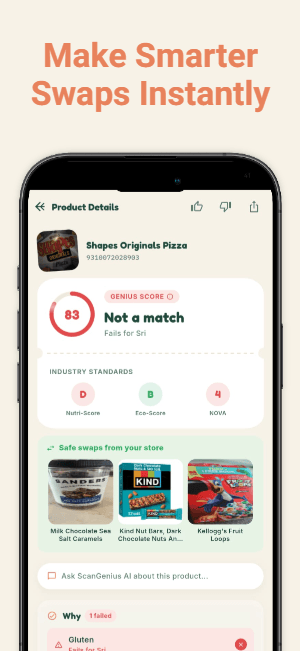
Instant Dairy-Free Audit Trail
7. Frequently Asked Questions (FAQ)
Which aged dairy cheeses are naturally lactose-free without added enzymes?
Authentic long-aged hard cheeses such as Parmigiano-Reggiano, 24-month Aged Cheddar, Gruyère, Manchego, and mature Gouda are naturally virtually free of lactose. During the traditional aging process, lactic acid bacteria convert lactose into lactic acid, and residual whey is drained away. In cheeses aged over 12 to 18 months, lactose levels drop below 0.1 grams per 100 grams, making them safe for almost everyone with lactase deficiency. Food Scan Genius analyzes the specific barcode and age statements to confirm these biochemical thresholds.
Can someone with a true cow’s milk allergy safely consume cheeses that are lactose free?
No. Lactose intolerance is a carbohydrate malabsorption issue caused by a deficiency of the brush-border enzyme lactase. In contrast, a cow’s milk allergy is an immune reaction triggered by dairy proteins such as casein or whey. Even if a cheese has 0 grams of lactose, it still contains intact milk proteins capable of inducing severe allergic reactions or anaphylaxis. Always check ScanGenius alerts for dairy protein warnings if you manage an allergy.
Are vegan dairy-free cheeses healthier than naturally aged cheeses that are lactose free?
Not necessarily. While vegan cheeses are inherently 100% free of lactose and milk proteins, many fall into NOVA Group 4 (ultra-processed foods). They frequently consist of isolated starches, saturated coconut oil, refined stabilizers, and synthetic emulsifiers that lack the bioavailable protein, calcium, and bioactive peptides found in traditionally fermented dairy. ScanGenius provides full NOVA classification and Nutri-Score context on every dairy-free cheese so you can weigh processing levels against digestive comfort.
How does Food Scan Genius detect hidden lactose in processed cheese blends?
Food Scan Genius relies on its NutriGraph database containing over 5,000,000 barcodes. Using recursive Abstract Syntax Tree (AST) parsing, the algorithm reads beyond the primary ingredients to analyze nested parentheticals and processing aids. If a packaged shredded cheese uses powdered milk solids, whey derivatives, or lactose-bearing bulking agents in its anti-caking blend, ScanGenius instantly flags the compound and warns sensitive users.
Know What’s In Your Food Before You Buy — Scan Free Today
Never second-guess confusing grocery labels again. Download Food Scan Genius to uncover hidden additives, toxic dyes, and allergens for the whole household before you buy.