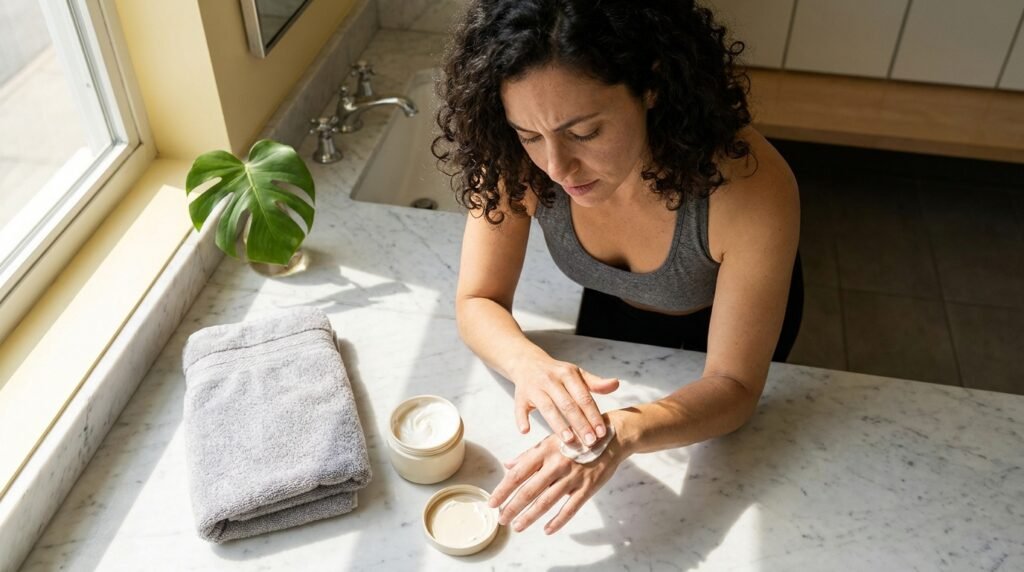
1. What a cream moisturizer for dry skin needs to contain
The best cream moisturizer for dry skin combines a humectant such as glycerin or urea, barrier lipids such as ceramides and cholesterol, and an occlusive such as petrolatum or dimethicone, without fragrance or other common irritants.
Each category does a different job. Humectants draw water into the stratum corneum. Emollients and barrier lipids fill the gaps between skin cells and make the surface feel smoother. Occlusives form a film that slows transepidermal water loss (TEWL). A cream that relies on only one of these tends to underperform. A humectant-only gel can pull water outward in very dry air, and a pure occlusive does not add water or lipids of its own.
The format matters too. Creams are oil-in-water emulsions with enough lipid to be noticeably richer than a lotion but lighter than an ointment, which is mostly oil or petrolatum with little water. For dry skin, a cream is usually the practical middle ground. Ointments suit very dry areas such as hands, heels and elbows, and lotions suit mild dryness or humid climates.
It also helps to separate dry from dehydrated. Dry skin lacks oil and lipids, and it often feels tight and looks flaky all the time. Dehydrated skin lacks water and can occur in any skin type, including oily skin. Both benefit from a humectant, but only truly dry skin needs a heavy lipid and occlusive load. If dryness comes with persistent redness, itching, cracking or weeping, that is a clinical question for a dermatologist rather than a moisturizer question. Eczema, rosacea and contact dermatitis all need individual assessment.
2. Ingredients and concentrations that matter
Ingredient lists are ordered by concentration down to roughly 1%. Below that, order is unreliable. A hero ingredient listed after the preservatives is likely present at a token level. These are the ingredients worth looking for, with ranges that have evidence behind them:
- Glycerin: The best-studied humectant. Effective levels are typically around 5-10%, and it should appear in the first five or so ingredients.
- Urea: At roughly 5-10% it hydrates. Above about 10% it also loosens dead surface cells (a keratolytic effect), and 20-40% products are aimed at thick, rough skin on feet or elbows. Urea can sting on cracked or inflamed skin, so check the percentage on the label.
- Hyaluronic acid or sodium hyaluronate: A useful humectant, but it is usually present at well under 1%. It is a supporting ingredient rather than the reason a cream works.
- Ceramides (NP, AP, EOP) with cholesterol and fatty acids: Skin-identical lipids are often discussed in a roughly 3:1:1 molar ratio of ceramides, cholesterol and free fatty acids. Ceramides alone, without the other two lipids, are less convincing. Brands rarely disclose exact percentages, so look for all three on the list.
- Petrolatum: The most effective occlusive, shown in classic studies to reduce TEWL by more than 98% when applied neat. In the US OTC skin protectant monograph, petrolatum qualifies at 30-100%. Many people dislike the feel, which is why creams blend it with lighter materials.
- Dimethicone: A silicone occlusive that is breathable and non-greasy. The same monograph recognizes it at 1-30%.
- Shea butter, squalane, colloidal oatmeal, allantoin: Supportive emollients and soothing agents. Allantoin is recognized at 0.5-2%.
What to be wary of. Added fragrance and essential oils (lavender, citrus, peppermint) are among the more common causes of contact reactions in dry or compromised skin. Denatured alcohol high on the list can feel drying, though fatty alcohols such as cetyl and stearyl alcohol are emollients and are not a concern. If you have reacted to a product before, keep a note of its full ingredient list and compare it with new ones.
On pH. Healthy skin surface pH sits around 4.5-5.5, and well-formulated moisturizers generally land in a mildly acidic to neutral range, roughly 4.5-7. Most brands do not print the pH of a cream, and it cannot be read from an ingredient list, so do not trust a number you cannot source. It matters far more for acids and vitamin C than for a basic cream. If the brand publishes a pH, check that it is not strongly alkaline. If it does not, judge the cream on tolerability and the ingredient list.
3. Layering order and interactions with your actives
The general rule is to apply products from thinnest to thickest and to treat the cream as the seal. Water-based serums go on first, then any lotion-weight treatment, then the cream. In the morning, sunscreen goes on last, after the moisturizer, unless your moisturizer is itself a labeled broad-spectrum SPF product. Applying cream to slightly damp skin, within a few minutes of washing, helps trap water already in the skin.
Problems usually come from how the cream interacts with the actives underneath it:
- Retinoids (retinol 0.25-1%, adapalene 0.1%, prescription tretinoin): Cream over a retinoid does not stop it working in any meaningful way, and it reduces dryness and peeling. If you are irritated, the sandwich method (cream, retinoid, cream) buffers the effect, though it can also reduce how much active reaches the skin. Do not stack a retinoid with exfoliating acids on the same night while your skin is dry.
- L-ascorbic acid (vitamin C): Typically formulated at 10-20% and at a pH below about 3.5 to penetrate. Apply it to clean skin first and give it a few minutes before the cream. A cream applied first can dilute the effect and block penetration.
- AHAs and BHAs (glycolic, lactic, salicylic acid): These work at an acidic pH, around 3-4, and are exfoliants. Adding a urea cream above 10% or a lactic acid body lotion on top is doubling up on exfoliation, which is a common cause of stinging and a worsening barrier in dry skin.
- Niacinamide (2-5%): Generally compatible with creams and often included in them. Higher percentages can cause flushing or irritation in some people.
- Benzoyl peroxide (2.5-5%) and prescription acne treatments: These are drying, so a ceramide-rich cream is a sensible companion. Apply the cream after the treatment has dried.
Where the combinations get complicated, checking is better than guessing. Scanning a cream’s barcode in Skin Scan Genius shows its actives next to the ones already in your routine, so you can see if a urea cream overlaps with your acid toner or whether a new moisturizer already contains a retinoid you apply separately.
One more practical point is that routines fail from stacking, not from any single product. If your skin is already dry, remove an exfoliating step before adding more products. A simple cleanser, a cream, and sunscreen in the morning outperform a ten-step routine that keeps the barrier inflamed.
4. Applying it properly and knowing when a cream is not enough
Most people under-apply. A common guide is the fingertip unit (the amount squeezed along an index finger from the tip to the first crease), which covers roughly two palms of skin area. For the face and neck, that is about a half to one fingertip unit. Apply twice daily if your skin is very dry, and reapply to hands after washing.
Habits upstream often matter as much as the cream. Long, hot showers, foaming cleansers with strong surfactants such as sodium lauryl sulfate, and low indoor humidity in winter all strip lipids faster than any moisturizer replaces them. Switching to a lukewarm rinse and a gentle, low-foaming cleanser is often the first useful change.
When you compare creams, use a short checklist:
- Is there a humectant (glycerin, urea, or both) high on the list?
- Are barrier lipids present, ideally ceramides with cholesterol and fatty acids?
- Is there an occlusive such as petrolatum or dimethicone?
- Is it fragrance-free, or at least free of essential oils?
- Does it duplicate an active you already use, such as an acid or retinoid?
That last question is the one a label alone rarely answers, and it is where a barcode scan in Skin Scan Genius saves time. For skin that stays red, itchy, cracked or inflamed despite a consistent, simple routine, see a dermatologist. Eczema, psoriasis, rosacea and allergic contact dermatitis need diagnosis, and some require prescription treatment that a cosmetic cream cannot replace.
Check it against your own routine. Skin Scan Genius reads a product’s full INCI list and flags conflicts with the actives you already use, by skin type and concern.
Frequently asked questions
Is a cream or a lotion better for dry skin?
Creams are usually better for dry skin because they contain more lipids and less water than lotions. Lotions can work for mild dryness or in humid weather. For very rough areas such as heels or hands, an ointment may suit better.
Should I apply moisturizer before or after serums?
After. Apply water-based serums and treatments first, then the cream to seal them in, and sunscreen last in the morning. The exception is a thick treatment or prescription product, which should be applied as directed by your clinician.
Is hyaluronic acid enough for dry skin?
Usually not. Hyaluronic acid attracts water but does not replace lipids or prevent evaporation. Pair it with ceramides and an occlusive such as petrolatum or dimethicone, or use a cream that contains all three types of ingredient.
Can I use a urea cream with retinol or exfoliating acids?
Low-concentration urea (around 5-10%) is generally well tolerated with retinoids, but urea above 10% has an exfoliating effect. Combining it with AHAs, BHAs, or a strong retinoid on the same night can irritate dry skin. Alternate nights if you notice stinging or flaking.