
1. Why Finding Safe Gluten Free Protein Bars Is So Hard in 2026
If you have celiac disease, a protein bar is rarely just a snack. It is the thing in your bag when a meeting runs long, the post-workout fuel that has to be safe, the backup meal when travel leaves you with nothing else. Yet the protein bar aisle is one of the trickiest in the store. A bar can say ‘gluten free’ in bold on the front and still leave you wondering about the oats, the crisps, the flavorings, and the factory it came from. That worry is not paranoia. It is a reasonable response to a complicated supply chain.
The clinical stakes explain why. In celiac disease, ingestion of gluten triggers an autoimmune response that damages the lining of the small intestine, even when symptoms are mild or absent. The Celiac Disease Foundation Threshold Requirements and related guidance center on a familiar benchmark: foods labeled gluten-free in the US and EU must contain less than 20 parts per million of gluten. That standard is protective for most people with celiac disease, but it only helps if you can trust the label and understand what sits behind it.
Sensitive eaters face an additional layer. Many people with celiac disease, non-celiac gluten sensitivity, or IBS-type symptoms also react to sugar alcohols, chicory root fiber, certain milk proteins, or highly processed binders that are common in protein bars. A bar that is technically gluten-free can still leave you bloated and miserable. Ongoing PubMed Research on Ultra-Processed Foods & Gut Microbiome Disruption is one reason many shoppers now look at how processed a bar is, not just whether it contains gluten.
So if you have stood in an aisle squinting at a 6-point ingredient list, you are not being overly careful. You are doing detective work that the packaging makes harder than it should be. This guide shows where gluten and gut irritants hide in protein bars, which label signals matter most, and how to turn a two-minute label investigation into a two-second scan. Always discuss your personal thresholds and symptoms with your gastroenterologist or registered dietitian.
Scan Any Label for Hidden Additives and Allergens — Free
Never second-guess confusing grocery labels again. Download Food Scan Genius to uncover hidden additives, toxic dyes, and allergens for the whole household before you buy.


2. Where Gluten Hides in Protein Bars: Sneaky Ingredients and Label Loopholes
Protein bars combine many components: a protein base, a binder, crunchy inclusions, sweeteners, and flavor systems. Each one is a possible entry point for gluten or cross-contact. These are the six issues we see most often when auditing ingredient lists:
- Barley malt and malt extract: Common in chocolate coatings, crisps, and caramel-like binders. In the US, wheat must be declared as a major allergen, but barley and rye do not have to be called out in the allergen statement, so you have to recognize ‘malt’ on the ingredient list yourself.
- Protein crisps and puffs: Crunchy soy, rice, or pea crisps are sometimes made with barley malt or processed on shared lines. The crisp is a sub-ingredient, so its components can be buried in parentheses.
- Conventional oats: Oats are naturally gluten-free but are often contaminated with wheat or barley during growing, transport, and milling. Look for oats that are specifically certified or labeled gluten-free, and note that a small number of people with celiac disease react to avenin even in uncontaminated oats.
- Hydrolyzed wheat protein and wheat-derived binders: Some formulations use wheat-based proteins, starches, or fibers. Rules on wheat starch differ by region, so the same ingredient can be treated differently in EU and US products.
- ‘May contain’ and shared-facility statements: Precautionary allergen labeling is largely voluntary and inconsistent. Its absence does not prove a bar is safe, and its presence does not always mean a real risk, so the context of the manufacturer’s testing matters.
- Gut-irritating ‘free-from’ substitutes: Bars that remove gluten often add sugar alcohols (maltitol, sorbitol), inulin, or chicory root fiber to hold texture and sweetness. These are not gluten, but they commonly trigger digestive distress in sensitive eaters.
Regulation of the other ingredients matters too. Emulsifiers, sweeteners, and flavors in protein bars are evaluated under frameworks like the European Food Safety Authority (EFSA) Additive Safety Regulations, and tolerance of individual additives is highly personal. Likewise, some bars are high in saturated fat from coconut oil or palm kernel oil, which is worth weighing against the World Health Organization Guidelines on Healthy Diets & Saturated Fats. The goal is not to fear every bar, but to see the whole picture before you eat it.
3. Food Scan Genius vs. Other Ways to Vet a Protein Bar
| Dimension | Food Scan Genius | Fig | Spoonful | Manual Label Reading |
|---|---|---|---|---|
| Cost | 100% free core features, zero paywalls | $59/yr | Free tier with limited scans | Free, but costs time |
| Scan limits | Unrestricted core scanning | Tied to subscription | Limited | N/A |
| Ingredient depth | NutriGraph: 5M+ verified barcodes, recursive sub-ingredient parsing | Varies by product | Varies by product | Depends on your knowledge and attention |
| Profiles and custom sensitivities | 39 dietary profiles plus custom sensitivities (additives, dyes, seed oils) | Preset-focused | Preset-focused | Your own memory |
| Family and language support | Multi-household profiles with named fail attribution; 11 languages with real-time translation | Check current plan | Check current plan | Label language only |
The real technical difference is depth. Food Scan Genius runs on the NutriGraph Database, which links more than 5,000,000 verified UPC/EAN barcodes to ingredient data and parses sub-ingredients recursively. That matters for protein bars, where the problem is often not the first line of the label but the ingredient inside the ingredient: the crisp inside the coating, the flavor inside the binder. Instead of a surface-level keyword match for ‘wheat,’ the scan follows the nested structure and flags barley malt or wheat-derived components that a quick read would miss.
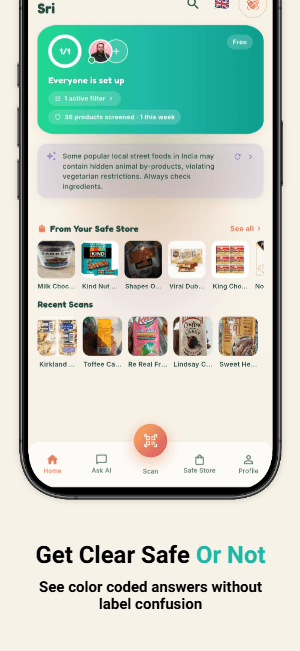
Then ScanGenius AI Insight adds context rather than a verdict. Each result includes a NOVA 1-4 classification and a Nutri-Score so you can see how processed a bar is and how its nutrition profile stacks up, without a simplistic good-or-bad number that ignores your needs. For a celiac shopper, the insight might say a bar passes your gluten profile but contains sugar alcohols you have flagged as a personal trigger. For a family, one scan can screen everyone in the household and name the problem plainly, such as ‘Fails for Sri (Gluten).’ With 11 supported languages and real-time in-app translation, it also works when you are traveling and the label is not in your language. Scan results support your decision but do not replace medical advice or the manufacturer’s testing information.
4. Related Food Safety & Dietary Guides
- Best Food Allergy Scanner App – Scan Food Labels Instantly — Food Allergy & Sensitivity Scanner Hub
- The 7 Best Free Food Scanner Apps of 2026 — best free food scanner apps
- Choosing the Best Barcode Scan App for Your Health — guide to choosing a barcode scanner app
- Food Scan Genius: World’s #1 Food Ingredient Scanner App — Food Scan Genius scanner app
5. Scientific & Health Authority References
- Celiac Disease Foundation Threshold Requirements
- European Food Safety Authority (EFSA) Additive Safety Regulations
- PubMed Research on Ultra-Processed Foods & Gut Microbiome Disruption
- World Health Organization Guidelines on Healthy Diets & Saturated Fats
6. How to Scan in 3 Simple Steps
- Download Food Scan Genius free on iOS or Android. There is no paywall on core features and no subscription is needed to start scanning.
- Set up your profile: choose the Gluten-Free/Celiac profile from the 39 dietary profiles, then use ‘Add Your Own Custom Sensitivity’ for personal triggers such as sugar alcohols, specific additives, or seed oils. Add family members under your household so each person is screened separately.
- Scan the protein bar’s barcode and get a result in about two seconds, with an audit trail showing exactly which ingredient or sub-ingredient triggered a flag, plus NOVA and Nutri-Score context.
Instant Gluten-Free Audit Trail
7. Frequently Asked Questions (FAQ)
What should I look for when choosing gluten free protein bars for celiac disease?
Start with a recognized gluten-free claim, which in the US and EU means under 20 ppm of gluten. Then check the ingredient list for barley malt, malt extract, and conventional oats, and look for certified gluten-free oats and crisps. Scanning with Food Scan Genius lets the NutriGraph Database check sub-ingredients automatically against your celiac profile, so nested sources are not missed. Always confirm with your care team what is right for you.
Is a ‘gluten-free’ label enough, or do I still need to check the ingredients?
The label is a strong starting point but not the whole story. Rules differ between regions, and the label does not address your other sensitivities, such as sugar alcohols or additives that may upset your gut. Scanning a bar with Food Scan Genius lets you see the ingredient-level audit trail behind the claim and screen for your custom sensitivities in the same step.
Why do some gluten free protein bars still cause digestive symptoms?
Several non-gluten ingredients can cause symptoms in sensitive eaters, including maltitol and sorbitol, inulin, chicory root fiber, and certain milk proteins. Accidental cross-contact is also possible, and some people react to oats even when they are uncontaminated. In Food Scan Genius you can add custom sensitivities to your profile so a bar is flagged for those ingredients, and persistent symptoms should be discussed with your doctor or dietitian.
Can I screen gluten free protein bars for my whole family at once?
Yes. Food Scan Genius supports multi-household family profiles, so one scan checks the bar against everyone’s dietary needs. Results name who is affected, such as ‘Fails for Sri (Gluten),’ which makes shared shopping faster, especially when one person has celiac disease and others have different preferences. The core feature is free, and the app works in 11 languages.
Know What’s In Your Food Before You Buy — Scan Free Today
Never second-guess confusing grocery labels again. Download Food Scan Genius to uncover hidden additives, toxic dyes, and allergens for the whole household before you buy.