
1. Why Choosing Dairy Free Cheese Is Harder Than It Looks in 2026
You stand in the refrigerated aisle holding a package that promises ‘melts like the real thing.’ You turn it over and find a 40-word ingredient list with starches, gums, oils, ‘natural flavors,’ and cultures. You put it back and pick up another. If you are shopping for a child with a milk allergy, managing lactose intolerance, or eating plant-based for ethical reasons, this scene is exhausting. You are not being picky. The category really is confusing.
Dairy free cheese is not one product type. Some are built on coconut oil and starch, some on cashews or almonds, some on soy or pea protein, and some on fermented nut bases that behave more like traditional cheese. Each type performs differently. A shred that bubbles beautifully on pizza may turn rubbery on a cold sandwich, and a firm sliceable block may crumble into oily paste in a grilled cheese. Shoppers often spend $6 to $9 on a trial block only to find it fails at the one job they bought it for.
For people with medical reasons to avoid dairy, the stakes go well beyond texture. Under the FDA Food Allergen Labeling & Consumer Protection Act (FALCPA), milk must be declared in plain language when it is an ingredient. But the words ‘dairy free,’ ‘non-dairy,’ and ‘plant-based’ on the front of a package are marketing claims, not a guarantee that you have read the whole story. Cross-contact statements are voluntary, and the front label rarely tells you how the product was made.
There is also a quieter worry: many people want to know how processed their food is. Research such as this PubMed Research on Ultra-Processed Foods & Gut Microbiome Disruption has raised questions about heavily formulated foods, and plant-based cheese often sits in that territory. That doesn’t mean you must avoid it. It means you deserve clear, unhurried information so you can decide what fits your household.
Scan Any Label for Hidden Additives and Allergens — Free
Never second-guess confusing grocery labels again. Download Food Scan Genius to uncover hidden additives, toxic dyes, and allergens for the whole household before you buy.


2. Sneaky Ingredients and Labeling Loopholes in Dairy Free Cheese
Reading a dairy free cheese label well means knowing where the gaps are. The ingredients below are not ‘bad,’ but each can matter depending on your allergy, your sensitivities, or your goals. Food additive approvals also differ by region. The European Food Safety Authority (EFSA) Additive Safety Regulations are reviewed on a different cycle than US rules, so a product sold in several countries may carry different formulations.
- ‘Non-dairy’ with casein: In the US, ‘non-dairy’ is not equivalent to ‘milk-free.’ Some products labeled this way contain casein, a milk protein. This is a well-known loophole, and the allergen statement is the place to check, not the front panel.
- Coconut oil and saturated fat load: Many melt-friendly shreds are mostly refined coconut oil and starch. That gives great stretch but can mean a lot of saturated fat per serving. The World Health Organization Guidelines on Healthy Diets & Saturated Fats recommend keeping saturated fat below 10% of total energy intake, so serving size and frequency matter.
- Tree nut and soy bases: Cashew, almond, and soy are all major allergens. A product can be completely dairy free and still be unsafe for someone with a nut or soy allergy, which matters for families managing more than one restriction.
- ‘Natural flavors’ and cultures: These terms can hide sub-ingredients, and sometimes the carrier or culture medium is not obvious. If you have a strict medical need, they deserve a second look.
- Modified starches, gums, and carrageenan: These create the melt and slice, and they are the main reason a product can be classified as ultra-processed. Some people with sensitive digestion prefer to limit them, and that is a reasonable personal choice.
- Colorings and shared-facility risk: Annatto, beta-carotene, and other colorants give the orange ‘cheddar’ look. Cross-contact with milk on shared equipment may appear only as a voluntary advisory, or not at all.
The practical takeaway is to match the base to the job. Starch-and-oil shreds usually melt best, cultured nut blocks usually slice and snack best, and soft spreads suit crackers. Always confirm the allergen panel first, then evaluate texture.
3. Food Scan Genius vs. Other Ways to Vet Dairy Free Cheese
| Dimension | Food Scan Genius | Fig | Spoonful | Manual Label Reading |
|---|---|---|---|---|
| Cost | 100% free core features, zero paywalls | $59/yr for full access | Limited scans | Free, but time-intensive |
| Ingredient Depth | 5,000,000+ verified barcodes with recursive sub-ingredient parsing | Ingredient-level screening | Ingredient-level screening | Depends on your own knowledge |
| Dietary Profiles | 39 profiles plus custom sensitivities (seed oils, dyes, additives) | Preset profiles | Preset profiles | Whatever you remember |
| Family Screening | Multi-household profiles, one scan, named fail attribution | Tier-dependent | Tier-dependent | Re-read for each person |
| Languages | 11 languages with real-time in-app translation | Varies | Varies | Only the label’s language |
Dairy free cheese labels are where simple keyword matching breaks down. Food Scan Genius is powered by the NutriGraph Database, which holds more than 5,000,000 verified UPC/EAN barcodes. Its recursive AST parsing opens compound ingredients such as ‘cultured nut base’ or ‘natural flavor’ and checks the sub-ingredients inside, so a hidden milk derivative is far less likely to slip by. With 39 supported dietary profiles and the option to add your own custom sensitivity, you can flag casein, tree nuts, soy, seed oils, a specific dye, or any additive your family wants to avoid.
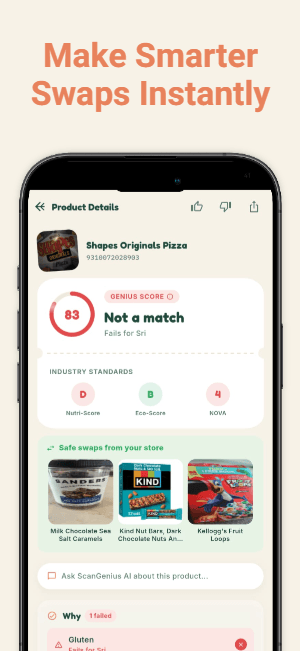
Each result also comes with ScanGenius AI Insight, which explains why a product was flagged instead of handing you a single judgmental number. You see the NOVA 1-4 classification and the Nutri-Score alongside context such as ‘this shred is starch- and coconut-oil-based, which supports melting but is higher in saturated fat.’ If you have several people to shop for, Multi-Household Family Profiles screen everyone in one scan and name who is affected, for example ‘Fails for Sri (Gluten).’ The goal is a calm, informed decision, not guilt.
4. Related Food Safety & Dietary Guides
- Best Food Allergy Scanner App – Scan Food Labels Instantly — Food Allergy & Sensitivity Scanner Hub
- The 7 Best Free Food Scanner Apps of 2026 — best free food scanner apps
- Choosing the Best Barcode Scan App for Your Health — guide to choosing a barcode scanner app
- Food Scan Genius: World’s #1 Food Ingredient Scanner App — Food Scan Genius scanner app
5. Scientific & Health Authority References
- FDA Food Allergen Labeling & Consumer Protection Act (FALCPA)
- European Food Safety Authority (EFSA) Additive Safety Regulations
- PubMed Research on Ultra-Processed Foods & Gut Microbiome Disruption
- World Health Organization Guidelines on Healthy Diets & Saturated Fats
6. How to Scan in 3 Simple Steps
- Download Food Scan Genius free on iOS or Android. There are no paywalls on core features and no scan caps, so you can check every block, shred, and slice in the aisle.
- Set up your profile for your needs. Choose from 39 dietary profiles (such as milk allergy, lactose intolerance, vegan, or tree-nut free), add a custom sensitivity like carrageenan or a specific dye, and create Family Profiles for each person you shop for. Pick any of the 11 languages you prefer.
- Scan the barcode of any dairy free cheese. In about two seconds you get an instant audit trail showing pass or fail per person, the sub-ingredients behind any flag, the NOVA and Nutri-Score classification, and ScanGenius AI Insight on how the product is likely to melt, slice, or snack.
Instant Dairy-Free Audit Trail
7. Frequently Asked Questions (FAQ)
Is dairy free cheese always safe for a milk allergy?
Not automatically. ‘Dairy free’ on the front of a package is a marketing claim, and ‘non-dairy’ in particular can still appear on products containing casein. Under FALCPA, milk must be declared in the ingredient list or a ‘Contains’ statement, so always check the allergen panel. Food Scan Genius parses sub-ingredients recursively and flags milk-derived components against your profile. For severe allergies, also confirm manufacturing practices with the brand and talk with your allergist.
Which type of dairy free cheese melts best?
Cheeses built on starches and refined coconut oil usually melt and stretch best, which makes them popular for pizza, quesadillas, and grilled sandwiches. Cultured nut-based blocks tend to be better for slicing, snacking, and cheese boards, but often soften rather than stretch. Food Scan Genius’s ScanGenius AI Insight describes the base ingredients so you can judge likely performance, and it also shows the saturated fat and processing level that come with that melt.
Is dairy free cheese considered ultra-processed?
Many commercial versions are, because they combine isolated starches, oils, gums, and flavorings. Food Scan Genius assigns a NOVA 1-4 classification to each scanned product so you can see where it falls, and pairs it with a Nutri-Score. These are informational, not a verdict. Some shoppers accept a more processed product for a specific use like pizza night, while others choose simpler cultured nut cheeses for everyday snacking.
Can I screen dairy free cheese for several family members with different needs?
Yes. Food Scan Genius offers Multi-Household Family Profiles, so one scan checks the product against everyone’s restrictions at once. If one child has a tree-nut allergy and another family member avoids soy, the result names who is affected, for example ‘Fails for Sri (Gluten),’ instead of leaving you to cross-reference each profile. You can also add custom sensitivities for items like carrageenan or specific dyes, and the app works in 11 languages.
Know What’s In Your Food Before You Buy — Scan Free Today
Never second-guess confusing grocery labels again. Download Food Scan Genius to uncover hidden additives, toxic dyes, and allergens for the whole household before you buy.